
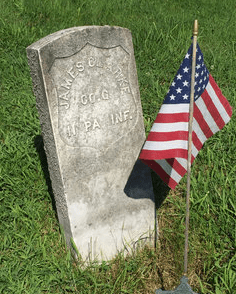
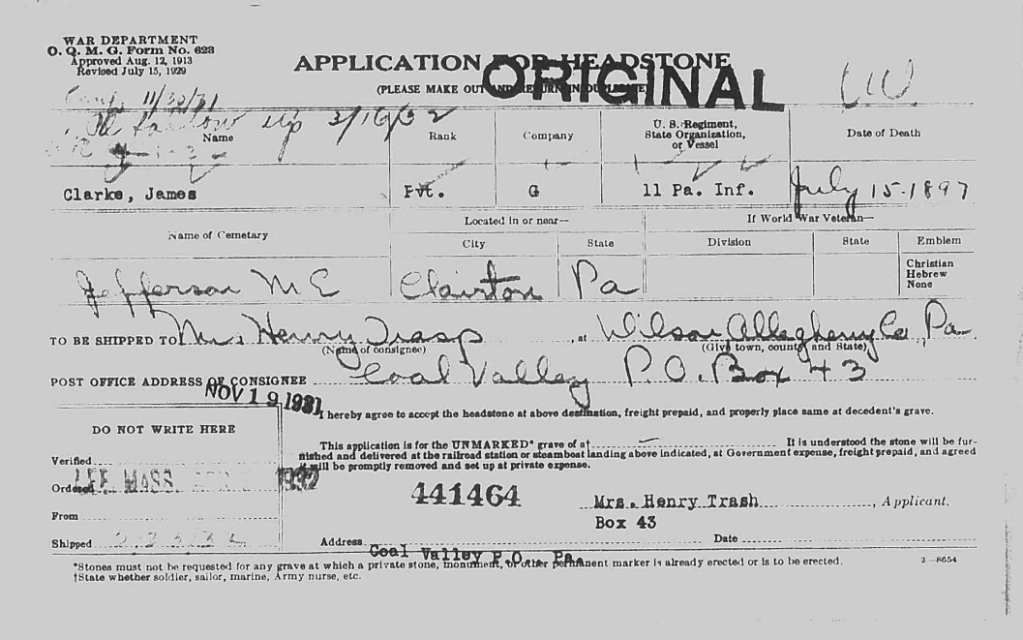
James Clarke mustered into Company G of the 11th Pennsylvania Infantry on July 3, 1862, joining the Union Army during one of the most turbulent phases of the Civil War.

Battle of Antietam
Clarke’s regiment, part of Brig. Gen. Thomas H. Hartsuff’s Brigade in the 1st Division of the I Corps, was heavily engaged in the early morning fighting on September 17, 1862, during the Battle of Antietam. The 11th Pennsylvania advanced shortly after sunrise through the East Woods and across the Cornfield, coming under intense Confederate fire. They then pressed into the West Woods, where the fighting reached a desperate pitch. Amid smoke and confusion, the regiment was struck by volleys from Confederate infantry concealed among the trees, forcing a chaotic withdrawal.
The 11th Pennsylvania lost one officer and 26 men killed, four officers and 85 men wounded, and two captured, reflecting the severe conditions of the battle. It was in this maelstrom that James Clarke was struck and suffered a fractured left hip, a wound that would end his military service.
Smoketown Field Hospital
Following his injury, Clarke was carried from the battlefield to the Smoketown Field Hospital, situated in an open field at the north end of Smoketown Road, roughly at 39°30’26.9″N 77°44’00.4″W, just north of Sharpsburg, Maryland.
The hospital was described as a sprawling complex of about 80 tents set in an oak grove, supplemented by two dilapidated cabins used for surgery and storage. Staffed by army surgeons, volunteer nurses, and members of the U.S. Sanitary Commission, Smoketown became one of the best-organized and longest-operating field hospitals of the Maryland Campaign. It remained in use until May 1863, tending to hundreds of wounded soldiers from both sides.Clarke remained under care there for several months before being honorably discharged on April 30, 1863 due to the lasting effects of his hip wound.
Later Life
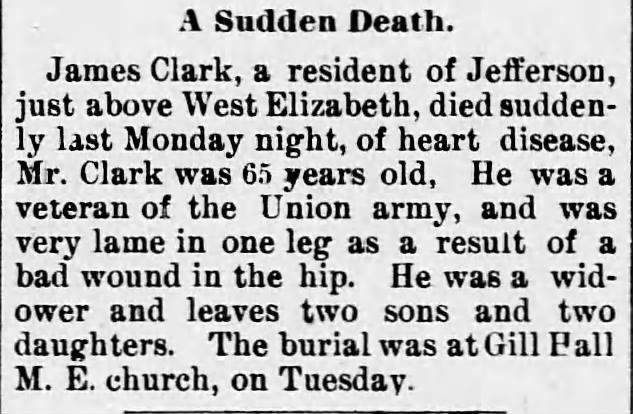
After returning home to Jefferson, near West Elizabeth, Pennsylvania, Clarke lived with a permanent limp in one leg, a daily reminder of Antietam’s toll. Despite his disability, he built a quiet life as a father and community member.
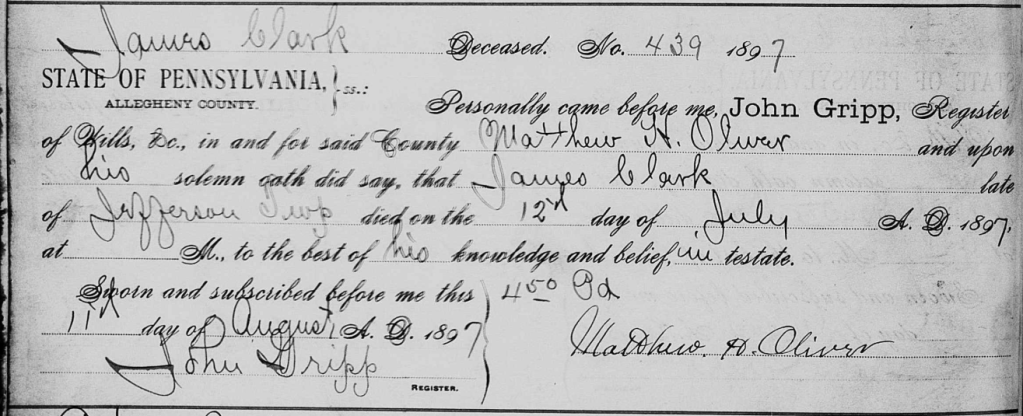
On July 12, 1897, at the age of 65, James Clarke died suddenly of heart disease. A widower, he was survived by two sons and two daughters. His funeral was held at Gill Hall Methodist Episcopal Church, where he was laid to rest.
James Clarke’s story embodies the endurance and sacrifice of the citizen-soldiers of the Union Army – ordinary men who faced extraordinary trials and carried their scars long after the guns fell silent.
 So Nobly Advanced
Leave a comment