
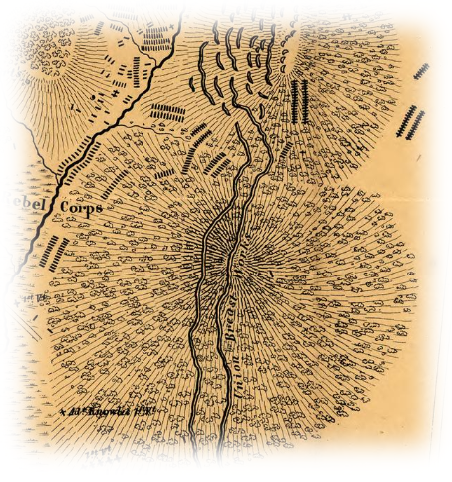
On the southern edge of the Gettysburg battlefield, beyond the crowds that gather on Little Round Top, there rises a quieter hill – Big Round Top, a steep, wooded mass of ancient diabase boulders. Its slopes saw little of the dramatic combat that immortalized its smaller neighbor, yet the ground here holds something equally remarkable: the stone breastworks built by Union soldiers in the dark hours of July 2-3, 1863.
These rough walls, still visible today, are among the most tangible, authentic reminders of the men who fought here—men who, after a day of violence, took to the darkness and built defenses stone by stone. Their names are rarely carved on monuments. Their work was not glamorous. But the walls remain, shaped by their exhaustion, determination, and need to survive.
This is their story.
Why Big Round Top Mattered
Big Round Top’s steep slopes and dense woods made it unsuited for artillery, but its height made it critical for observation and flank security. As fighting raged at Devil’s Den and Little Round Top on July 2, parts of Hood’s Confederate Division moved across and around the mountain. Union commanders realized that if the Confederates secured Big Round Top, they could threaten the entire Union left.
So before nightfall, elements of the V Corps – including troops from the 20th Maine, 83rd Pennsylvania, 44th New York, and 16th Michigan – were ordered to move toward the mountain. Later, during the night and into the early morning of July 3, the Pennsylvania Reserves, including regiments under Col. Joseph W. Fisher, were sent to reinforce and fortify the position.
It was these units – tired, hungry, and often fighting in near darkness – who turned loose boulders and forest debris into organized defensive lines.
Documented Builders: The Pennsylvania Reserves
While many units occupied parts of Big Round Top, the most concrete documentary evidence for breastwork construction comes from the Pennsylvania Reserves. Col. Fisher wrote shortly after the battle that upon advancing to the heights:
He ordered his men “to throw up a strong breastwork of stone,” and recorded that “it was very soon done,” creating a secure position for the brigade. – Fisher, Third Brigade, Pennsylvania Reserves (reported in The Big Round Top Controversy, prvchs.org)
Fisher’s statement provides explicit evidence: these walls were built by his infantry during the night of July 2-3.
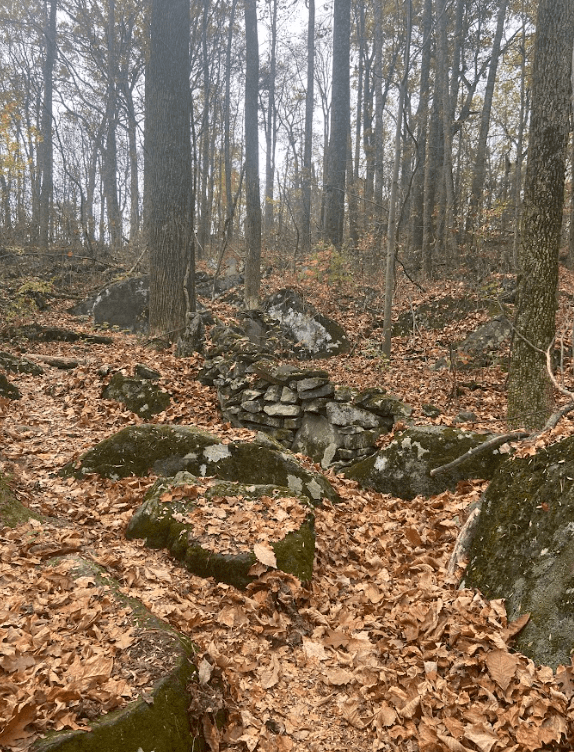
Their work was not a formal engineering project. These were infantrymen improvising in the dark – lifting, stacking, dragging, and wedging stones between natural outcrops. The terrain itself dictated the shapes of the walls, which still curve and twist around boulders today.
Likely Contributors: Other V Corps Infantry
Though Fisher’s Reserves are the only regiment explicitly documented building stoneworks on Big Round Top, other units present almost certainly contributed to the effort.
Units present on the hill or its approaches included Vincent’s Brigade:
- 20th Maine
- 83rd Pennsylvania
- 44th New York
- 16th Michigan
These units pushed up the slopes of Big Round Top as dusk fell, driving off remaining Confederate pickets. While we lack direct statements from these regiments describing the construction of walls, the men spent part of the night on or near the slopes – likely fortifying their positions in accordance with common Civil War practice.
A geology article on Gettysburg notes broadly that soldiers throughout the battlefield “repurposed [stone] walls to provide cover [and] build breastworks.” – Destination Gettysburg, “Geology of Gettysburg and Impact on the Battle”
Thus, even though the Pennsylvania Reserves left the clearest written account, the walls on Big Round Top were almost certainly the product of multiple hands – Union soldiers from several regiments, adapting to the rocky terrain with the only materials available.
What the Men Faced That Night
Even without direct personal accounts from every soldier on Big Round Top, we know a great deal about their conditions:
- They had just come off a brutal day of marching and fighting.
- Many lacked water; some units had gone hours without resupply.
- The terrain was brutal – steep, dark, choked with boulders and timber.
- Enemy skirmishers were still on the mountain.
- No one knew if a night attack was coming.
In this environment, they began stacking stones – not for glory, but for survival.
The breastworks they built were quick, rough, and utilitarian with low walls, sometimes only two or three feet high, following the contours of the land. Soldiers filled gaps between boulders, dragged smaller stones to reinforce natural shelves, and shaped what protection they could before dawn.
A Mental ‘Walk’ Over Their Works
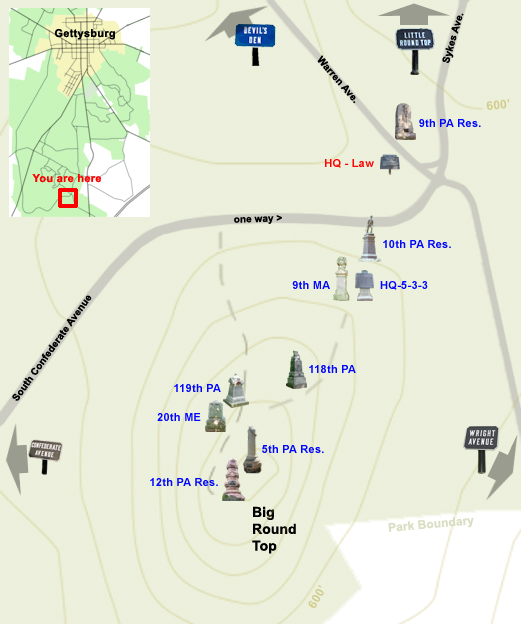
Several segments of these wartime breastworks remain visible today. They align broadly with the locations described in after-action reports and preserved in early battlefield photography.
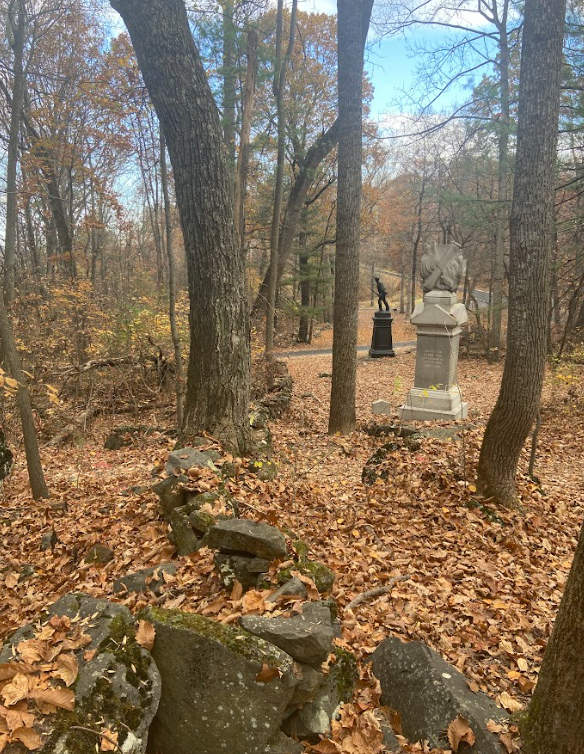
- Northern Shoulder (Pennsylvania Reserves Line) – This area shows some of the most intact stonework today. It aligns with Col. Fisher’s account of his brigade constructing “strong breastworks of stone.” These are arguably the clearest physical traces of the men who built them.
- Eastern Ridge – Midway up the eastern slope is a series of curved stone runs. Their placement matches descriptions of where Union troops formed defensive lines during the night and early morning.
- The Crest – Near the top, just below the 20th Maine monument, a ring-like arrangement of stones forms the summit defensive line. These stones correspond closely to early photographs of “breastworks on Round Top” taken shortly after the battle.
What These Stones Mean Today
Unlike monuments erected later, the walls on Big Round Top were built by the soldiers themselves. They are not symbolic – they are authentic battlefield artifacts, created by the hands of men who feared they might not live to see dawn.
They endure for reasons the builders never expected:
- The dense forest preserved them from farming and erosion.
- Big Round Top saw little modern construction.
- They were photographed shortly after the battle, helping historians identify original alignments.
- Park preservation efforts have ensured their survival.
When you walk those trails today and see stones stacked between boulders, you are witnessing the same work a soldier placed there in July 1863.
There are few places on the battlefield where the past feels so literal – so physical.
The Legacy of the Builders
We do not know most of their names. We cannot assign each stone to a specific regiment or soldier.
But we know this: Men who were drained by battle and burdened by fear built these walls with their own hands, in darkness, to protect themselves and their comrades. They carried no expectation that their work would last. Yet these stones endure – quiet, subtle, powerful reminders of the labor that underpinned the Union victory at Gettysburg.
The stone walls of Big Round Top were not built for fame – They were built for survival.
Today they stand, in my opinion, as one of the most honest, understated memorials on the battlefield.
 So Nobly Advanced
Leave a comment