
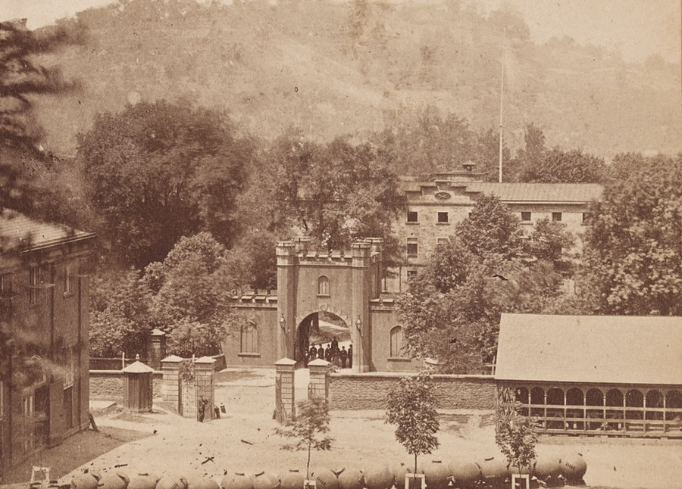
On the afternoon of September 17, 1862 – the same day Union and Confederate armies clashed at Antietam – the quiet mill-town of Lawrenceville outside Pittsburgh was shattered by one of the deadliest industrial accidents of the Civil War.
At approximately 2:00 p.m., three violent explosions ripped through the Allegheny Arsenal, killing 78 workers, most of them teenage girls assembling rifle cartridges for the Union Army.
The tragedy stunned Western Pennsylvania and remains one of the worst civilian disasters of the war.
The Arsenal and Its Workforce
Established in 1814, the Allegheny Arsenal served as a major supply point for the Western Theater. By 1862 it hummed with wartime activity. Women and girls made up the majority of the labor force in the Laboratory buildings, rolling cartridges, filling paper tubes with powder, and packaging ammunition for shipment.
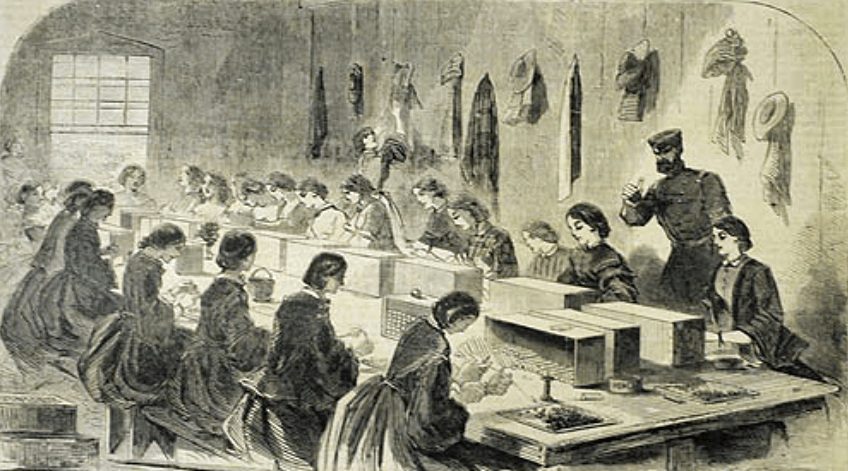
Many victims were young immigrants – Irish, German, and Scots – whose wages supported their families. Their names filled Lawrenceville’s boarding houses and narrow streets, binding the community intimately to the Arsenal’s daily rhythms.
The Explosion
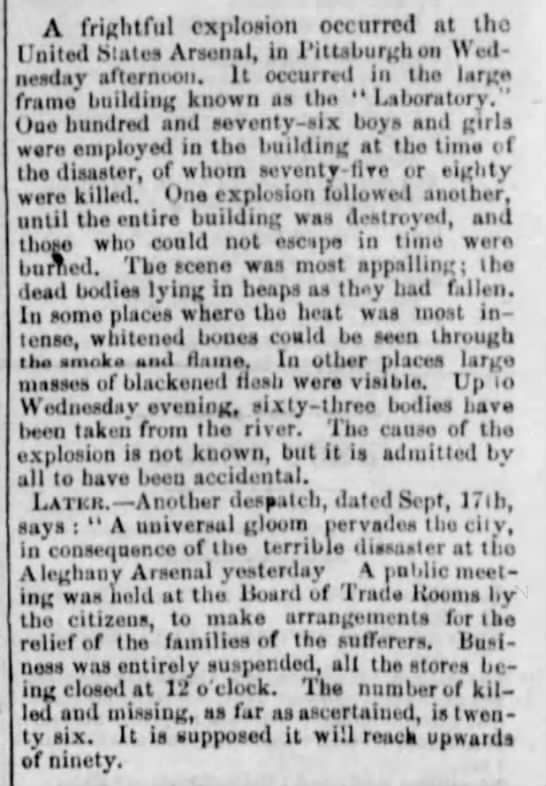
At about 2:00 p.m., three almost-simultaneous explosions ripped through the Arsenal’s Laboratory complex. The blasts were heard as far as downtown Pittsburgh. The first explosion destroyed the main laboratory; the second and third blew apart adjacent structures and ignited a massive fire.
Contemporary newspapers struggled to describe the devastation. The Pittsburgh Gazette, reporting the next morning, wrote:
“No pen can describe, no tongue can tell the awful scene… Bodies were burned beyond recognition, some reduced to mere skeletons where the flesh had been consumed.” – Pittsburgh Gazette, Sept. 18, 1862
The blasts left a cratered ruin. Some workers were killed instantly; others fled in flames. The horror was immediate – and witnessed up close by Lawrenceville residents.
Eyewitness Testimonies: Voices of the Day
Rev. Richard Lea – Pastor of the Lawrenceville Presbyterian Church
When the first explosion shattered his church windows, Rev. Richard Lea rushed outside. In a sermon delivered shortly afterward, he described what he saw upon climbing over the Arsenal wall:
“A sight met my eyes that no language can portray… The bodies of the dead and dying were huddled together, burned, mangled, torn.” – Rev. Richard Lea, Commemorative Sermon, 1862
Lea helped carry survivors to makeshift aid stations, later recounting the desperate efforts to identify remains and comfort relatives.
Mary Jane Black – Survivor and Arsenal Worker
Among the most compelling survivor accounts is that of Mary Jane Black, who testified at the coroner’s inquest. She described the instant the building blew apart:
“I saw two girls running past me, their clothes all in flames… I caught one and tried to tear the burning pieces away.” – Coroner’s Testimony, quoted in Judith Giesberg, Civil War Times / HistoryNet
Black’s account is invaluable – one of the few voices of a young woman who survived the catastrophe from inside the building.
J. R. Fricke – Wagon Driver
Driver J. R. Fricke, who had delivered barrels of powder to the Laboratory earlier that day, testified years later in a congressional inquiry. He had repeatedly warned that the stone macadam road caused powder to spill from wagons:
“The hoof of the horse would strike fire… the powder lay scattered like dust.” – U.S. House Report No. 1434 (47th Congress, 1884)
His description provided a crucial clue as investigators tried to determine whether friction ignited loose powder.
What Caused the Disaster?
Two official investigations – the Coroner’s Inquest (1862) and a later Congressional Inquiry (1883–84) – reached no definitive single cause.
Key findings included:
- Spilled Gunpowder on the Roadway: Multiple witnesses testified that powder routinely fell from wagons hauling barrels to the Laboratory. Sparks from iron horseshoes or wagon wheels striking the stony roadbed may have ignited it. Source: House Report No. 1434 (1884)
- Negligent Storage Procedures: Investigators noted that barrels of powder were stored too close to the Laboratory buildings – contrary to safety procedures.
- No Evidence of Sabotage: Though some early rumors claimed Confederate agents caused the explosion (the same day as Antietam), both inquiries dismissed sabotage as unfounded.
Most historians today agree the most plausible explanation is accidental ignition of spilled powder – exactly as Fricke described.
Aftermath: Grief, Fury, and a Community in Mourning
The explosions left 78 dead, overwhelming Lawrenceville with grief. Because many bodies were burned beyond recognition, families identified remains by scraps of clothing, earrings, shoes, or hair.
Funerals filled the following days. A mass burial took place at St. Mary Cemetery, and individual families interred wives, daughters, and sisters with whatever fragments could be recovered.
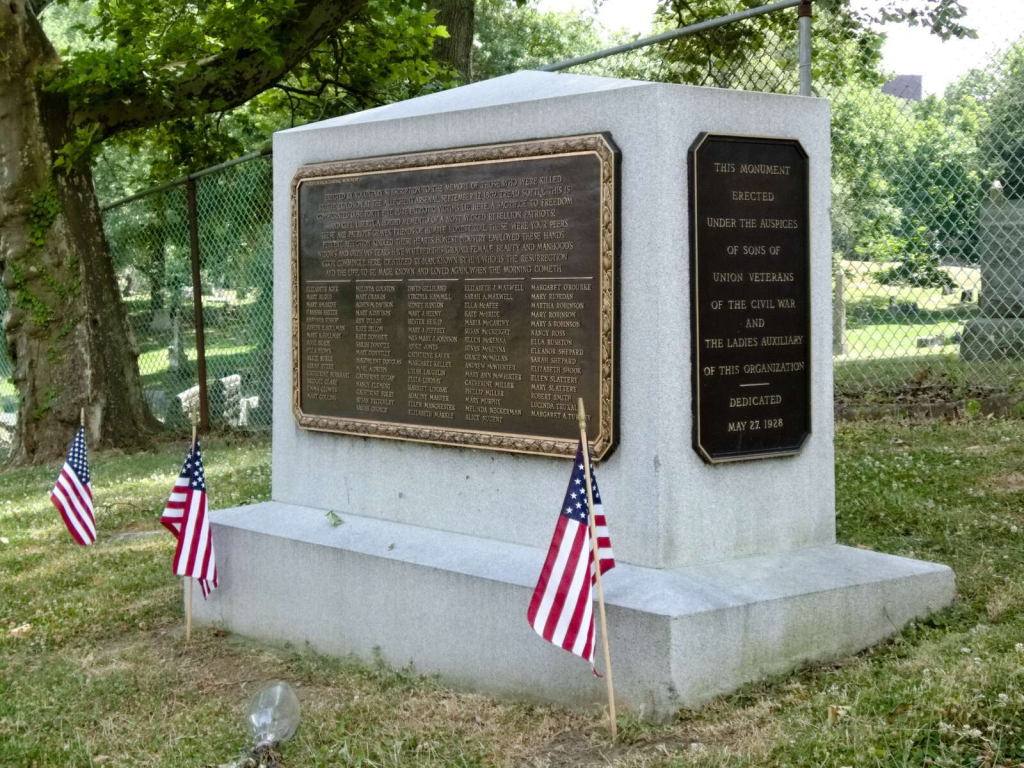
A monument to the victims – still standing – was soon erected at Allegheny Cemetery, inscribed with the names of those who perished.
Public anger followed. Many citizens blamed lax Army oversight; others condemned unsafe working conditions for girls barely old enough to work. Yet no one was held criminally responsible.
The Arsenal Site Today
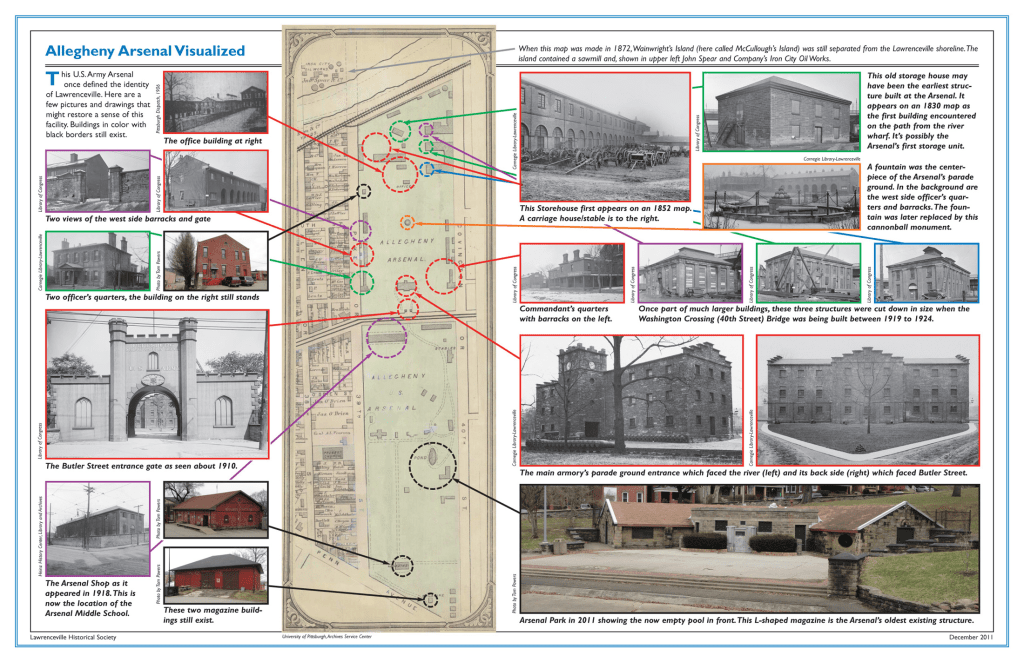
Much of the original complex has vanished, but key elements remain:
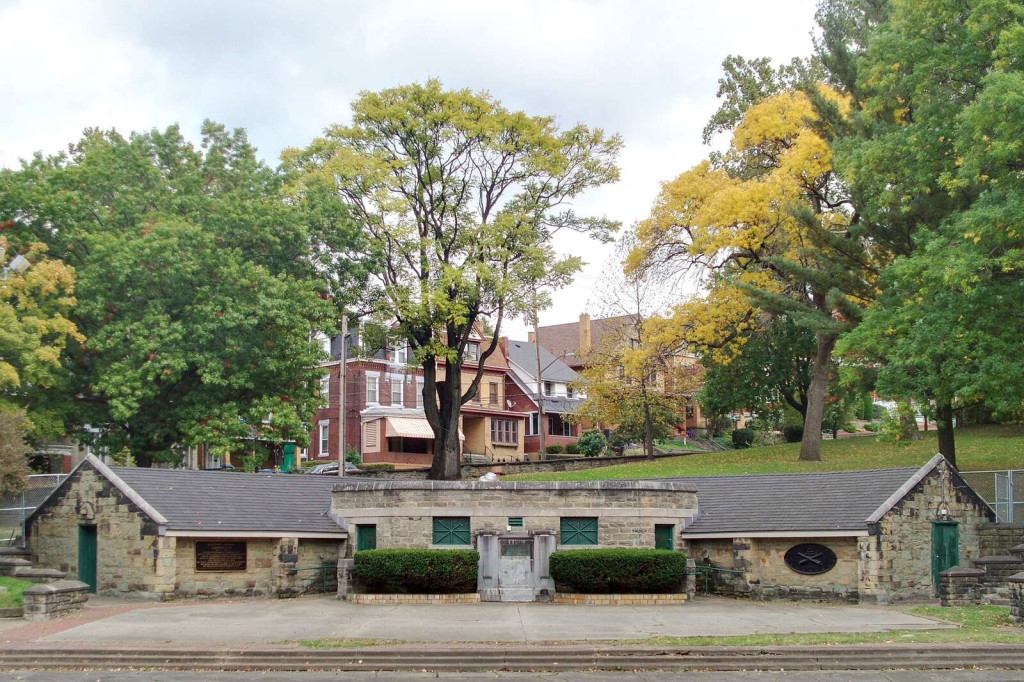
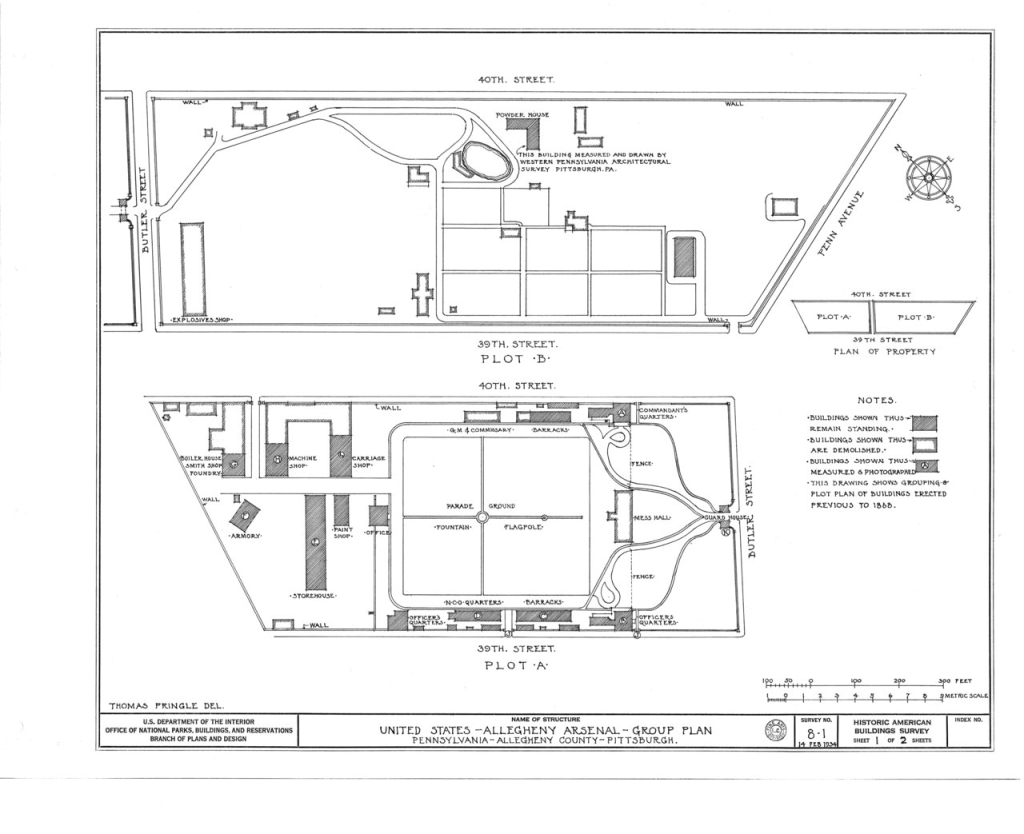
The Arsenal Wall
A large stretch of the stone perimeter wall still stands along 39th Street in Lawrenceville. Rev. Lea climbed over this same wall to reach the burning buildings.
Marker & Remnants
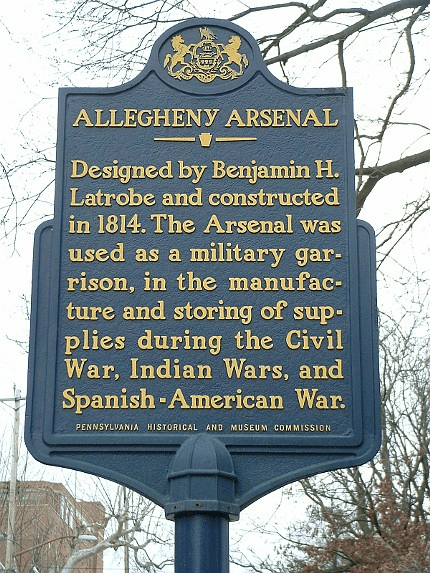
A Pennsylvania Historical and Museum Commission marker stands near the site, and archaeological surveys in recent decades uncovered foundations of the Laboratory buildings.
Allegheny Cemetery Monument
The most solemn memorial is the monument in Allegheny Cemetery (Section 17), listing the names of the 78 workers. Many families who had no remains to bury inscribed daughters’ names here.
St. Mary Cemetery Burials
Numerous victims – especially Irish Catholic girls – rest in a common plot at St. Mary Cemetery in Lawrenceville.
Walking the area today, the quiet neighborhood gives little hint of the catastrophic event that once unfolded there. Yet the wall, the memorials, and the cemetery rows keep the memory alive.
Why the Arsenal Explosion Matters
The Allegheny Arsenal tragedy is more than a footnote to the Civil War. It is a reminder that the cost of war extended far beyond the battlefront. These young women – some as young as 13 or 14 – were civilian workers supporting the Union cause, contributing to the very munitions used on distant fields such as Antietam and Gettysburg.
Their sacrifice reflects Lincoln’s own words about those who advanced the “unfinished work” of preserving the Union. Though they carried no rifles, their labor and their deaths form an essential part of that story.
Sources & References
- Rev. Richard Lea, Sermon Commemorative of the Great Explosion at the Allegheny Arsenal, 1862 (Library of Congress).
- Pittsburgh Gazette, “Appalling Disaster! Explosion at the U.S. Arsenal,” Sept. 18, 1862.
- U.S. House of Representatives, Report No. 1434, 47th Congress, 1st Session, “Allegheny Arsenal Explosion,” 1884.
- Judith Giesberg, “Explosion at the Allegheny Arsenal,” Civil War Times/HistoryNet.
- Jessie Kratz, “The Allegheny Arsenal Explosion and the Creation of Public Memory,” National Archives (2024).
- Rich Condon, “The War in Their Words: The Allegheny Arsenal Explosion,” HistoryNet (2022).
- PHMC Historical Marker Database, “Allegheny Arsenal.”
- Archaeological surveys summarized in the Pennsylvania Archaeologist (various issues).
- Allegheny Cemetery burial records, Section 17.
 So Nobly Advanced
Leave a comment