
On a quiet hillside at Jefferson Methodist Episcopal Cemetery, the headstone of Alexander Packie Welch (1845–1899) stands modestly among the older stones.
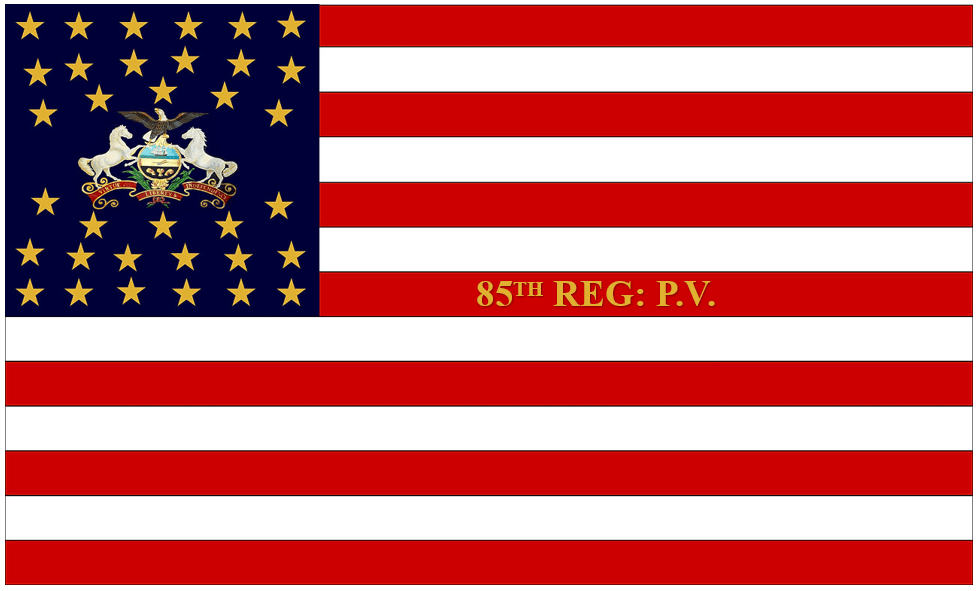
His story is not merely the account of a late-war private who served in the final campaigns of 1864-65. It is the story of a younger brother shaped by the paths, wounds, and sacrifices of the brothers who went before him – and one who would never return.
This is Alexander’s story, illuminated by the family ties that defined his journey into the Union Army.
Early Life Along Peters Creek
Alexander grew up in Union Township, Washington County – today’s Finleyville / South Park / Jefferson Hills region – on the rolling farmland of the Welch household. He was one of the younger sons of J.S. and Susan Welch, raised in a world of shared farm labor, church gatherings, and boisterous brotherhood.
He grew up watching his older brothers carve their paths – none more influential to him than James, Louis, and especially Joseph, whose lives would guide Alexander’s own in profound ways.
The Brothers Who Went Before Him
James M. Welch – The Eldest, the Leader, the Example
The oldest brother, James, was a natural figure of stability – someone Alexander likely admired from childhood. In 1861, James enlisted in the newly formed 85th Pennsylvania Infantry, quickly proving himself capable and rising to Sergeant, then Second Lieutenant.

He survived the Peninsula Campaign, but in 1863 suffered a crippling heatstroke during siege operations around Charleston, losing his speech for nearly two years. He returned home a changed man – physically weakened, often in pain, and no longer the robust eldest son he had been.
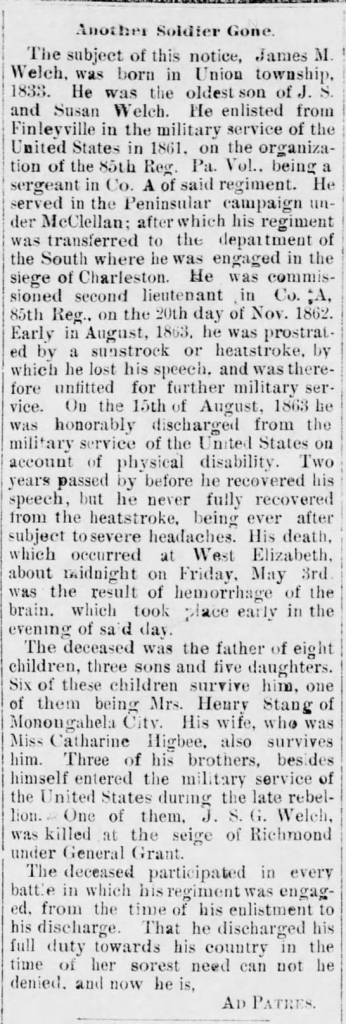
For young Alexander, James’s suffering was a sobering lesson in the war’s cost.
Joseph S. G. Welch – The Brother Lost to War
If James shaped Alexander’s understanding of war’s dangers, Joseph shaped something deeper: its grief.
Joseph, only three years older than Alexander, served faithfully in Company A, 85th Pennsylvania, marching and fighting through the same campaigns that had marked James.
In the summer of 1864, during the brutal operations north of the James River, Joseph was killed in action at Second Battle of Deep Bottom (X Corps, 1st Division, 1st Brigade) on August 16, 1864.
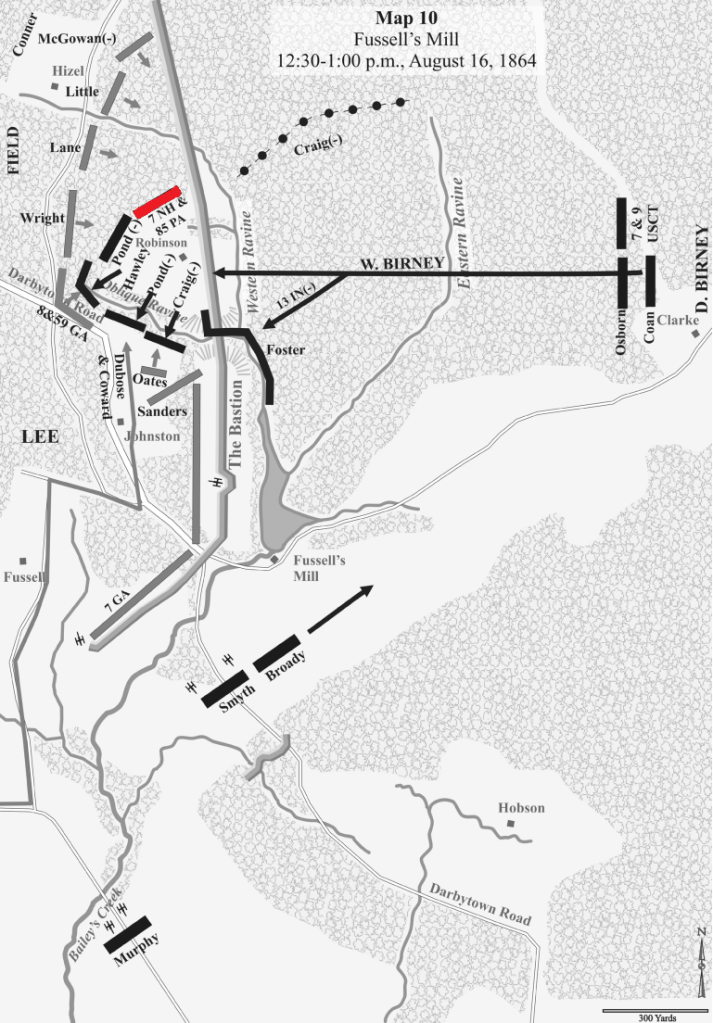
The news shattered the Welch household. For Alexander – 19 years old, on the cusp of adulthood – Joseph’s death would become the single most defining moment of his life.
Louis Bedford Welch – The First to Answer the Call
Even before James and Joseph, Louis, the third oldest brother, had enlisted in the spring of 1861 in one of Pennsylvania’s earliest regiments. Though his service was short – only three months – Louis’s departure set the precedent that the Welches were a family who answered their country’s call.
The example had been set. Three brothers had gone. The fourth would follow for reasons far more personal.
Joseph’s Death – and Alexander’s Decision
On August 16, 1864, Joseph was killed. On August 22, 1864, Alexander enlisted.
Only six days separated his brother’s death from his own decision to join the same regiment and the same company: Company A, 85th Pennsylvania Infantry.
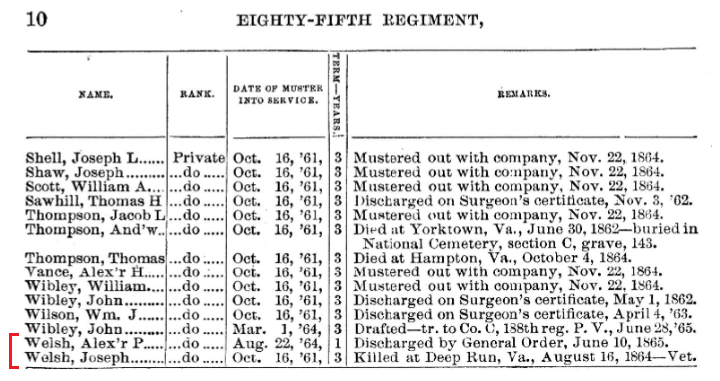
This was not coincidence.
This was not mere patriotism.
This was an act born of grief, duty, and brotherly love.
Young men in Civil War America often enlisted after a brother fell. It was an emotional and cultural pattern echoed across Pennsylvania – and Alexander fits that pattern exactly.
Alexander was not simply joining the Union Army.
He was stepping into Joseph’s absence.
Into the Ranks: The Final Campaigns of 1864-65
When Alexander reached the regiment in late August 1864, he arrived during some of the war’s hardest months.
He soon found himself participating in operations that tested even the veteran soldiers:
- Chaffin’s Farm / New Market Heights (September 1864)
- Darbytown Road (October 1864)
- Fair Oaks & Darbytown Road (October 1864)
These battles were waged in dense woods, swampy ground, and hastily constructed earthworks north of the James River. Sleepless picket duty, disease-ridden camps, and sudden Confederate attacks defined their days.
Alexander, brand-new to combat, entered some of the most grueling conditions the regiment had ever faced.
Transfer to the 188th Pennsylvania
In November 1864, when the three-year men of the 85th mustered out, Alexander was transferred with the remaining veterans and new recruits into the 188th Pennsylvania Infantry, continuing his service until he was discharged on June 10, 1865 after the war’s end.
He returned home bearing memories of Joseph’s absence, James’s suffering, and the hard final push of the Union Army.
Life After War: Rebuilding in the South Hills
Returning to western Pennsylvania, Alexander married Amanda Jane McElheny, a local woman from the South Hills region. Together they built a family and a life in the hills and hollows between Peters Creek, Jefferson, and Snowden.
Unlike James, Alexander did not appear to suffer long-term war injuries.
Unlike Joseph, he returned home at all.
But the war left its imprint on him in quieter ways.
Alexander died on January 3, 1899, at the age of 53-54.
He was buried in Jefferson Methodist Episcopal Cemetery, not far from where he had been born and not far from the stone of his eldest brother James in neighboring Lobbs Run Cemetery.
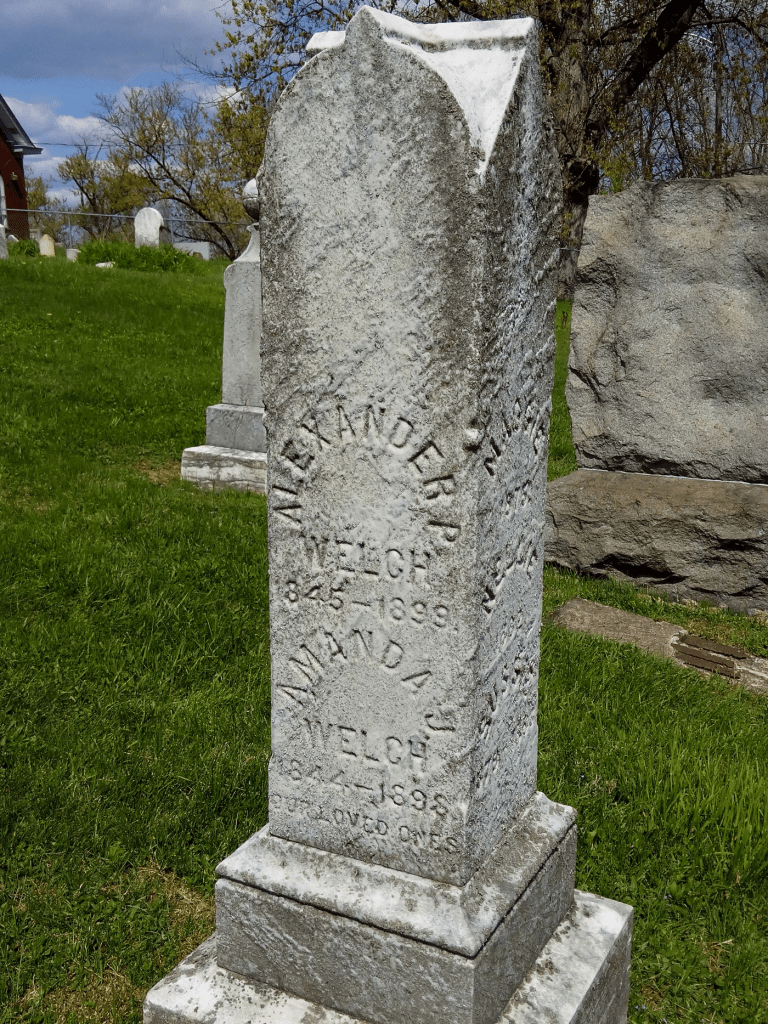
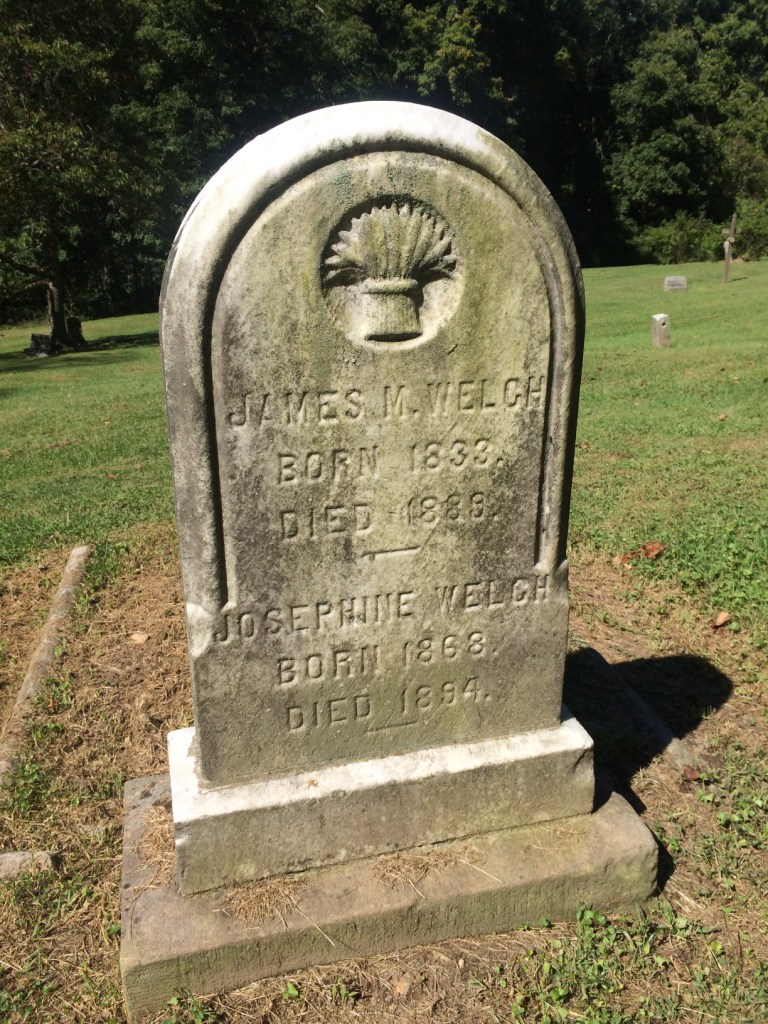
Their graves – scattered but close – still tell the story of a family shaped by a single war.
The Meaning of His Story
Alexander’s service gains its meaning not from the number of battles he fought, but from the family story behind his enlistment:
- He watched an older brother return home broken.
- He mourned another brother killed in battle.
- He stepped forward into the same company – into the same danger – not out of necessity, but out of love and loyalty.
- And he returned home to build a quiet life, carrying the memory of the brother he lost.
His story reflects both the cost and the courage found in countless Civil War families across Pennsylvania – but the Welch family’s story is particularly vivid, preserved in cemetery stones, obituaries, regimental rosters, and the echoes of memory in the South Hills.
Alexander’s headstone may be simple, but the story behind it is anything but.
Sources
Military & Regimental Records
- Samuel P. Bates, History of the Pennsylvania Volunteers, 1861-1865 – 85th Pennsylvania Infantry; regimental history.
- Pennsylvania Veterans’ Burial Cards (James M. Welch).
- Roster references for 85th PA and 188th PA via PA-Roots and CivilWarInTheEast.
Newspaper & Genealogical Sources
- The Daily Republican (Monongahela City), obituary of Lt. James M. Welch, May 7, 1889.
- Higbee Family Genealogical Compilation (Scribd, 2015–2017) documenting Welch-Higbee relationships; birth, marriage, and burial data.
- FamilySearch genealogical entries for Alexander Welch and Amanda Jane McElheny.
Local History
- History of Washington County, Pennsylvania (Crumrine/Creigh), including descriptions of Union Township and the “Union Guards.”
- Local cemetery surveys for Jefferson Methodist Episcopal Cemetery and Lobbs Run (Jefferson) Cemetery.
 So Nobly Advanced
Leave a comment