
Joshua McMasters was born on 20 July 1842, a Pennsylvania native whose boyhood unfolded in what was then the rural farmland of Jefferson Township in Allegheny County. The earliest clear record of his life appears in the 1850 U.S. census, where eight-year-old Joshua resides not with parents of his own surname, but within the household of Robert and Sarah Ann McElhany, a young farming couple raising several children.
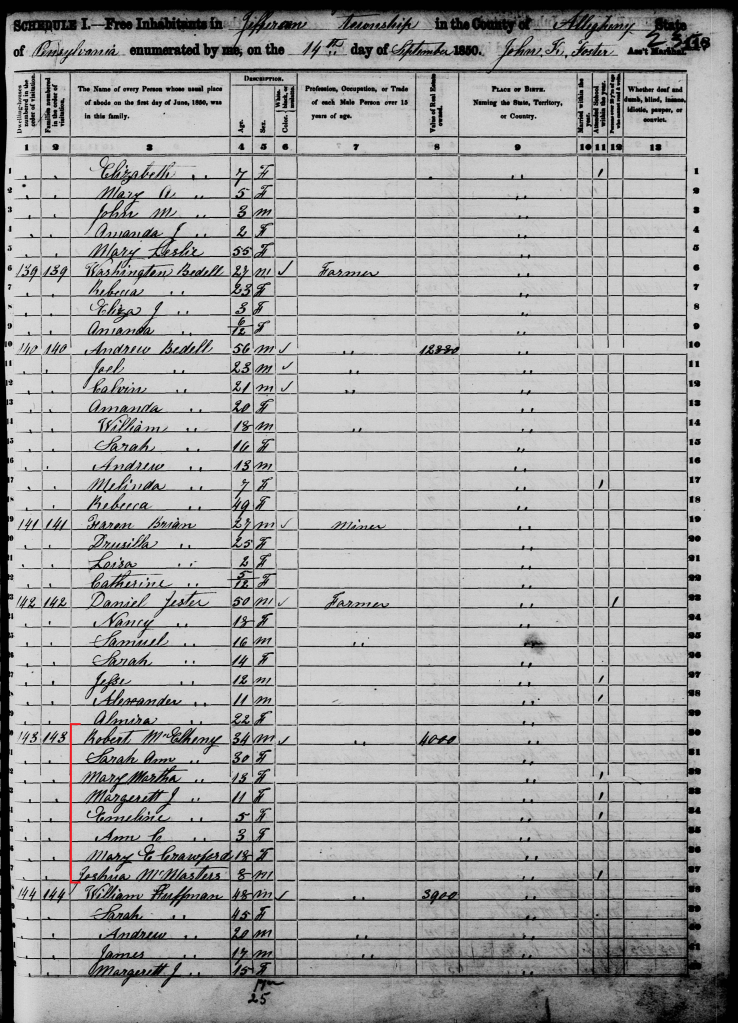
Joshua is listed last in the census entry – after the McElhany children and an eighteen-year-old woman named Mary E. Crawford. This ordering is typical of census practice for wards, dependents, or relatives living within a household but not part of the immediate nuclear family. Though we do not know the precise nature of the relationship, the record makes clear that Joshua was raised in the McElhany home. His childhood was shaped by their farm, their routines, and the close-knit rural community that defined Jefferson Township in the years leading up to the Civil War.
Enlistment in the 7th Ohio Cavalry
As the Civil War escalated, young men across western Pennsylvania and eastern Ohio stepped forward to serve. On 12 September 1862, at the age of twenty, Joshua enlisted as a Private in Company K, 7th Ohio Cavalry. This regiment, known as the “River Regiment,” drew many of its troopers from counties along the Ohio River and was formally organized the following month at Ripley, Ohio.

The 7th Ohio Cavalry served primarily in the Western Theater, operating in Kentucky, Tennessee, northern Georgia, Alabama, and the Carolinas. As a trooper in this regiment, Joshua became part of a mounted force that moved quickly and often – riding long distances, patrolling contested countryside, and engaging in the complex and shifting cavalry actions that defined the war in the interior South.
Campaigns and Service in the Western Theater
During Joshua’s term of service, the 7th Ohio Cavalry took part in some of the most consequential mounted operations of the war. In 1863, the regiment rode north during the pursuit of John Hunt Morgan’s raid, contributing to the series of actions that culminated at the Battle of Buffington Island, where a large portion of Morgan’s force was captured. The regiment subsequently served in the Knoxville Campaign, guarding supply routes and countering Confederate cavalry in East Tennessee.
In 1864, the 7th Ohio Cavalry supported the Union armies during William T. Sherman’s movements toward Atlanta, operating on the flanks and striking at Confederate cavalry resistance. The regiment continued to serve actively in 1865, participating in Wilson’s Raid, one of the last major cavalry offensives of the war, pushing deep into Alabama and Georgia as the Confederacy collapsed.
Joshua remained with Company K throughout these campaigns and was mustered out with the regiment on 1 July 1865, completing nearly three full years of continuous service.
Life After the War
Following his discharge, Joshua returned to the familiar hills and farms of Jefferson Township, the place where he had grown up and to which he remained closely tied. At some point after the war – likely in the late 1860s or early 1870s – he married Mary Ann, with whom he made his home in the Gill Hall area. Their life together appears to have been quiet and rooted, centered on the rural community Joshua had always known.
Joshua lived into advanced age, passing away on 14 April 1928.
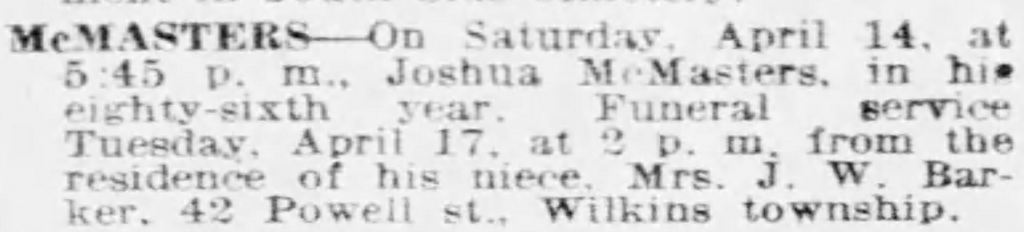
He was buried in the cemetery of Jefferson United Methodist Church on Gill Hall Road, alongside his wife, not far from the farmland where he spent his youth.
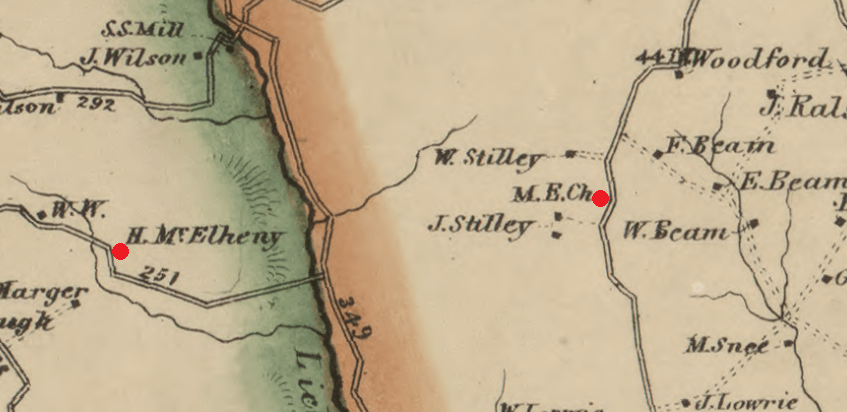
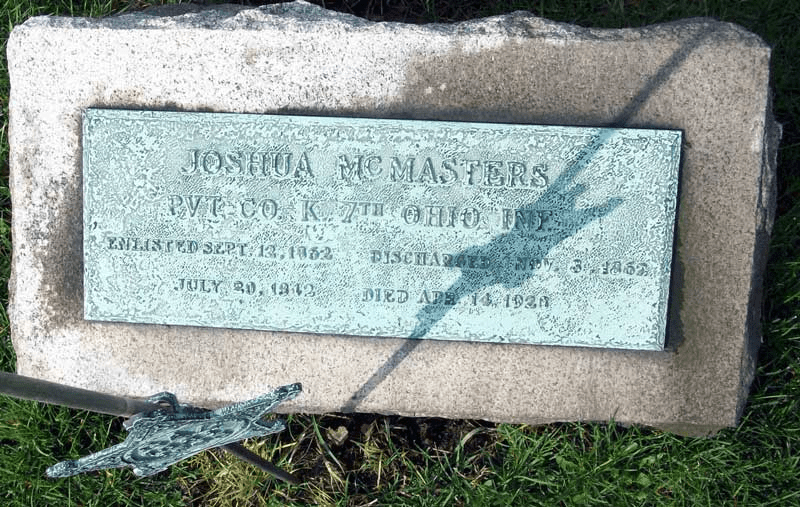
His grave stands as a reminder of a man whose life bridged two worlds: a boyhood shaped in the household of another family, and a wartime service that carried him hundreds of miles from home in the saddle of an Ohio cavalry regiment.
Notes: Identified Errors and Misinterpretations in Records
Modern researchers may encounter conflicting information about Joshua’s military service, largely due to a series of transcription errors and misunderstandings that entered local cemetery records long after the war. For example, Joshua’s headstone lists identify him as a soldier of the 7th Ohio Infantry, with a short term of service ending in November 1862. These details are not supported by the official military record.
Ohio’s compiled wartime rosters list “McMaster, Joshua” unequivocally as a member of Company K, 7th Ohio Cavalry, with a three-year enlistment beginning on 12 September 1862 and a final muster-out on 1 July 1865. Additionally, some online transcriptions list Joshua’s death year as 1920, but a direct reading of his gravestone confirms the correct year as 1928.
These discrepancies likely stem from worn stone lettering, shared surnames among regional families, and the conflation of cavalry and infantry units with similar numbering. For historical accuracy, the Ohio military rosters and a direct reading of Joshua’s headstone provide the most reliable evidence for his service and lifespan.
Sources
- Official Roster of the Soldiers of the State of Ohio in the War of the Rebellion, 1861–1866, entry for “McMaster, Joshua,” Company K, 7th Ohio Cavalry (enlistment 12 September 1862; mustered out 1 July 1865).
- 1850 U.S. Federal Census, Jefferson Township, Allegheny County, Pennsylvania (household of Robert and Sarah Ann McElhany).
- Interactive Pittsburgh historic Maps
- Jefferson United Methodist Church Cemetery records and headstone readings, Gill Hall Road, Jefferson Hills, PA (for birth and death dates of Joshua McMasters).
- History and campaign summaries of the 7th Ohio Cavalry, including operations during Morgan’s Raid, the Knoxville Campaign, the Atlanta Campaign, and Wilson’s Raid.
 So Nobly Advanced
Leave a comment