On July 3, 1863, survival at Gettysburg was sometimes measured not in yards or seconds – but in arm-lengths of stone.
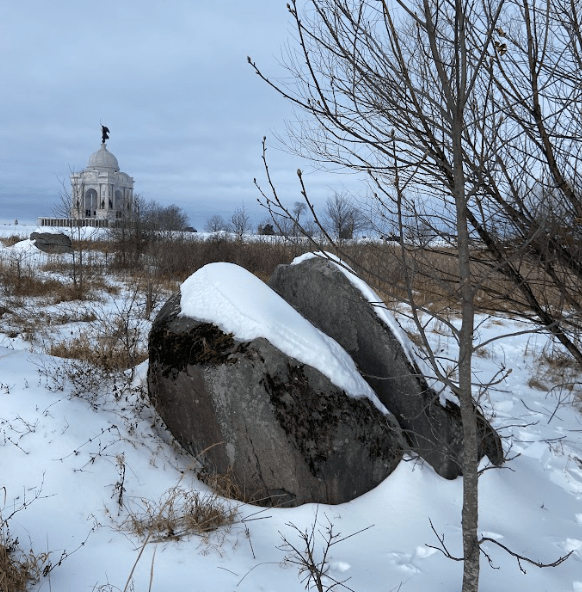
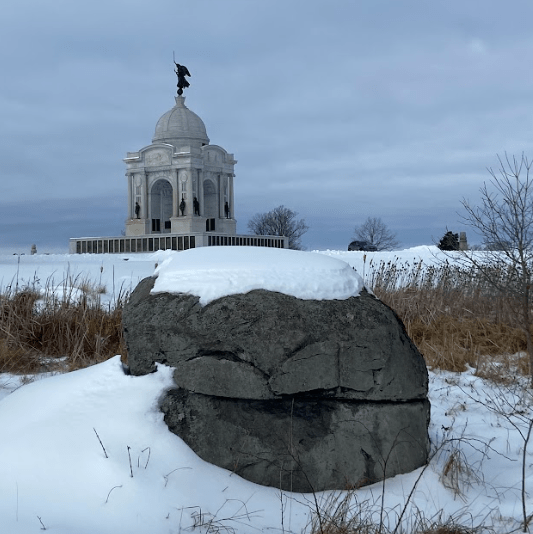
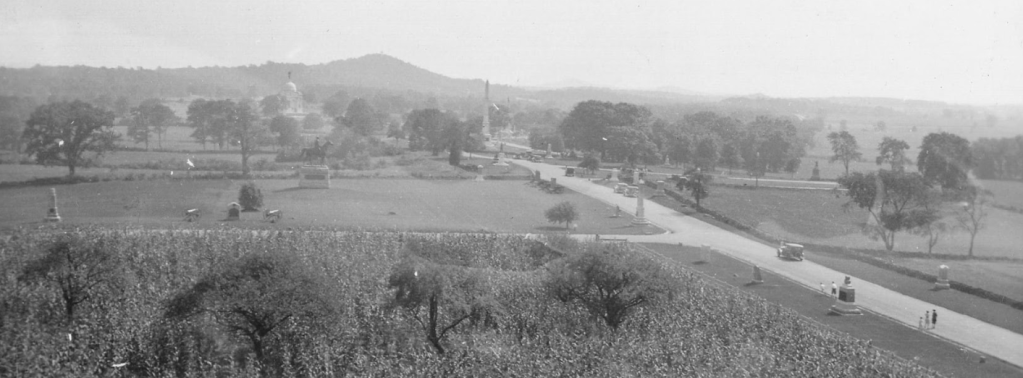
Along Cemetery Ridge, near what is today the towering Pennsylvania Monument, Union soldiers found themselves so close to annihilation during the Confederate artillery bombardment preceding Pickett’s Charge that only the raw contours of the land stood between them and likely death.
Two nearby boulders – unmarked, uninscribed, and largely unnoticed – became accidental sanctuaries.
They remain where they have always been. Their monument is the earth itself.
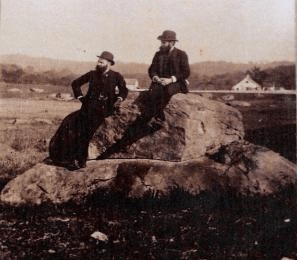
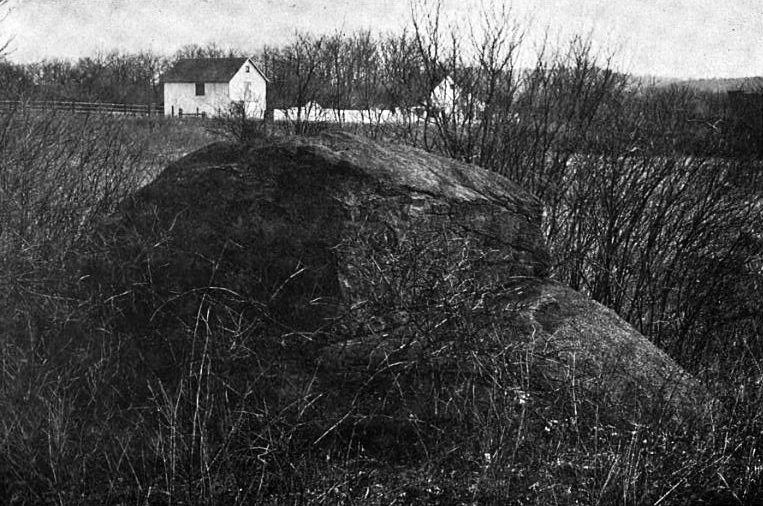
Hampton’s Battery Rock
As Confederate guns opened in preparation for Pickett’s Charge, Union artillery positions along Cemetery Ridge were deliberately targeted. Hampton’s Battery, Independent Pennsylvania Light Artillery – mustered from the Pittsburgh region of Pennsylvania – stood exposed beneath one of the most intense bombardments ever unleashed on the North American continent.
Shells burst overhead. Shrapnel ripped through gun positions. Several men of the battery were wounded while still dangerously close to their pieces. With the barrage ongoing and evacuation nearly impossible, comrades dragged the injured only a short distance – behind a nearby boulder rising from the ridge.
That stone was the margin of survival. It broke blast patterns and intercepted fragments.
It provided just enough shelter to keep wounded men alive while the ground convulsed around them.
When veterans of Hampton’s Battery returned to Gettysburg in later years, they sought out the boulder again. Remembering what it had done on that terrible afternoon, they quietly named it “Hampton’s Battery Rock”, or “Shelter Rock” – a name carried not by dedication or ceremony, but by memory.
Samuel Shilling’s Rock
Only a short distance away stands another boulder with a story just as stark.
On the afternoon of July 3, Private Samuel Shilling, Company E, 148th Pennsylvania Infantry, was struck in the right hip by artillery shrapnel. Wounded under active shellfire and unable to withdraw to safety, Shilling did the only thing he could.
He crawled.
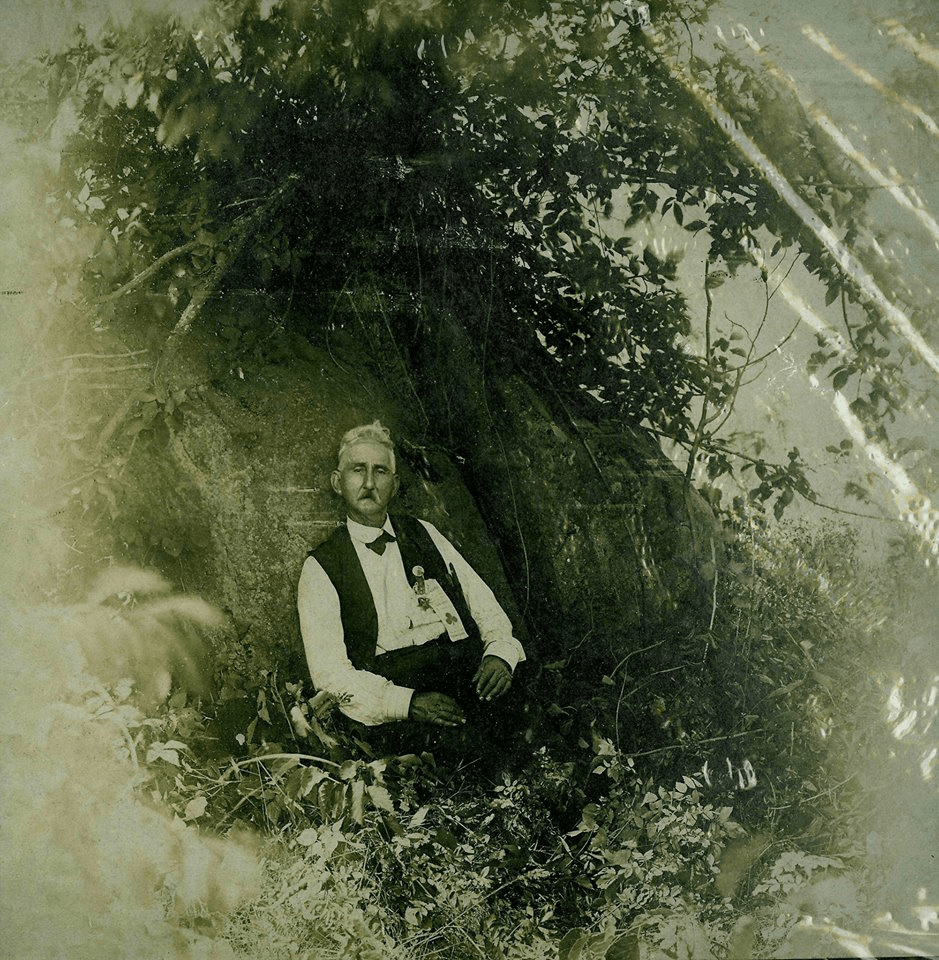
Dragging himself across exposed ground torn by exploding shells, he reached the nearby rock and pressed himself against it for protection as the barrage continued. That boulder shielded him from further injury and allowed him to survive wounds that might otherwise have proven fatal.
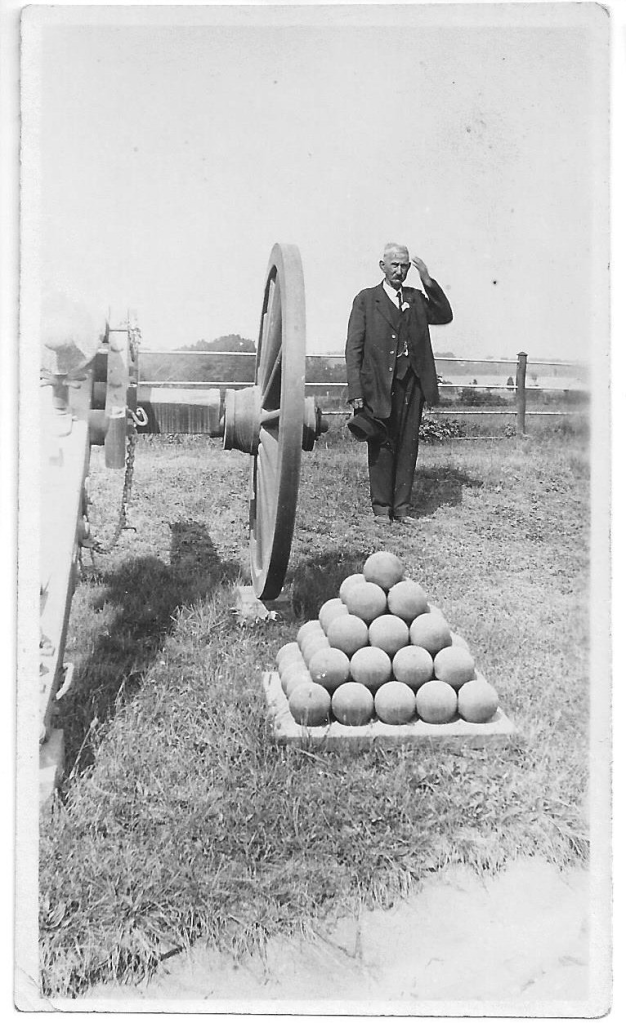
Fifty years later, in 1913, Samuel Shilling returned to Gettysburg for the great veterans’ reunion marking the battle’s fiftieth anniversary. He was photographed beside the very rock behind which he had taken refuge – his body aged, his uniform long gone, but the stone steadfast and unchanged.
The man remembered the moment. The rock remembered the man.
Narrow Margins
Hampton’s Battery Rock and Samuel Shilling’s Rock tell the same truth from different angles.
One sheltered a group of wounded artillerymen. One sheltered a single infantryman.
Together, they reveal how survival on July 3 was often improvised, intimate, and measured in feet rather than formations.
These men were not saved by fortifications. They were not shielded by engineered defenses.
They survived because the land itself intervened.
A boulder. A few feet of cover. A narrow margin between chaos and survival.
While today’s Cemetery Ridge is often remembered for its sweeping lines and monumental sculptures, these ancient stones speak of a quieter reality – individual soldiers pressed against stone and earth while iron tore the sky apart.
Imagine.
Memory Without Marble
Formal monuments rise all along the grounds of Gettysburg Battlefield, including the nearby Pennsylvania Monument that dominates this stretch of Cemetery Ridge. They honor units, states, and sacrifice on a monumental scale.
Hampton’s Battery itself is commemorated far from Gettysburg by a formal monument in East Park on the North Side of Pittsburgh – a place of civic remembrance and permanence.
But here, on the battlefield itself, the most personal memorials were never erected – They were already there.
As Abraham Lincoln reminded the nation only months after the fighting ended: “[W]e can not dedicate – we can not consecrate – we can not hallow – this ground. The brave men, living and dead, who struggled here, have consecrated it, far above our poor power to add or detract.”
Hampton’s Battery Rock and Samuel Shilling’s Rock embody this Truth with uncommon clarity – No human hand sanctified them. They became hallowed in the moment of their use.
The Work Passed Down
In 1913, Samuel Shilling returned to Gettysburg not to see what had changed – but to stand beside what had not.
That is the quiet power of these stones.
They ask nothing of us. They do not demand reverence, inscription, or ceremony. They simply remain – marking where men once lay under fire, alive only because the earth allowed them to be.
To notice them is enough. To understand what they represent is more.
These boulders are not monuments raised by hands, but witnesses preserved by circumstance. They remind us that survival was often accidental, that sacrifice was intimate, and that the margin between life and death was sometimes no wider than a few feet of stone.
To remember that truth – to see the battlefield not only as a place of grand movements, but of individual lives pressed against the earth – is the work passed down to us.
It is not work that requires construction. It is a work that requires only attention.
These simple stones tell a story – and listening to this story is a foundational part of the unfinished work entrusted to us.
“In great deeds, something abides. On great fields, something stays. Forms change and pass; bodies disappear; but spirits linger, to consecrate ground for the vision-place of souls… generations that know us not and that we know not of, heart-drawn to see where and by whom great things were suffered and done for them, shall come to this deathless field, to ponder and dream; and lo! the shadow of a mighty presence shall wrap them in its bosom, and the power of the vision pass into their souls.” – Joshua Chamberlain
Locations
Hampton’s Battery Rock Coordinates: 39.8071409488359, -77.23370918996359
Samuel Shilling’s Rock Coordinates: 39.80707004011248, -77.23328125887426


 So Nobly Advanced
Leave a comment