
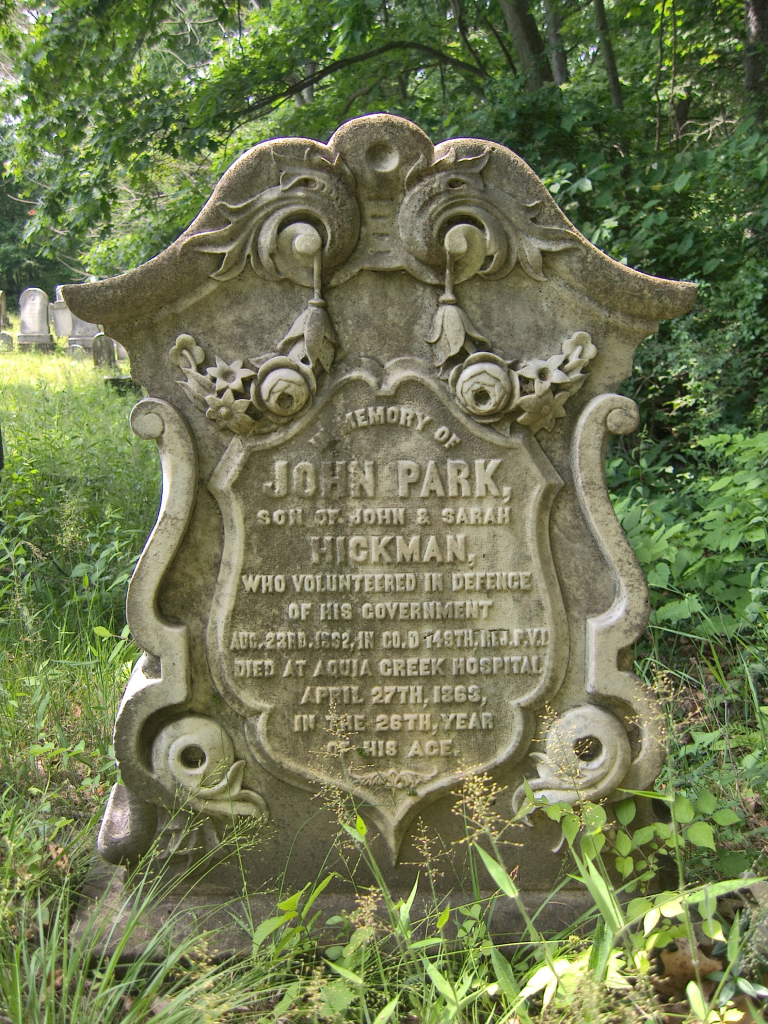
Among the headstones of Bethany Cemetery stands an unusually expressive monument. It does not list battles. It does not proclaim heroics. Instead, it offers a single, deliberate assertion:
“Volunteered in defense of his government.”
The stone marks the grave of Private John Park Hickman, a Union soldier whose service ended not on a battlefield, but in a military hospital – claimed by disease while still in uniform. His story asks a quieter question than most Civil War narratives, yet a fundamental one: how should service be measured when sacrifice arrives without spectacle?
A Son of Bridgeville
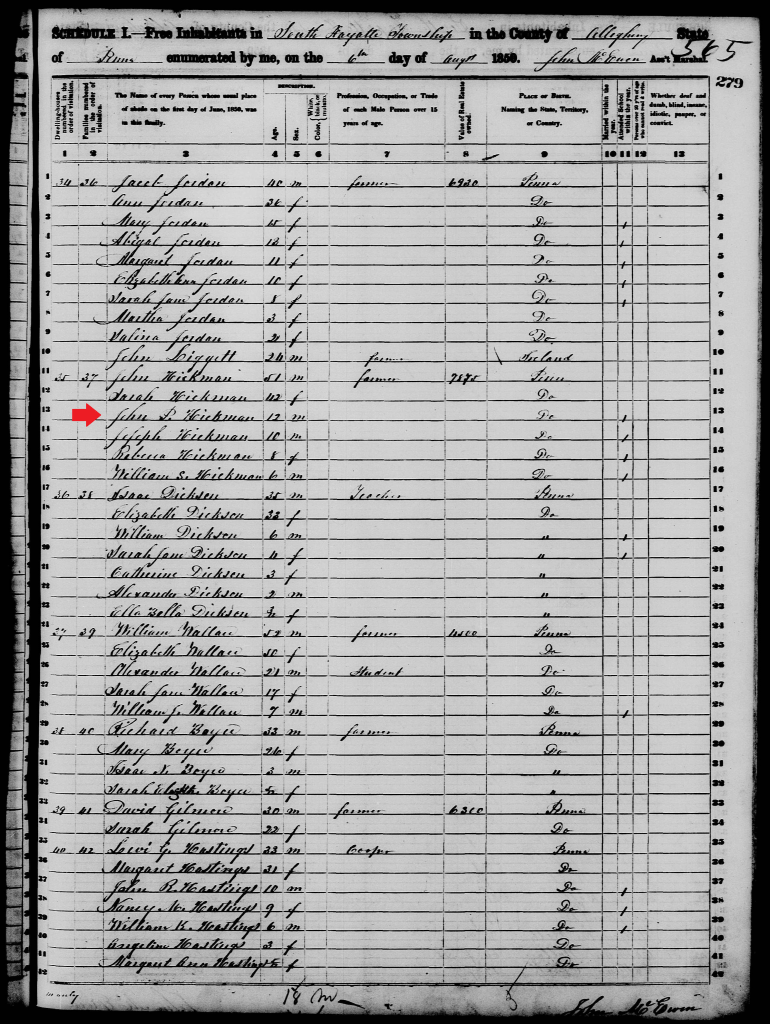
John Park Hickman was born in 1837, the son of John Hickman (1789-1887) and Sarah Park Hickman (1807-1879). He grew to adulthood in Bridgeville, Pennsylvania, within a family firmly rooted in Allegheny County. His siblings would live full lives into the closing years of the nineteenth and early twentieth centuries. John would not.
When the war entered its second year and voluntary service became both more urgent and more perilous, Hickman answered the call.
Volunteering in Defense of His Government
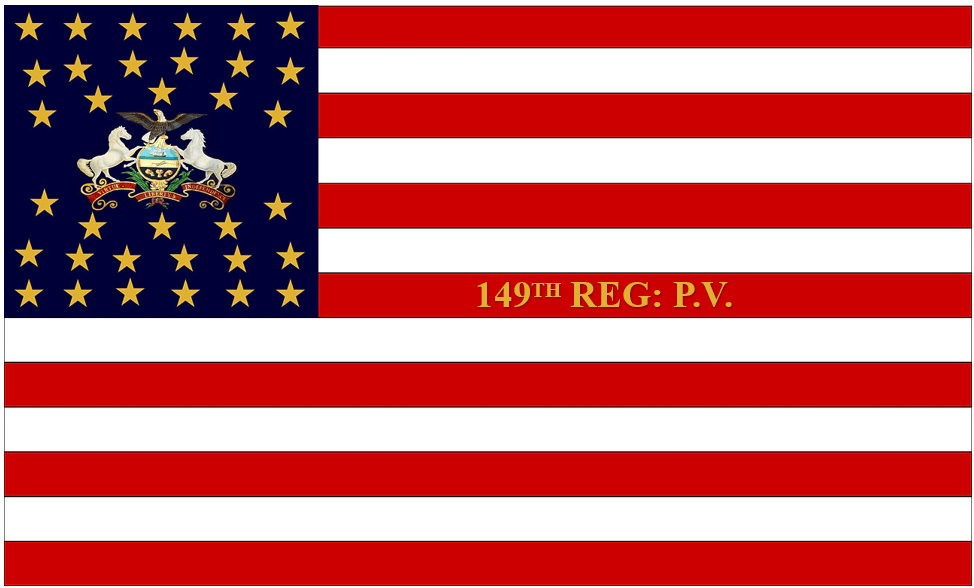
On August 23, 1862, John Park Hickman enlisted as a private in Company D, 149th Pennsylvania Volunteer Infantry. The regiment – associated with the Bucktail tradition – would soon be assigned to the Army of the Potomac, where its men endured the relentless demands of active field service.
By the late summer of 1862, the nature of the war was no longer abstract. Casualty lists were long. Disease was rampant. To volunteer at this stage was to do so with knowledge of the risks involved.
Hickman did not enlist for glory. He enlisted, as his monument records, “in defense of his government“.
Service Without the Battlefield
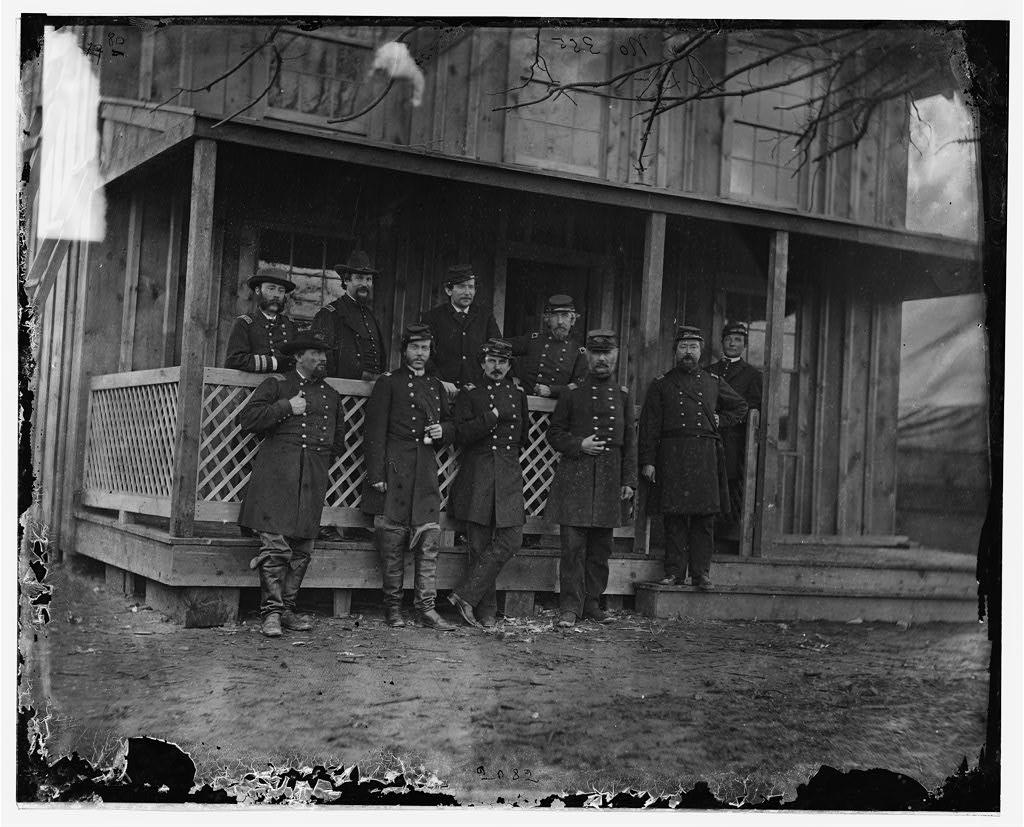
After the 149th Pennsylvania joined the Army of the Potomac, the hardships of camp life took their toll. Exposure, inadequate shelter, and disease afflicted thousands of soldiers long before they ever saw combat. Hickman was among them.
Stricken with fever, he was removed from his company as the army prepared for operations that would culminate in the Chancellorsville Campaign. Along with other sick soldiers, he was sent to the Union general hospital at Aquia Creek, one of the largest logistical and medical hubs supporting Union forces in northern Virginia.
There, far from the sound of gunfire, the war continued its work.
Death in – and for – Service
John Park Hickman did not recover.
On April 27, 1863, he died at Aquia Creek Hospital, in the 26th year of his age. His death occurred while he remained an enlisted soldier, absent from his regiment not by choice, but by military necessity.
He did not die after the war.
He did not die as a civilian.
He died in service, his life claimed by the same system of war he had willingly entered.
The absence of a battlefield does not diminish the reality of that sacrifice. Disease was not incidental to Civil War service – it was one of its most persistent and deadly companions.
The Meaning Preserved in Stone
Returned home, Hickman was laid to rest in Bethany Cemetery. His family marked his grave with a monument that speaks volumes through restraint.
It does not claim valor in combat.
It does not enumerate campaigns.
It does not ask the visitor to imagine what might have been.
Instead, it affirms what was.
By declaring that he “volunteered in defense of his government,” the family anchored his death to purpose, duty, and civic loyalty. In a war fought to preserve a constitutional order, they framed his service not by action witnessed, but by obligation accepted – and fulfilled at the highest cost.
Service Measured Correctly
The Civil War left behind countless stories like John Park Hickman’s – men who marched, fell ill, and died beyond the edges of preserved battlefields. Their names rarely appear in regimental histories’ dramatic chapters, yet their service sustained the army all the same.
Hickman did not live to fight – But he did live to serve.
And he died because of that choice.
The Republic endured. He did not.
That exchange – quiet, unadorned, and final – is the true arithmetic of war.
Service is not defined by where a man fought, but by what he was willing to give.
John Park Hickman did not reach the battlefield, yet he placed loyalty to the Union above his own life, served honorably, and died in – and for – that service.
Sources
- Find A Grave Memorial: John Park Hickman (1837-1863), Bethany Cemetery, Bridgeville, Allegheny County, Pennsylvania
- Pittsburgh Cemeteries – “John Park Hickman Monument, Bethany Cemetery” – NOTE: Incorrect information identified therein.
- Bates, Samuel P., History of Pennsylvania Volunteers, 1861-1865, Volumes covering the 149th Pennsylvania Infantry
- Official Records of the War of the Rebellion (Series I), Army of the Potomac assignments and movements, 1862–1863
- National Park Service, Soldiers and Sailors Database – 149th Pennsylvania Volunteer Infantry
 So Nobly Advanced
Leave a comment