
There are moments in battle when the drill book becomes luxury.
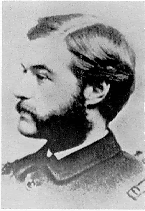
Captain John Bigelow Jr. of the 9th Massachusetts Light Battery reached one of those moments late on July 2, 1863 – when the familiar order, “limber up and withdraw,” became a death sentence.
The men, who would have had to step into the open to hitch their teams, were already being measured and sighted by Confederate sharpshooters.
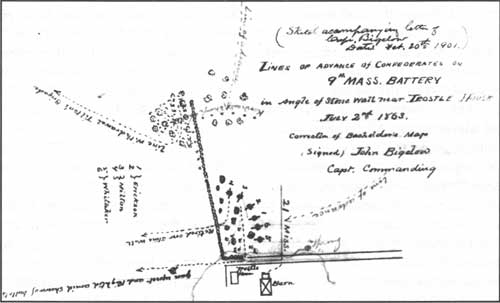
Everything that follows here rests on Bigelow’s own primary account in ‘The Peach Orchard, Gettysburg, July 2, 1863‘ and the map he later drew to show exactly where this occurred.
The Ground, and the Problem
Bigelow’s six guns were originally ordered forward in the late afternoon to ground along the Wheatfield Road, between the Peach Orchard and the Wheatfield. At first, they supported a line that still existed. They engaged Confederate batteries down the Emmitsburg Road and then turned on infantry forming near the Rose buildings.
But as the fighting intensified, the shape of the field changed.
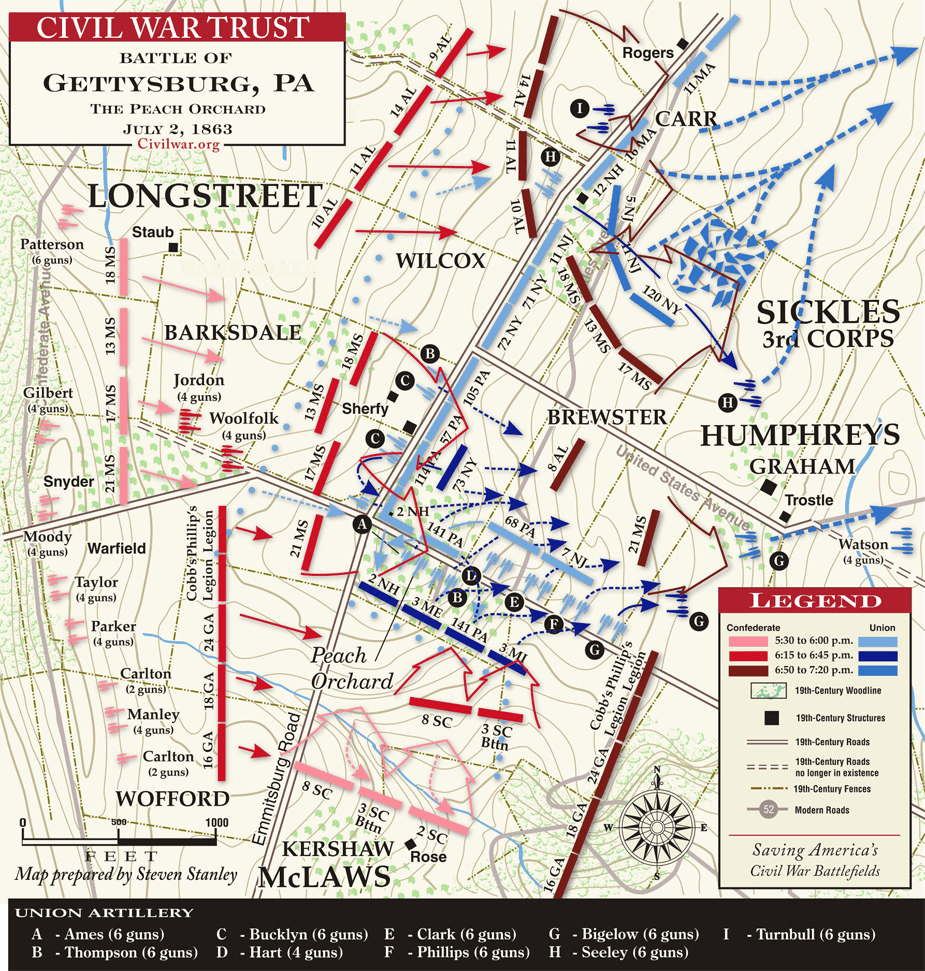
Infantry support thinned. Enemy pressure thickened. The battery’s position became a lonely point in a dissolving line.
Bigelow later summarized the timeline in language that is easy to misread unless you notice the shift in meaning.
He wrote that the battery was “hotly engaged from about 4:30 to 6:30 P.M.”
But he also wrote that his command delayed the enemy for “thirty precious minutes.”
Those words describe two different phases of the same fight: Two hours in the battle vs. thirty minutes in the vise.
Why Limbering Was Impossible
Under normal conditions, an artillery withdrawal is simple: teams come forward, the gun is limbered, and the piece rolls out. But that assumes space, time, and the ability to stand upright without being shot.\
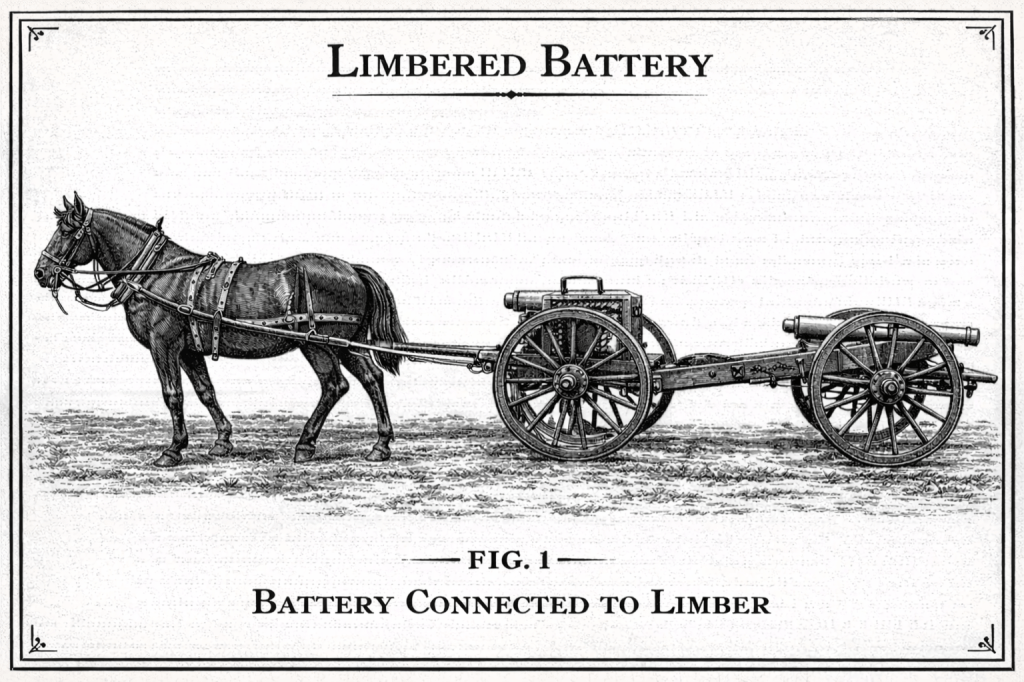
Bigelow was explicit. Had his men attempted to limber under these conditions, they would have been killed where they stood. Confederate sharpshooters had both the range and the angle.
So he ordered something rarely required on a battlefield…. The battery would retire by prolonge and continue firing as it did so.
This was not flight. This was not disorder.
This was the deliberate backing of cannon out of a killing ground while canister continued to tear through the advancing enemy.
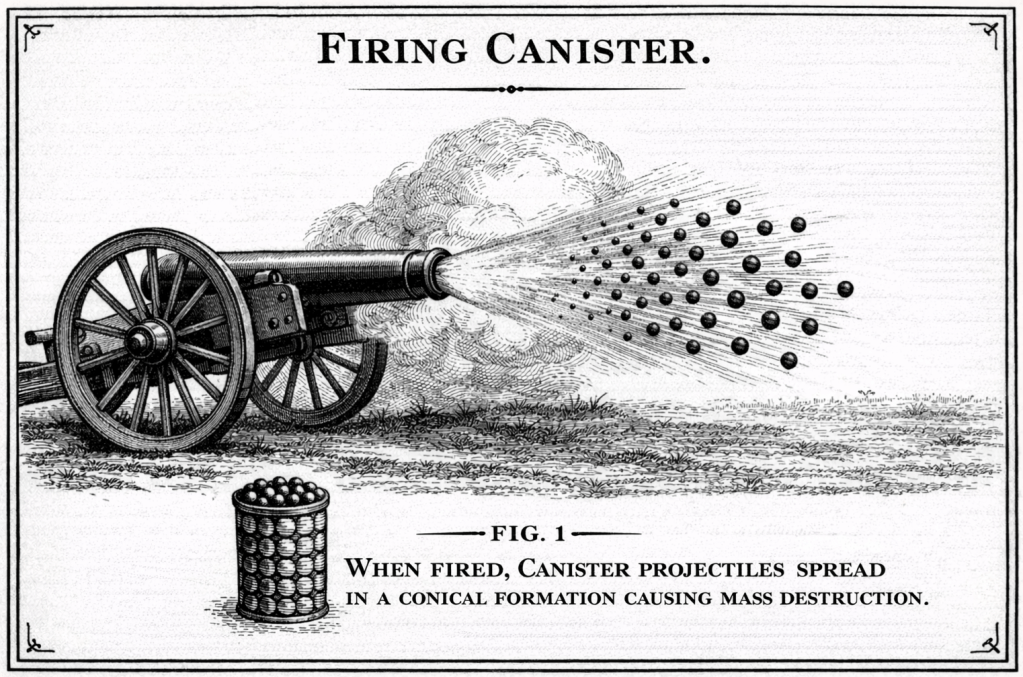
There was nothing clever about it. Nothing ornamental. It was simply the only method left that prevented the guns from being taken – and, just as critically, prevented time from being lost at the most exposed point of the Union line.
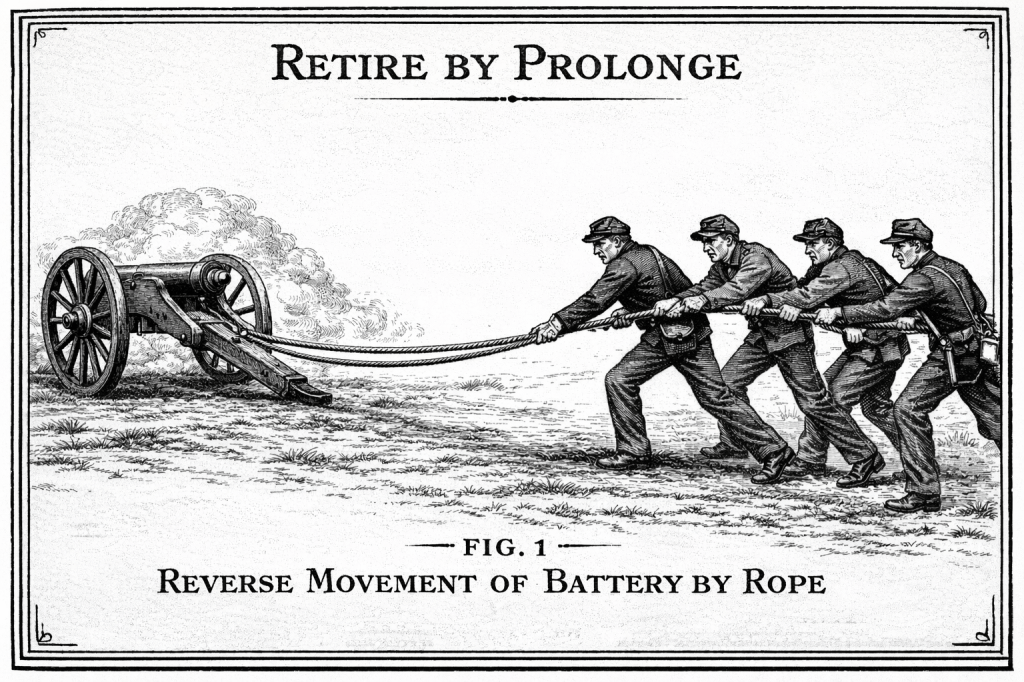
What “Retire by Prolonge” Looked Like
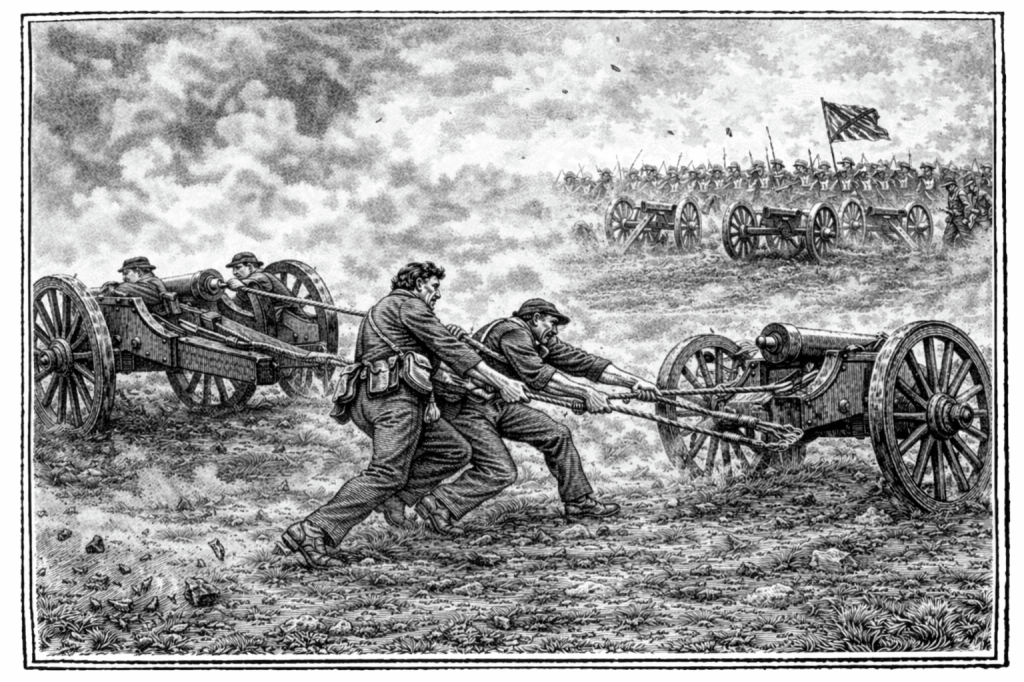
A prolonge was a heavy rope used to control a gun’s movement when standard hitching was impossible. In this action, it became the difference between abandoning the battery and saving what could still be moved.
Bigelow describes the mechanics without flourish. The guns fired. Their recoil helped shift them rearward. The men then dragged the pieces back by rope and hand, preserving alignment while canister continued to leave the muzzles.
Progress came in short, brutal increments – measured in yards, not ground gained – under smoke, dust, and steadily rising casualties.
It worked because it asked nothing of the enemy.
It created distance the only way distance could be created.
Two Hours in the Fight – Thirty Minutes That Mattered
Bigelow’s wording is deliberate.
The battery had been engaged since about 4:30 P.M. near the Peach Orchard, part of the long, grinding fight along the Union left.
But when he writes of “thirty precious minutes,” he is isolating the final phase – when the infantry had fallen back, when the battery stood alone, and when limbering the guns meant certain death.
Those minutes, roughly from six o’clock to half past, were the prolonge.
Two hours in the fight. Thirty minutes when they were the line.
The Corner by the Trostle House
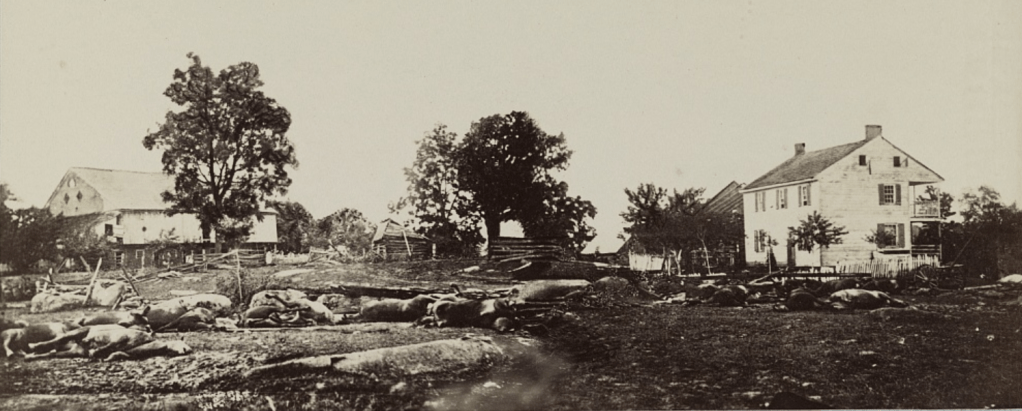
When the thirty minutes ended, the battery had not escaped. It had only reached the stone walls near the Trostle farmhouse.
Here, the geometry of the field changed – and the battery ran out of what it needed most: Men. Horses. Space.
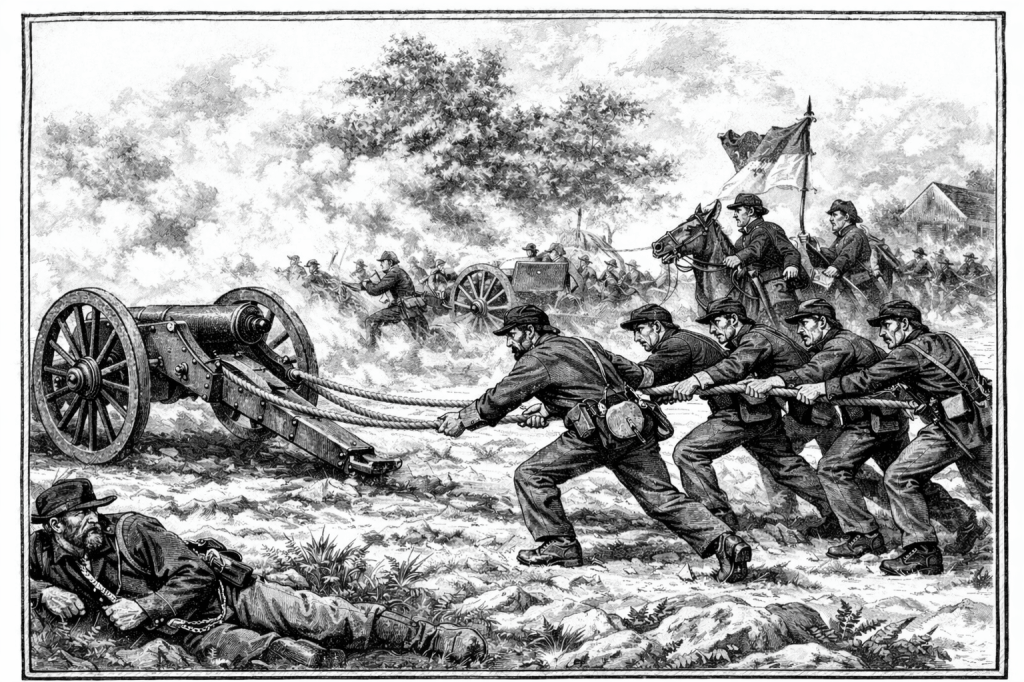
Bigelow records that at this corner, losses were so severe that the battery could no longer maneuver as a unit.
Out of six guns, only two could be saved.
Four had to be abandoned.
Not because they were overrun, but because there was no longer a way to maneuver them effectively.
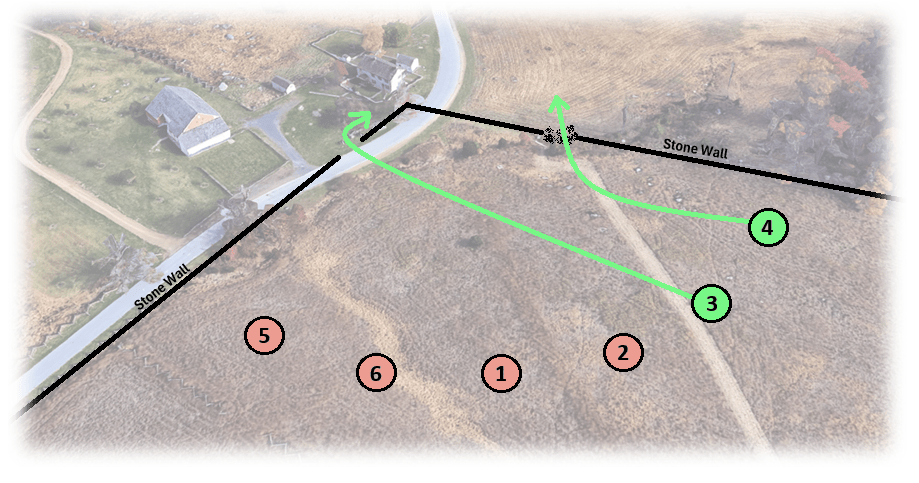
Gun #3: Through the Gate
One of the surviving pieces, identified by Bigelow as Gun No. 3, was dragged to the narrow gateway beside the Trostle buildings and pulled onto the farm lane.
This route appears on Bigelow’s own map and can still be traced on the ground.
Gun #4: Through the Wall
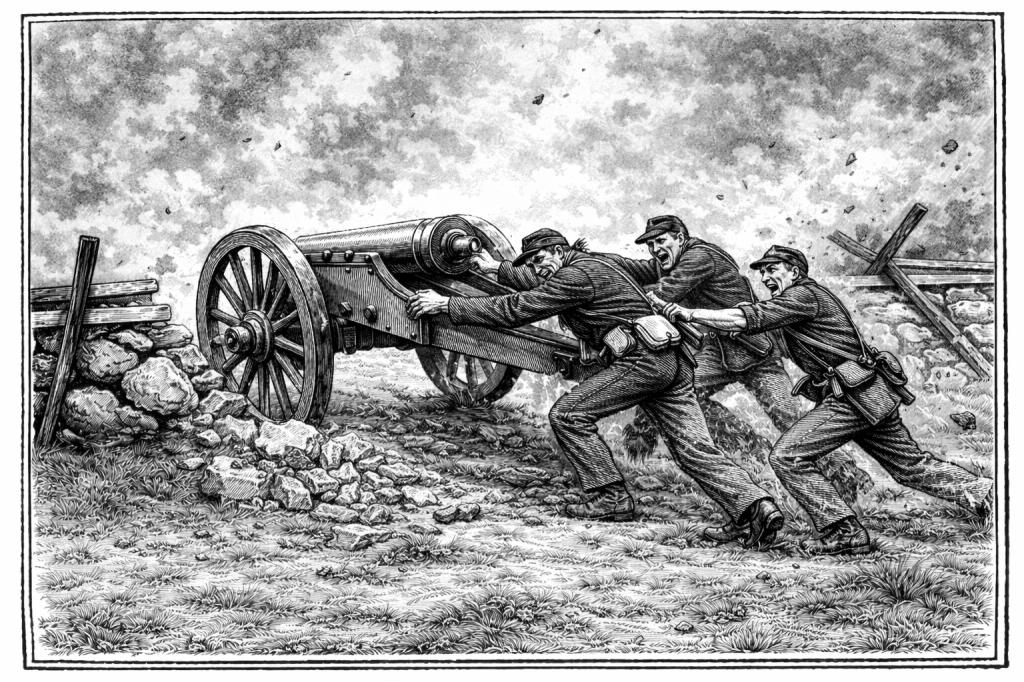
The second piece, Gun No. 4, could not reach the gate. Instead, the remaining men pushed down a section of the eastern stone wall and dragged the gun through the breach.
A cannon did not belong going through a stone wall. But by that point, the drill book no longer mattered.
The wall fell.
The gun went through.
The piece was saved.
The Four Guns Left Behind
The remaining four guns stayed where they stood at the end of the prolonge and were captured by the advancing 21st Mississippi.
Later, after the line had been restored, Union forces retook the ground and recovered the pieces.
But at that moment, Bigelow faced a simple choice: Save two? Or lose all six?
He saved two.
The Ground Still Tells the Story
Bigelow included a hand-drawn map in his pamphlet showing exactly where this occurred.
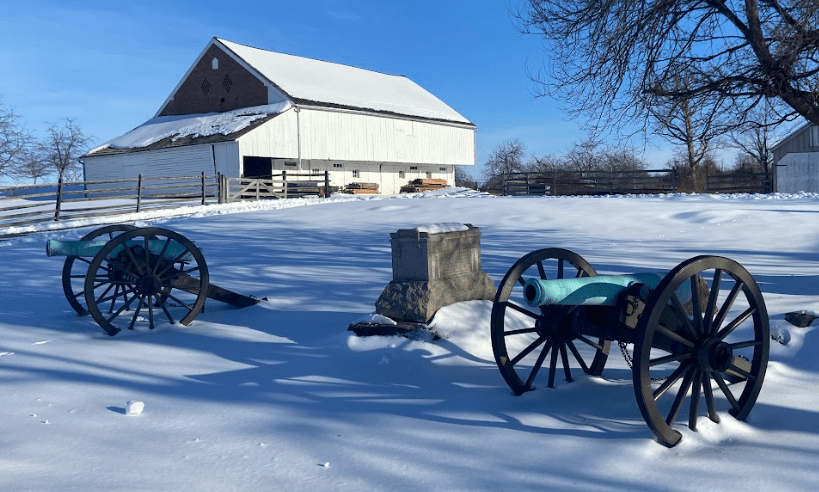
Today, you can stand by the Trostle house, see the gate location (as marked by the 9th Massachusetts Battery 2nd Position Monument, shown below), trace the route of Gun No. 3, and look along the stone wall where Gun No. 4 passed through.
You can walk into the field where the other four guns were left behind after thirty minutes of backing away under fire.
This was not a retreat in formation.
This was a battery dissolving into whatever pieces could still move – and saving what could be saved.
Why This Matters
It would be easy to simply summarize this fight as “They held the line for thirty minutes.“
But the fuller truth is this: They held the line for thirty minutes, reached a stone wall with almost nothing left, abandoned four guns out of necessity, smashed down a wall to save another, and dragged two pieces out by hand and rope.
That is what the end of the 9th’s prolonge looked like.
- Three officers killed or wounded
- Six of seven sergeants killed or wounded
- Twenty-eight enlisted men killed or wounded
- Eighty horses killed or disabled, out of eighty-eight on the field
- Ninety-two rounds of canister fired out of ninety-six in the chests
- More than three tons of ammunition expended
Most great moments in battle are remembered as charges, but sometimes the work that preserves a line is done by men who refuse to collapse when the geometry turns against them – men who find a way to withdraw without surrendering the time others need to stand.
Bigelow’s gunners did not perform a miracle. They performed a discipline.
They retired by prolonge, firing canister as they went, holding their position long enough for the
Union line behind them to be rebuilt.
That is the work, in crisis, which those before us so nobly advanced.
“In every battle there comes a time when both sides consider themselves beaten;
then he who continues the attack wins.” – Ulysses S. Grant, Personal Memoirs
Sources
Primary:
- Major John Bigelow, The Peach Orchard, Gettysburg, July 2, 1863
Supporting:
- Patrick Browne, “9th Massachusetts Battery at Gettysburg,” Historical Digression
- “At Gettysburg,” The 9th Massachusetts Battery website

 So Nobly Advanced
Leave a comment