
Part of Series: “The Kittanning Regiments – A Portrait of Service”
A Small Town on the Eve of War
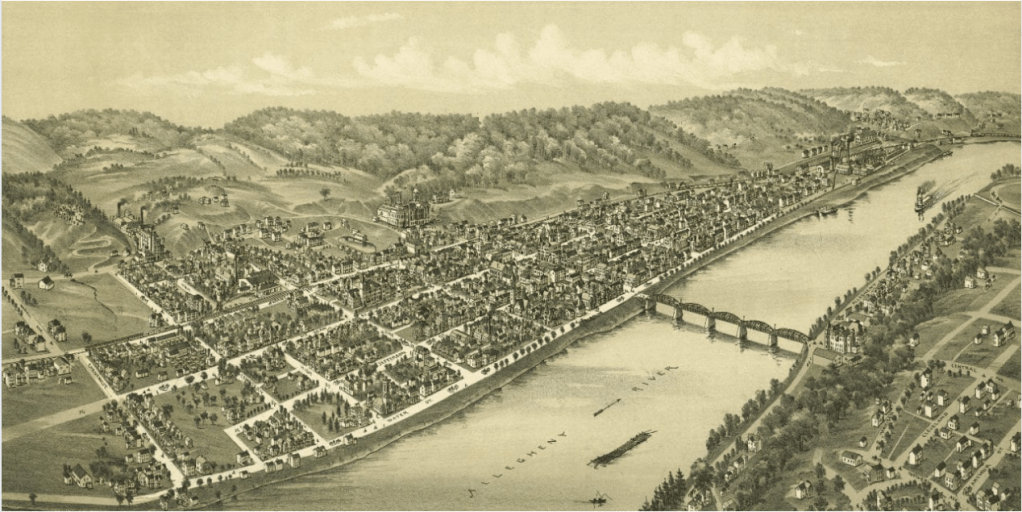
The Kittanning of 1861 would have borne some resemblance to the town it is today: a small community on the banks of the Allegheny River, surrounded by rural countryside. Going into Kittanning was a trip into town for me when I was growing up, as it must have been for many residents of that era.
For some boys traveling to Kittanning in the fall of 1861, however, it would have been their first time leaving their homes – their farms, their families, their loved ones. And for many, it was the first stop on a long journey that would ultimately end at Andersonville Prison in Georgia.
A Nation Learning How to Make War
The scene in Kittanning during 1861 reflected the chaotic nature of the times. A nation was grappling with its identity as its citizens figured out how to make war. In March of that year, Abraham Lincoln called for the enlistment of three-month regiments to put down the rebellion. Many young men leapt at the opportunity for adventure and glory.
But as summer lapsed into fall, the hard reality of a prolonged conflict began to set in. Lincoln issued a new call for 300,000 men to serve three-year terms of enlistment, and Kittanning – like nearly every town across the Union – became a bustling center for military recruitment.
Camp Orr and the Role of Kittanning
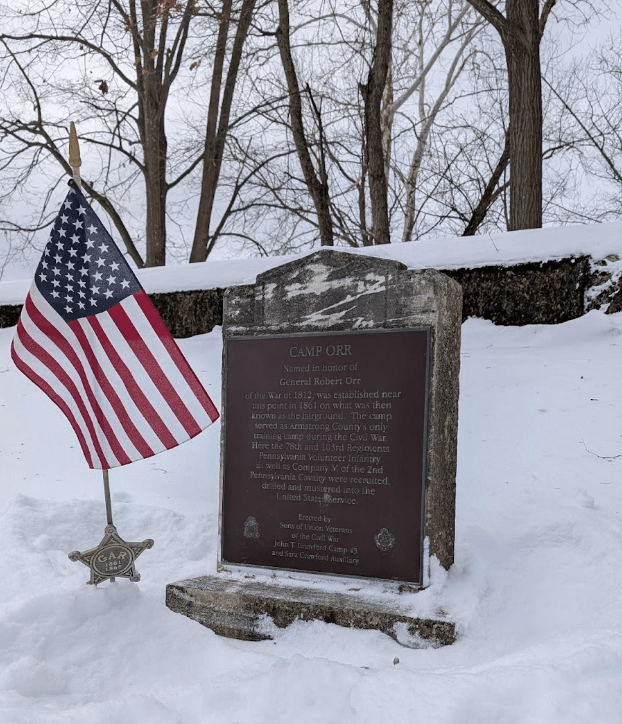
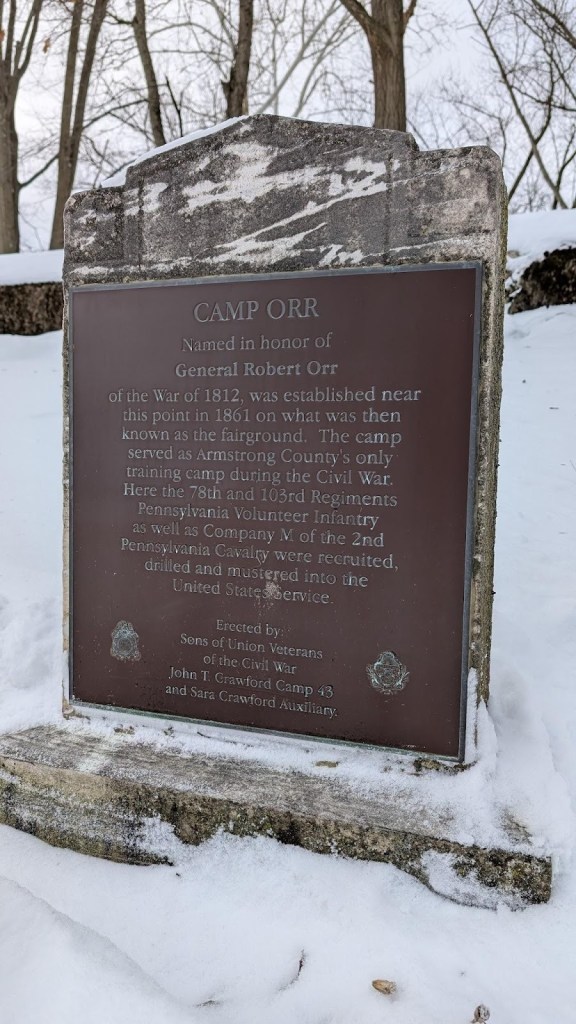
Kittanning’s location at the northern end of the Allegheny Valley Railway made it a natural rendezvous point for Armstrong County. An encampment was established to organize and train newly enlisted troops, and it was named Camp Orr, in honor of General Orr, a veteran of the War of 1812.
Two local regiments – the 78th and 103rd Pennsylvania Volunteers – were organized here. In addition, members of other militias and companies passed through Camp Orr on their way to Pittsburgh, then Harrisburg, and eventually into the cauldron of war.
Searching for Camp Orr
Having grown up in the area without ever hearing about Camp Orr, I was naturally curious. So where exactly was it?
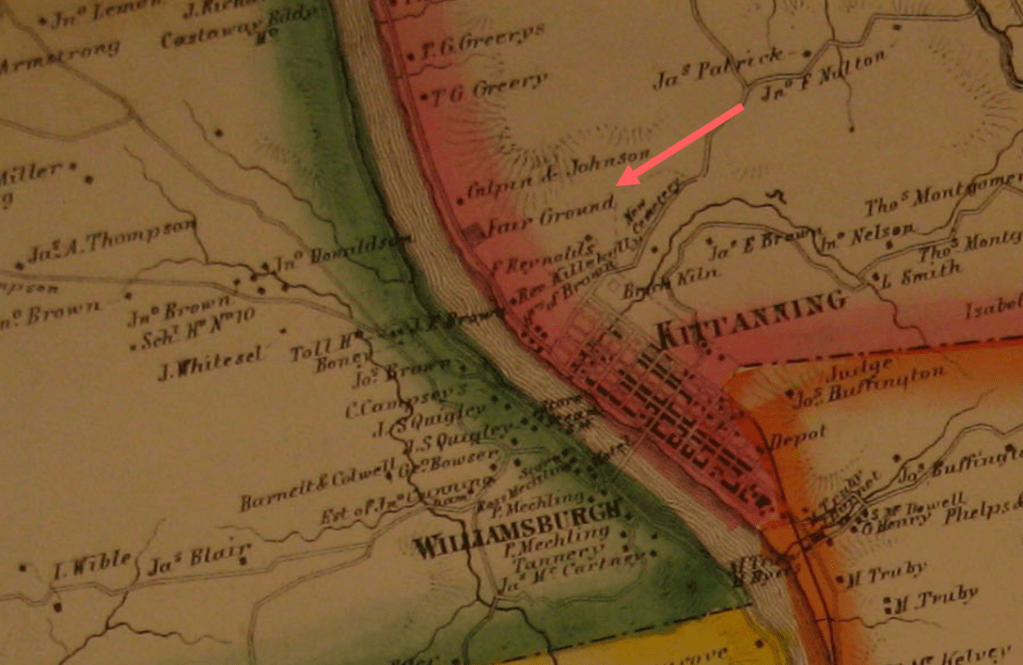
The regimental historian of the 103rd placed the site just north of the town limits at what was then the Armstrong County Fair Grounds. An Armstrong County Landowner Map published in 1861 confirms this location, showing it just above a widened bend in the Allegheny River.
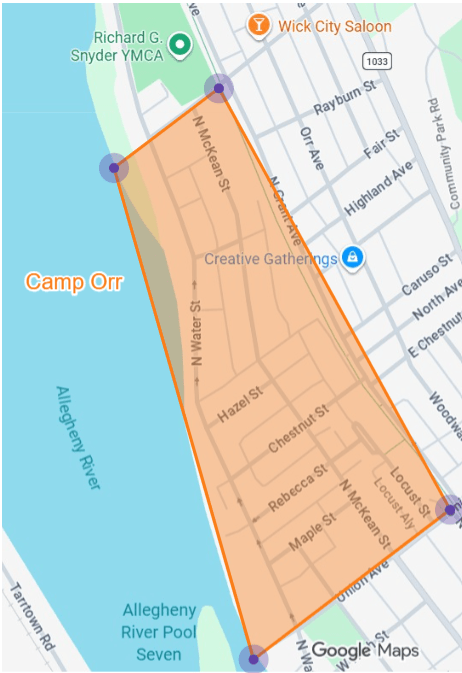
Further details from an Armstrong County website describe the camp’s boundaries more precisely. Camp Orr was situated between the Allegheny River and the rail bed (along present-day Grant Avenue), and bounded by Montieth Street and Union Avenue.
The Camp Orr Marker
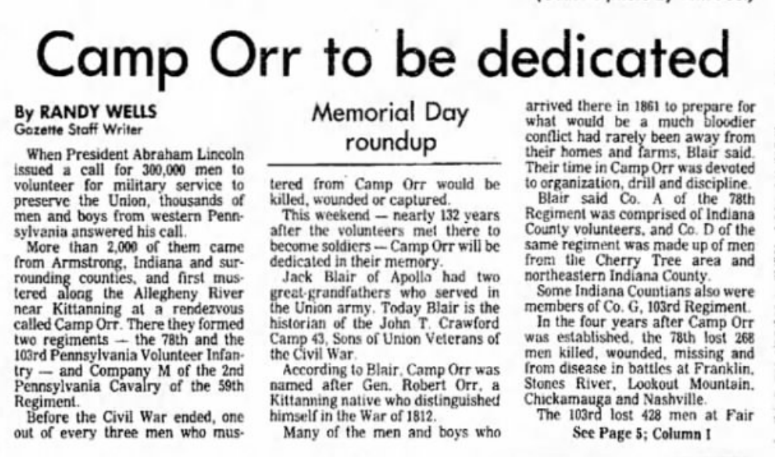
In my search results, I repeatedly encountered references to a historical marker commemorating Camp Orr. The most concrete mention came from a May 29, 1993 article in the Indiana Gazette, which described the dedication of the monument.
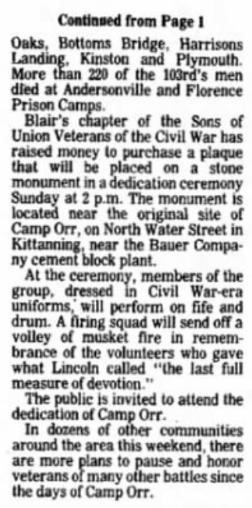
Despite this, I could find no photographs of the marker posted online. After extensive searching, I finally spotted it in a video posted by the Ford City Library, which tours the Civil War room of the Armstrong County Historical Museum. Knowing the marker was located somewhere along North Water Street allowed me to track it down using Google Street View – once again, just above the widened bend of the river.
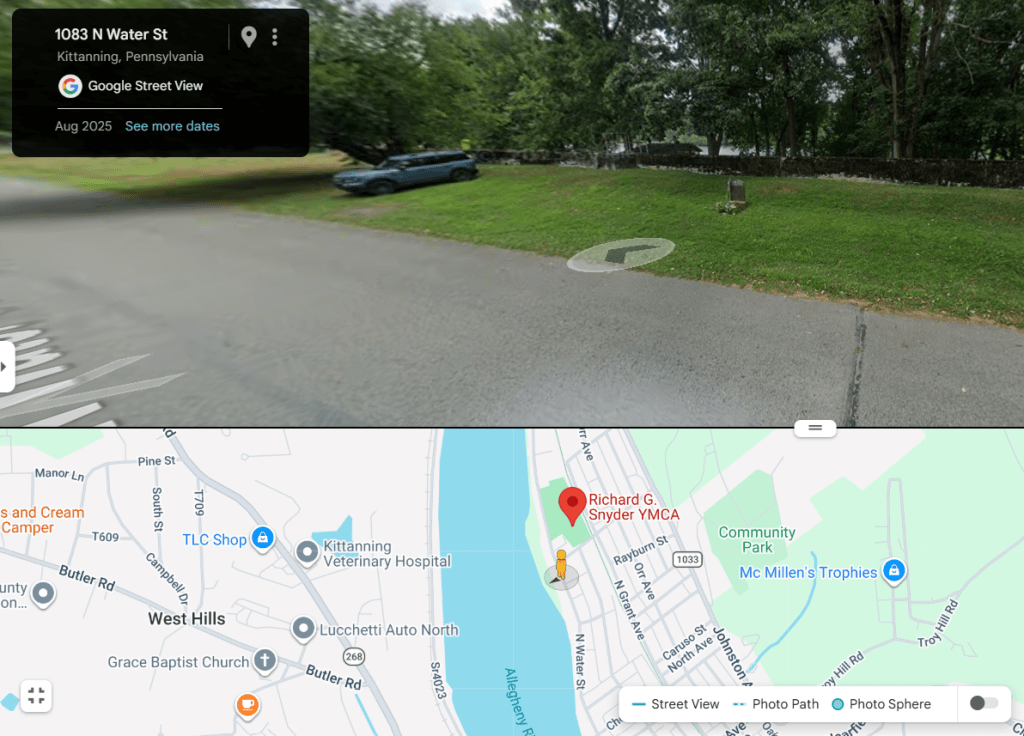
After days of online sleuthing, I finally made the trip into Kittanning to photograph the site myself.
Life at Camp Orr
The men of the 78th and 103rd regiments wintered at Camp Orr in late 1861 and early 1862. A Kittanning newspaper noted in December:
“The 103rd Regiment, now at Camp Orr, is filling its ranks rapidly. Col. Finlay has obtained for the men 1,000 blankets, thus rendering them very comfortable… Shall patriotism not therefore call many more of our young men to the standard of the 103rd regiment? Col. Lehmann, the acting commander of the camp, is a gentleman of kind and urbane manners, and will act the part of a father to all under his care. Come then, fellow citizens, obey your country’s call – sink or swim, live or die, survive or perish, arise. Let us be for our country now and forever.”
At Camp Orr, the men learned how to become soldiers. They were uniformed and drilled, schooled in military discipline, and generally confined within the camp by guards and a tight board fence.
Despite this, Corporal Dickey – writing in his regimental history of the 103rd – fondly recalled “daring experiences” that occurred before ever confronting the enemy. He described sneaking into town at night to evade guards, and being “captured” on one such adventure, earning himself a stern lecture from his captain. Otherwise, there was ample time to kill as the men battled ennui along the banks of the Allegheny.
From Kittanning to the Army of the Potomac
All of this would soon change. On Monday, February 24, the 103rd boarded a train for Pittsburgh, then Harrisburg. By spring, the regiment was attached to the IV Corps of the Army of the Potomac.
While the exploits of the regiment deserve a detailed exploration of their own, we fast-forward to April 1864.
Capture and Andersonville
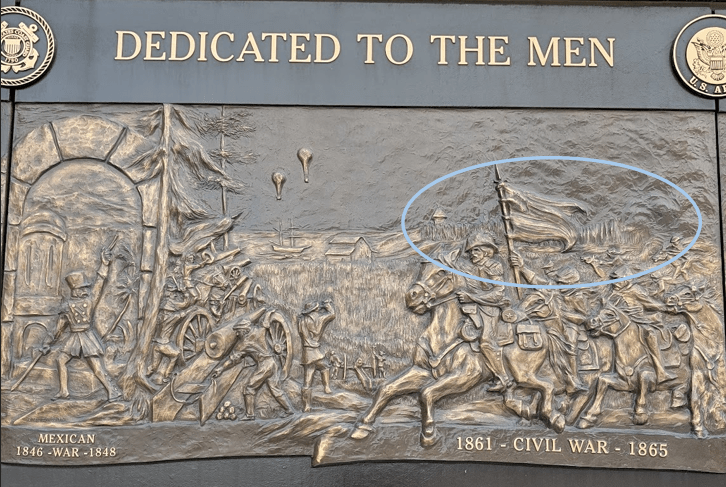
After being captured during the fall of Plymouth, North Carolina, the remaining men of the regiment were transported to the infamous Andersonville Prison. The fate of the 103rd is depicted on the Armstrong County Memorial Wall. Note the stockade and guard tower circled below:
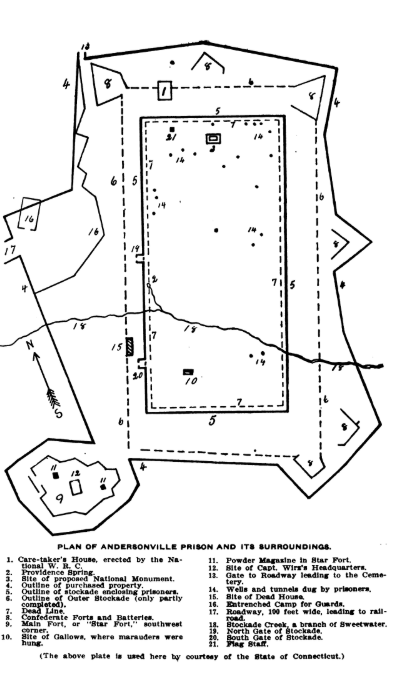
Life in Andersonville was horror beyond description. More than 30,000 men were crammed into an area intended for only 8,000. Prisoners lived in total exposure, with no shelter from the elements or the relentless Georgia sun. Rations were woefully inadequate; men wasted away into walking skeletons, and thousands died from scurvy, dysentery, and other diseases.
The men who had once camped beside the serene Allegheny River now depended on a thin stream for survival. Already fouled by guards and the camp kitchen before it entered the stockade, the water source quickly devolved into a swamp of filth and human excrement.
Humanity Amid Horror
As I read through the accounts of the men of the 103rd imprisoned at Andersonville, I noticed that they mostly focused on small humanities showed to one other and daring prison escapes. Each said they took great pains to forget the atrocities of the camp, and did not care to try to remember.
In truth, the structure of society inside the prison had collapsed. Prison gangs beat and murdered fellow inmates for food and scraps of shelter. This violence was somewhat curtailed when a group of prisoner “Regulators” arrested gang members and, with the guards’ permission, hanged several on makeshift gallows inside the camp.
Although Captain Henry Wirz, the camp’s commander, would later become the only Confederate executed for war crimes, the men of the 103rd recognized that Confederate soldiers and civilians alike were suffering. By this stage of the war, the South’s infrastructure was collapsing entirely.
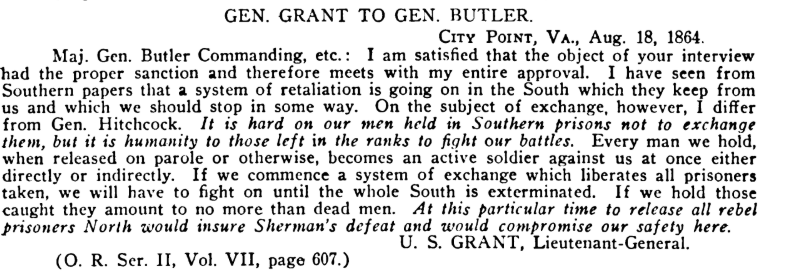
What makes the prisoners’ suffering even more tragic is that Confederate officials repeatedly sought to exchange all of the men held at Andersonville and other prisons. Grant and Lincoln refused, unwilling to resupply the South with tens of thousands of able-bodied soldiers. Grant believed such an exchange would doom Sherman’s March to the Sea.
“Conquering Peace”
In the brutal calculus of war, the South needed the men more than the North. Corporal Dickey reflected:
“The men who languished and died in the military prisons of the South… were not surpassed in indomitable courage and heroic devotion to duty by any who fell in charging the ranks of the enemy, and… did fully as much in conquering peace as those who comprised the armies of Grant and Sherman.”
Reflection and Next Steps
I’ll admit that seeing Andersonville depicted on the Armstrong County Memorial Wall was jarring. It is not what we typically associate with monuments or military glory. Yet it represents sacrifice in a form we can scarcely comprehend.
A full 40 percent of the regiment that marched out of Camp Orr never returned, and Andersonville accounts for a significant portion of that staggering loss.
In researching the history of my hometown of Kittanning and Camp Orr, I was humbled and fascinated by the compelling stories of the men of the 78th and 103rd regiments. There is much more to discuss, and these regiments will be the focus of my next several posts.
Next week, we’ll examine the life of Colonel Theodore F. Lehmann of the 103rd.
As Corporal Dickey reminds us, the contributions of the 103rd POWs were equal to any of those who fell in battle. We must always honor the selfless sacrifice of POWs and the role they have played in conquering peace.
Sources
- History of the 103rd Regiment, Pennsylvania Volunteers, Luther S. Dickey, 1910
- Indiana Gazette (Indiana, PA), “Camp Orr Monument Dedication,” May 29, 1993
- Armstrong County Landowner Map (1861), Ancestor Tracks
https://ancestortracks.com/Armstrong_Co_Map,1861.html - Armstrong County Veterans Memorial Wall History
https://www.co.armstrong.pa.us/index.php/county-government-m/veterans-affairs-m/war-wall-history-m - Map of Kittanning, Pennsylvania (1896), Knowol
https://www.knowol.com/information/pennsylvania/map-kittanning-pa-1896/


 So Nobly Advanced
Leave a comment