
Part of Series: “The Kittanning Regiments – A Portrait of Service”
This post is a continuation of our series on the Kittanning regiments. Here we’ll take a look at the 78th Pennsylvania Infantry and their return home, in an attempt to uncover the meaning of their homecoming and piece together the significance of one of their own who never returned to be laid to rest among them.
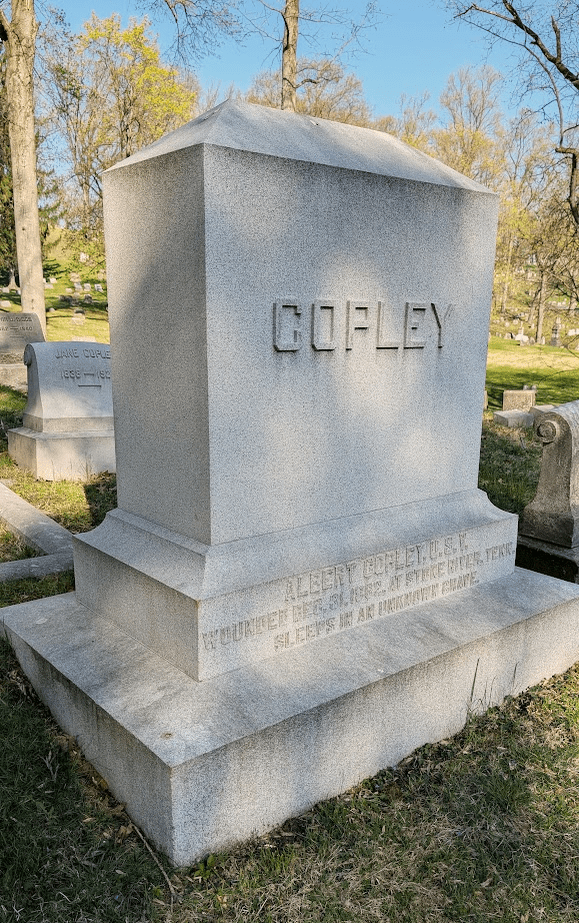
This isn’t Albert Copley’s grave. It’s just a reminder – a memory set in stone. It sits atop a hill in the Allegheny Cemetery, standing taller than the surrounding headstones in the Copley family lot. It’s the place where his father, Josiah, would have liked to have him buried. And it’s a place we can visit today and remember.
Origins at Camp Orr
Albert’s story begins with the 78th PA volunteers as the regiment coalesced at Camp Orr in Kittanning in the late summer of 1861. Men arrived from Armstrong, Indiana, New Bethlehem, Clarion, Butler, and Freeport among others. They were farmers and laborers, most barely into their twenties, who answered Lincoln’s call and gathered along the banks of the Allegheny River. Their days quickly settled into a rigid routine of drill and discipline under the watchful eye of Colonel William Sirwell. Squad drill gave way to company drill, and eventually to full regimental movements, as raw volunteers learned to march, to obey, and to think as a unit. What began as a loose collection of recruits slowly took on the structure and identity of a regiment, preparing to leave behind the familiarity of home for the uncertainty of war.
Early Adventures of Green Troops
When the regiment finally left Camp Orr, they traveled by the Allegheny Valley Railroad to Pittsburgh, where they spent five days at Camp Wilkins while Negley’s brigade of the 77th, 78th, and 79th Pennsylvania was organized. From there, they marched through the streets of Pittsburgh and boarded a steamboat on the Monongahela River, beginning their journey south. As the boat carried them down the Ohio River toward Louisville, Kentucky, the men of the 78th experienced one of their first moments of uncertainty. Crossing into Kentucky, they spotted a company on a hill with an artillery piece trained in their direction. Many braced for their first taste of combat, only to find the gun was fired in salute, not hostility. They reached Louisville in perfect safety.
By late October, the regiment had moved some fifty miles south of Louisville by rail and set up camp, posting picket lines along the surrounding countryside. At first, the new realities of soldiering resulted in a comedy of errors. On one of their first nights, a nervous sentinel shouted “Halt, halt!” and fired into the darkness at the sound of rattling chains. When daylight came, a mule was spotted tottering in a field nearby. Another equally vigilant soldier made a determined bayonet charge and captured an opossum. As the regimental historian later observed, “hardly a night passed that a horse, a cow, or a mule did not pay the penalty with his life for approaching too near the picket line.” These early misadventures soon gave way to more serious business, and by December the 78th received its first taste of action in a light skirmish around Munfordsville.
Stones River
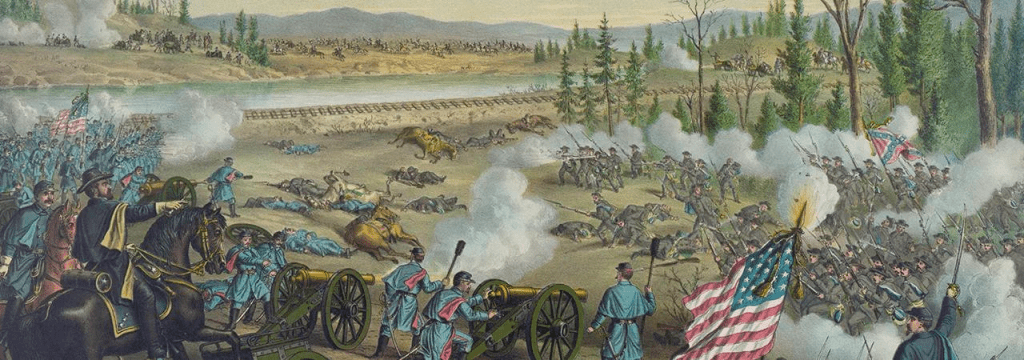
By the time the 78th Pennsylvania reached the field near Stones River, they were no longer green. They were soldiers who had felt the confusion and shock of battle. On the first day, the Union army was struck hard, and like many units, the 78th experienced the disorder of a line driven back under pressure. But by the time the fighting resumed, the regiment found itself posted near the left of the army by the river, supporting the artillery behind the crest of a hill.
On the afternoon of the decisive fighting, the regiment lay just behind that ridge as Confederate forces surged against the Union left. Shells, solid shot, and grape swept over and around them. From that position, they watched as the attack fell heavily on the troops in front of them, particularly Van Cleve’s division at the river bend. Despite their tribulations, the men drew strength from their commanders. General Negley rode along the line, repeating “pay them back for what they did on Wednesday!” With the day’s outcome on the line, the 78th charged and captured a battery of 4 guns.
Albert Wounded and Captured
For Albert Copley, it was the beginning of the end.
Wounded by an exploding shell during the battle, he was captured along with other Union soldiers and placed aboard a train bound south. They made it as far as southern Georgia before being turned back as Union forces threatened the region. The journey itself proved more dangerous than the battle. Though not mortally wounded, Copley endured nearly 1,200 miles of continuous travel under harsh conditions. By the time the train reached Knoxville, Tennessee, he was too weak to continue and was removed to a hospital.
From there, he managed to write a short letter home to his father, Josiah, describing his situation and expressing hope for recovery. It would be the last word his family received from him. Days later, a letter came notifying of Albert’s death. There were no further details.
Josiah wrote to his son’s captain and even to General Negley, but neither could provide any further information. Albert Copley, like many others, disappeared in the chaos of war.

On to Chickamauga
For the survivors, war continued. The 78th remained with the Army of the Cumberland, moving through the long campaigns that followed – Tullahoma, Chickamauga, Chattanooga, and eventually the advance toward Atlanta. These were years defined less by single dramatic moments than by endurance: marching, fighting, entrenching, and holding ground across the mountains and valleys of Tennessee and Georgia. By the time their service drew to a close, the men who had once struggled to keep step at Camp Orr had become seasoned veterans, tested repeatedly and found equal to the demands placed upon them. When they were finally mustered out on October 17th, 1864, they carried with them the memory of battles won and the weight of everything endured along the way.
The Return Home
The journey home had the 78th passing back along the same rivers that had carried them away, from Nashville to Pittsburgh, and finally home toward Kittanning. The men who left Camp Orr three years prior came back veterans shaped by marching and combat. The homecoming they long sought was also tempered by their loss. Writing years later, regimental historian J.T. Gibson remembered it as a moment of inseparable joy and grief, where every handshake and embrace carried the memory of comrades who never returned. Towns along the route welcomed them warmly, eager to honor their service. Yet even in celebration there was a quiet recognition of the cost of victory.
A Father’s Search
For Josiah Copley, there was no such homecoming.
A few weeks after learning of his son’s death, he traveled to Pittsburgh, drawn by word that a regiment from the Army of the Cumberland would be passing through the city late at night. A meal had been organized by the Pittsburgh Subsistence Committee, and Josiah entered a hall filled with hundreds of soldiers gathered around long tables. As he walked through the rows of soldiers he found himself drawn to one man who stood alone. Josiah described the conversation as follows:
“He told me he was a member of an Ohio regiment, giving its number, and that he belonged to what was known as the Army of the Cumberland. Did you ever meet any of the men of the 78th Pennsylvania? I asked. Yes, he replied; we lay for sometime alongside of that regiment, and I got acquainted with a good many of the boys. Did you know a man named Albert Copley? He started at the question, and exclaimed, Albert Copley? Why, I was lying beside him in the hospital when he died. He then told me that he was captured at the same time–that they traveled all that round in the same car–that he dressed Albert’s wounds daily as well as he could–that before reaching Knoxville he himself took sick–that both were put in the same hospital, and occupied couches side by side. He said Albert was in a fair way of recovery until erysipelas set in, which soon terminated in death. He spoke of his resignation, cheerfulness, and hopefulness, and of his gratitude to his nurse, who had been very kind to him. I inquired of him if he knew anything of his grave; but he did not, for he was to sick to attend his funeral. He told me that Albert gave that nurse what little he had in return for his unwearying kindness.”
It’s a story that defies the logic of probabilities. For Josiah, it was a final piece of his son to hold on to. But there’s more to the story. In future posts we’ll use modern scholarship techniques to take a deep dive into Albert’s compelling story.
The Boys from Camp Orr
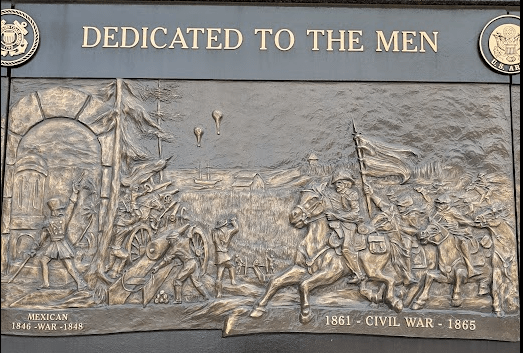
We’ve previously told the story of the 103rd PA and their journey from Camp Orr to Andersonville. The service of the 78th was defined by endurance, persistence, and moments of battlefield glory. Both are depicted on the Armstrong County War Memorial. And each, in their own way, defined sacrifice and aided in the victory.
We remember the men from Camp Orr – men like Albert Copley – who selflessly
took up the unfinished work, and So Nobly Advanced.
Sources
- History of the Seventy-Eight Pennsylvania Volunteer Infantry, J. T. Gibson, 1905
- https://www.pa-roots.com/2025/08/12/josiah-copley/
- https://www.co.armstrong.pa.us/index.php/county-government-m/veterans-affairs-m/war-wall-history-m
 So Nobly Advanced
Leave a comment