
History did not wait.
It did not begin with the polished prose of later historians, nor with the formal reports compiled in Washington. It did not require distance, reflection, or even the passage of years.
Instead, it began immediately – formed in the minds of the men who marched, fought, endured, and, at last, witnessed the end.
Among those men was Private John Hogan, Company F, 87th Pennsylvania Volunteers, of the Sixth Corps – a late-war enlistee who entered service at Allegheny City (now Pittsburgh) in February 1865 and would be discharged with his company that June. In the aftermath of victory, he set to paper a piece titled “The Last of Old Lee.”
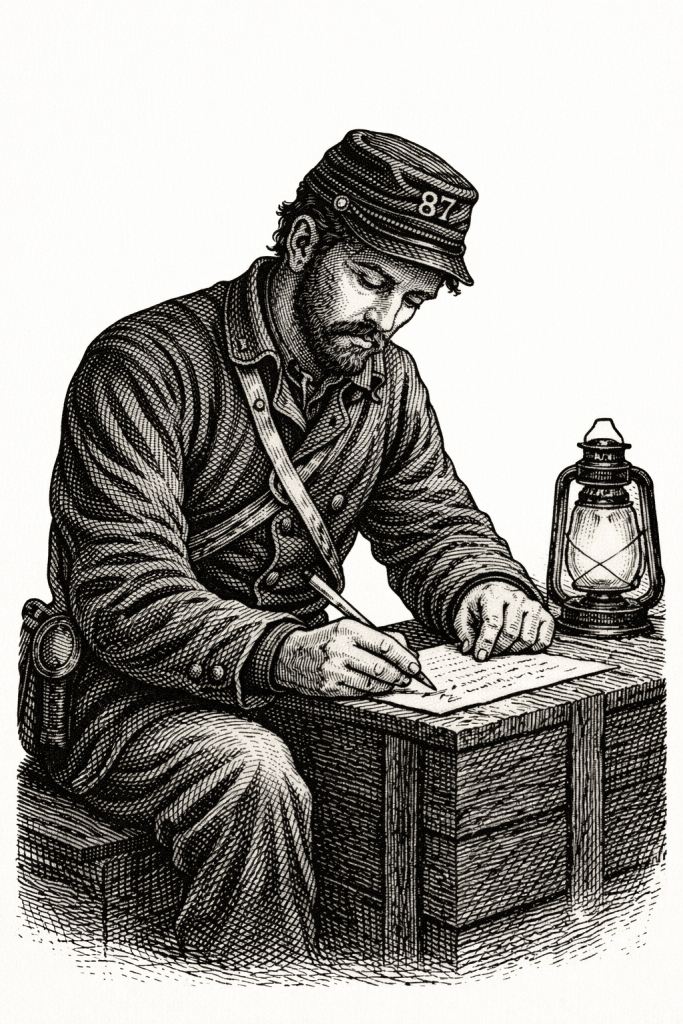
What he produced was not merely a poem, nor simply a soldier’s recollection – it was something more foundational…
It was history.
Not as later generations would refine it, but rather as it was first understood: immediate, emotional, selective, and deeply human. In Hogan’s words, we find not just what happened in the final days of the war, but how those events were first shaped into meaning.
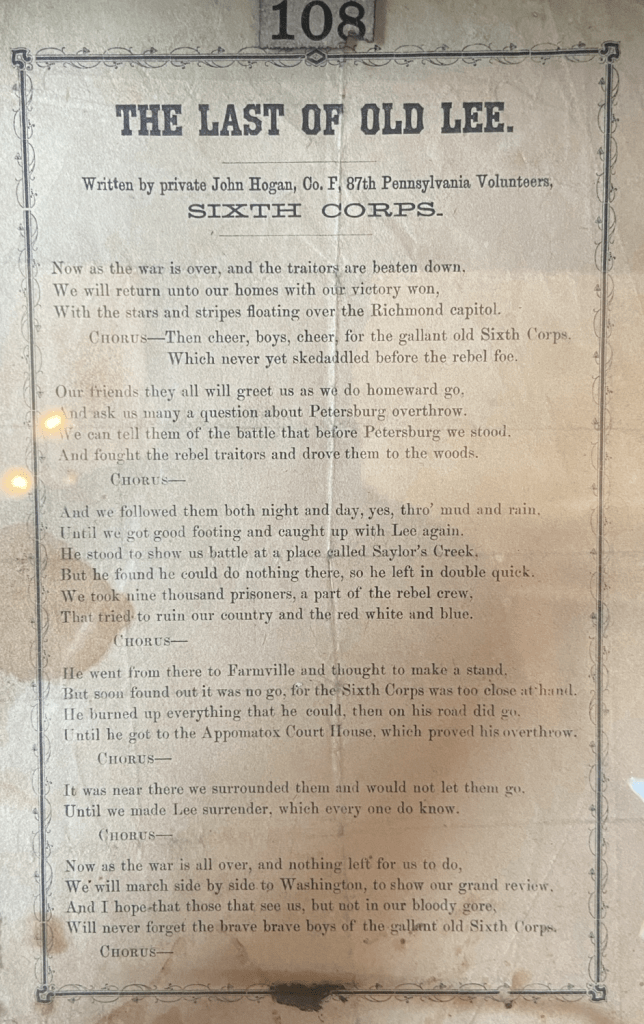
The Artifact – A Soldier’s Account in Verse
Hogan’s piece is structured as a song, complete with repeating chorus lines – intended to be recited, shared, and remembered among comrades. It traces the final campaign against Robert E. Lee, Commander of the Army of Northern Virginia, from the breakthrough at Petersburg to the surrender at Appomattox.
The opening lines establish the framework:
“Now as the war is over, and the traitors are beaten down,
We will return unto our homes with our victory won…”
From the outset, the war is not presented as uncertain or ambiguous. It is resolved. The Confederates are not merely defeated – they are “traitors,” their cause morally settled in the mind of the writer.
This is not detached observation.
It is interpretation – already formed.
The chorus reinforces the identity at the center of the narrative:
“Then cheer, boys, cheer, for the gallant old Sixth Corps,
Which never yet skedaddled before the rebel foe.”
Here, Hogan – who had mustered into service on February 27, 1865, and would be discharged on June 29 of that same year – does what historians would later do more formally: he assigns character. The Sixth Corps is cast as steadfast, reliable, and unwavering – a reputation earned in the field and now preserved in memory.
The Campaign – Narrative from the Ground
Within the structure of verse, Hogan compresses the Appomattox Campaign into a sequence of lived moments:
- The fall of Petersburg
- The relentless pursuit “both night and day… thro’ mud and rain”
- The decisive engagement at Sailor’s Creek, where: “We took nine thousand prisoners…”
- The flight toward Farmville
- The final collapse at Appomattox Court House
This is not the campaign as mapped by staff officers or later reconstructed through archives. It is the campaign as experienced by a private soldier: movement, exhaustion, contact, and culmination.
Most striking is the sense of inevitability. The pursuit is described not as a gamble, but as a tightening noose:
“It was near there we surrounded them and would not let them go,
Until we made Lee surrender…”
In Hogan’s telling, the end of the war appears less as a dramatic turning point and more as a foregone conclusion – one that the soldiers themselves felt unfolding in real time.
Meaning in the Moment – The War Interpreted Before It Ended
What elevates this artifact beyond simple recollection is the immediacy with which it assigns meaning.
Hogan does not wait for reflection. He does not hesitate to judge. He does not present events neutrally. Instead, he organizes them into a clear moral and narrative structure:
- The Union cause is just and victorious
- The Confederate cause is illegitimate and defeated
- The Sixth Corps is central to that victory
- The campaign itself is a story of relentless pressure leading to inevitable surrender
This is, in effect, a completed interpretation of the war’s final act, produced not years later, but in its immediate aftermath.
John Hogan is not merely remembering – he is explaining.
Memory and Legacy – Awareness of the Future
In its closing lines, the piece turns forward:
“And I hope that those that see us…
Will never forget the brave boys of the gallant old Sixth Corps.”
Here, Hogan reveals something essential: an awareness that the war will be remembered, and that memory will not fully capture what was endured.
There is an implicit tension:
- The public will see the soldiers
- But they will not see “our bloody gore”
The experience of war – the exhaustion, the suffering, the immediacy of danger – will fade.
What remains must be carried forward through narrative.
And so Hogan writes, not just for his fellow soldiers, but for those who will come after.
Convergence with the Historical Record
Hogan’s account, though poetic, aligns closely with the known sequence of events in the final campaign of the Army of the Potomac:
- The breakthrough at Petersburg in early April 1865
- The rapid pursuit of Lee’s army westward
- The crushing blow at Sailor’s Creek, where thousands of Confederates were captured
- The continued pressure that denied Lee the opportunity to regroup
- The final encirclement at Appomattox Court House on April 9, 1865
What is absent are the broader strategic complexities – the logistical constraints, the command decisions, the uncertainties faced by high command. What remains is what mattered most to the soldier: movement, contact, and outcome.
In this way, Hogan’s piece does not contradict the later-produced historical record – it distills it into the clarity of lived experience. His words are not interpretation – they are primary history itself.
The Deeper Truth – Soldiers as the War’s First Historians
This artifact reveals a truth often overlooked:
The Civil War’s first historians were not scholars, but soldiers.
Before official histories were compiled, before monuments were raised, before memory was formalized, the men who fought began the work of interpretation themselves.
They selected what mattered. They assigned meaning. They shaped narrative.
Hogan’s “The Last of Old Lee” is not history in its final form. It is something more fundamental:
- It is history in its earliest stage
- It is memory becoming narrative
- It is experience being ordered into meaning
In this process, we see the origin of all that would follow. Later historians would refine, challenge, and expand these narratives – but they would not begin from nothing.
They would build upon foundations laid by the soldiers themselves.
The War Ends – The Story Begins
At Appomattox, the war ended in fact.
But almost immediately, it began again in memory.
Men like Private John Hogan – whose brief but precisely timed service placed him within the final movement of the Army of the Potomac from Petersburg to Appomattox – did not wait for others to tell their story. They told it themselves – imperfectly, emotionally, but with clarity of purpose. In doing so, they ensured that the meaning of the war would not be left entirely to distance or abstraction.
They carried forward the unfinished work, not only through victory, but through remembrance.
And in that act, they advanced the nation’s story – already, even then – So Nobly Advanced.
Addendum – The Espy Post and the Afterlife of Memory
The story of “The Last of Old Lee” does not end with its composition, nor with its circulation among the men who first read and carried it.
It continues in a room…
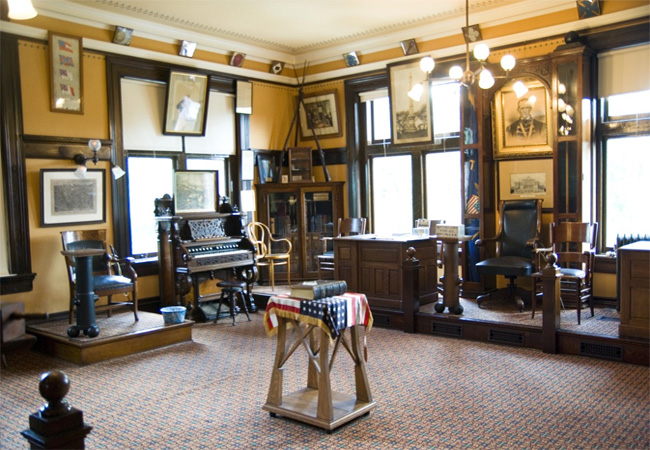
The artifact now resides within the former meeting space of the Capt. Thomas Espy Post No. 153, Grand Army of the Republic, housed in the Carnegie Library in Carnegie, Pennsylvania.
Established in 1879, the Post was one of thousands formed by Union veterans across the country – organizations that served not only as fraternal bodies, but as custodians of memory.
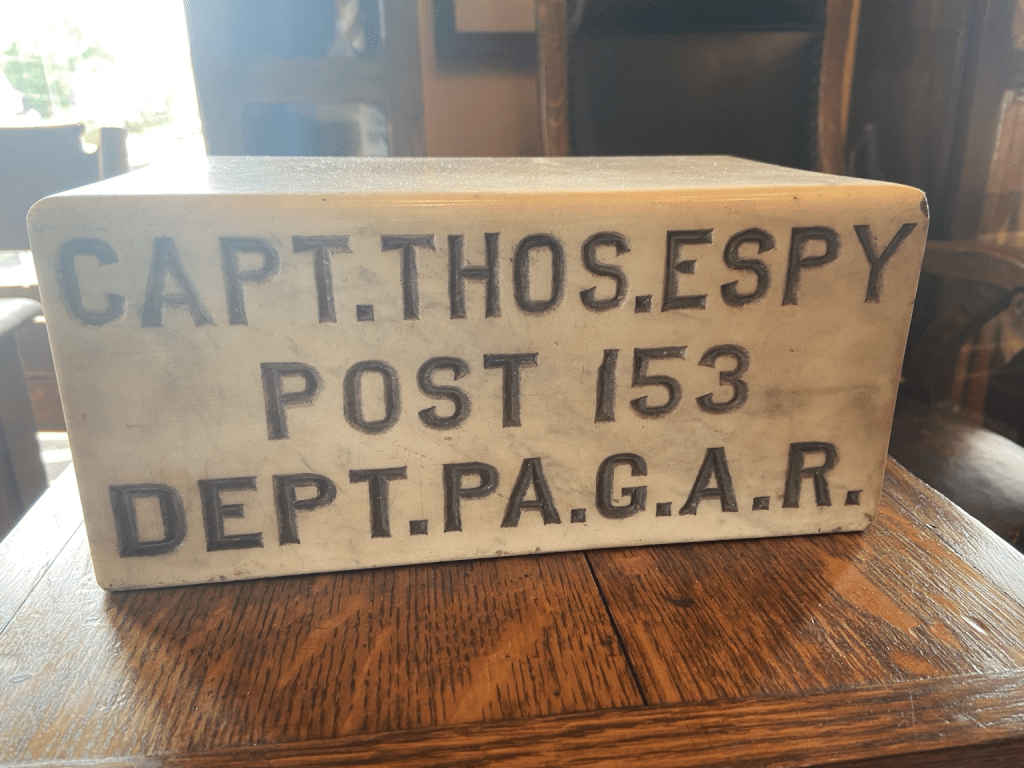
By the early twentieth century, as their numbers diminished, the members of Espy Post confronted a question that extended beyond their own lives:
What would become of the physical remnants of their war?
Their answer was deliberate.
In 1906, through formal agreement with the Carnegie Free Library, the Post secured a dedicated Memorial Room – an institutional space designed to preserve their books, records, and relics. These were not gathered casually. They were catalogued, arranged, and protected with the understanding that they would one day speak in place of the men themselves. Among these items was Hogan’s song, already decades removed from its moment of creation, yet still bound to the memory of those who had known it firsthand.
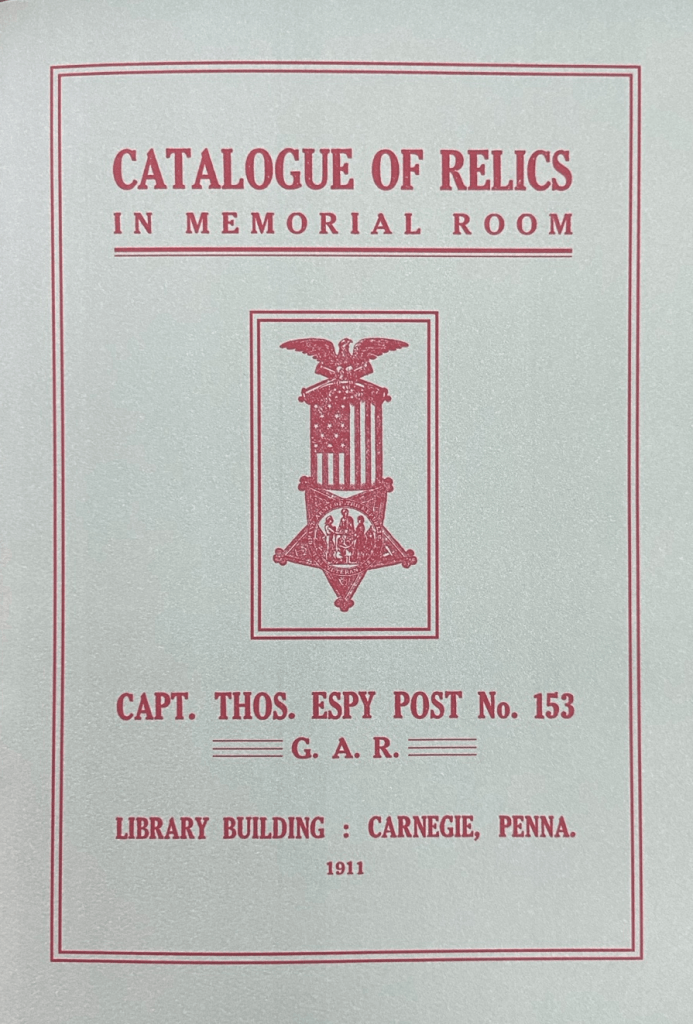
The catalogue entry preserves more than description – it preserves a chain of human connection.
Written just after the surrender of General Robert E. Lee, printed in Richmond while the army was still in motion, the piece was presented by Hogan to a fellow soldier of the 87th Pennsylvania, and kept in his possession for over forty years before being entrusted to the Post. In that journey – from hand to hand, and finally into institutional care – the artifact passed through the full arc of memory: from experience, to sharing, to preservation.
After the last members of Espy Post had answered their final roll calls, the room itself was closed.
For decades, it remained (mostly) undisturbed – a space shaped entirely by the veterans who had furnished it. When it was later reopened, what emerged was not a reconstruction, but a preservation: a rare surviving G.A.R. post room, and with it, a body of memory left largely as its makers intended.
In this setting, “The Last of Old Lee” exists not as an isolated document, but as part of a larger act of remembrance. It is one voice among many – yet one that reveals, with particular clarity, how the soldiers of the Civil War first told their own story, and then took steps to ensure that it would endure beyond them.
The artifact was written in the aftermath of war.
It was carried in the company of those who understood it.
And it was preserved, deliberately, for those who would not.
Sources
- Hogan, John. “The Last of Old Lee.” Private printing or broadside, attributed to Company F, 87th Pennsylvania Volunteers, Sixth Corps.
- Catalogue of Relics in Memorial Room, Capt. Thomas Espy Post No. 153, G.A.R., Carnegie, Pennsylvania, 1911.
- Carnegie Carnegie Library. “Civil War Room.” https://carnegiecarnegie.org/civil-war-room/
- Pennsylvania Civil War Muster Rolls. “87th Pennsylvania Infantry, Company F.” https://www.pa-roots.com/pacw/infantry/87th/87thcofnew.html
- Find A Grave. “John Hogan.” Memorial ID 291439371. https://www.findagrave.com/memorial/291439371/john-hogan
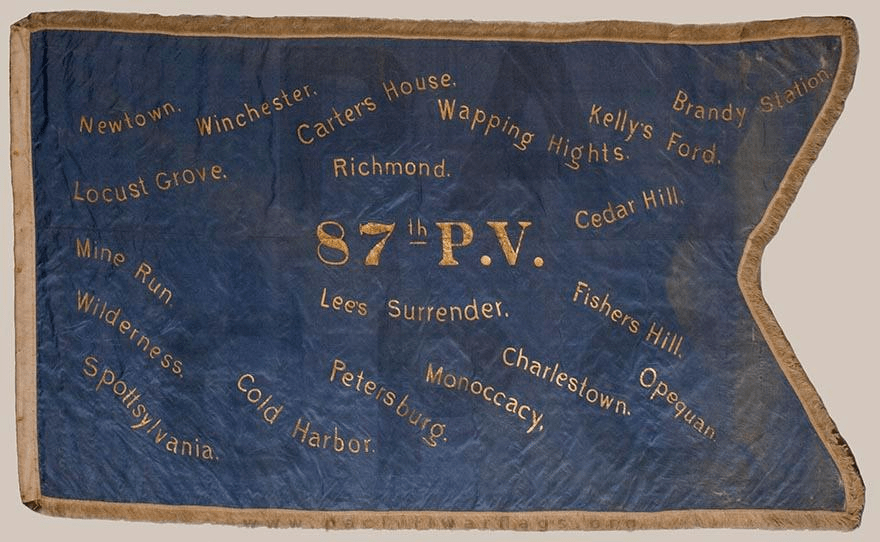


 So Nobly Advanced
Leave a comment