
Part of Series: E. P. Holland – The Veteran Who Kept the Record
Enoch P. Holland was only about five years old when, by his own later recollection, he first marched at the head of a militia company.
No one could have mistaken the child for a soldier. He was far too young to shoulder the obligations of military service, vote for officers, answer to militia law, or understand fully the uniforms, weapons, commands, and ceremony unfolding around him. Yet Holland remembered that the local organization then known as the Cherokee Guards had given him a place of his own. He served as its Pioneer, a ceremonial position that placed him at the front of the marching column when the company paraded through the community.
Nearly seventy years later, he still remembered it.
That childhood place at the head of the column began an association that would follow Holland through most of his youth. The company would change its name and appearance. Officers would come and go. Men would enter its ranks, resign, disappear from the record, or recommit themselves to further service. Holland himself would grow from a child participating in the company’s public ceremonies into a young man formally mustered into its ranks and accountable to its rules, obligations, and discipline.
By the time civil war threatened the country in 1861, the organization was no longer merely part of Holland’s childhood landscape. It represented nearly two decades of familiarity, memory, and belonging.
When another company later tried to persuade him to enlist with them, Holland explained why he hesitated in only a few words:
“I prefered [sic] to stick to my old company.”
To understand what Holland meant by ‘my old company‘, we can turn not only to the Memoir he wrote decades afterward, but to a remarkable surviving record created by the organization itself.
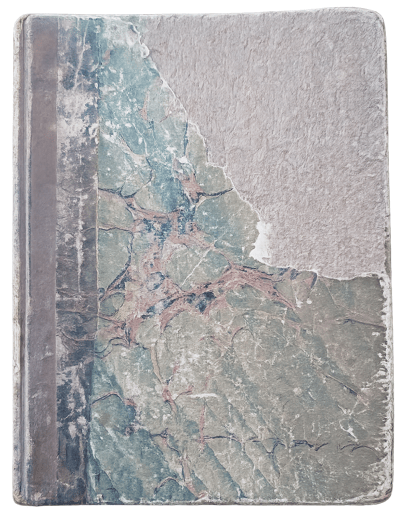
The original St. Clair Guards Roll Book, preserved today among the collections of the Andrew Carnegie Free Library & Music Hall in Carnegie, Pennsylvania, is far more than a roster. Its handwritten pages record officers and members, elections and meetings, attendance and absences, money collected and fines imposed, uniforms and musicians, resignations and expulsions, musters and agreements. It preserves the ordinary administrative work through which a voluntary militia company sustained itself for years before the crisis of 1861 transformed familiar military ritual into preparation for actual war.
Read beside Holland’s Memoir of Thomas Espy, introduced in the previous installment, the Roll Book allows two different forms of evidence to speak to one another. Holland remembered the people, appearance, excitement, and personal relationships surrounding the militia of his youth. The Roll Book records the structure beneath those memories: the rules, obligations, decisions, and repeated acts of participation that allowed the company to endure.
Together, they allow us to follow Holland across a remarkable transformation—from a small boy marching at the head of a local parade to a twenty-three-year-old man determined, if circumstances allowed, to enter the Union Army beside the company he had known for most of his life.
Before the St. Clair Guards
Holland remembered the story beginning around 1841 or 1842, when a militia company was organized in the small community of Sodom. Even in his later recollection, some details had become uncertain. He remembered the name as the Cherokee Guards, although he acknowledged that the organization may instead have been called the “tribe.”
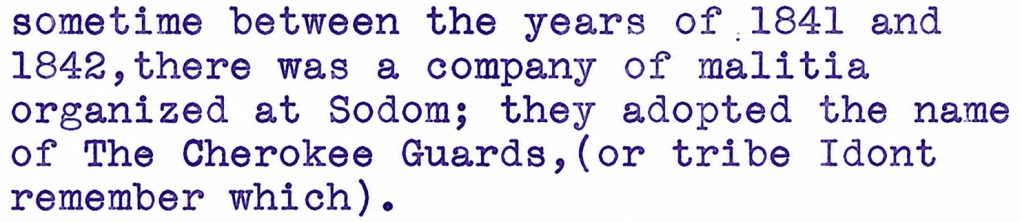
That uncertainty is understandable. Holland was remembering events from early childhood after the passage of many decades. The broader outline of the organization, however, remained clear in his memory.
The company was initially commanded by John Fife, a local man who had attained the militia rank of major, while Thomas Espy served as first lieutenant. Holland recalled that Fife remained in command for roughly a year before resigning, after which Espy assumed leadership of the company.
The company’s appearance remained especially vivid.
The Cherokee Guards did not wear the conventional military clothing that later generations would associate with Civil War soldiers. Holland remembered long yellow flannel hunting shirts trimmed with black fringe, red leggings, skull caps, and moccasins. Belts carried tomahawks and knives, while the men appeared with bows and arrows as well as some rifles.
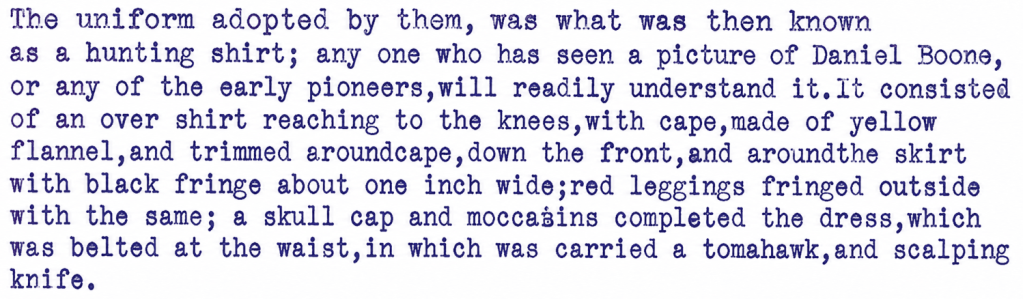
For a child growing up in rural Allegheny County, such a company must have made military life unusually visible. Its members were not distant soldiers encountered through newspapers or stories. They were men from the surrounding community, dressed for parade and drill along familiar roads, commanded by officers Holland knew personally.
A militia parade was therefore more than military exercise. It was a public event. Uniforms, weapons, music, formations, and commands drew the company into view before families and neighbors, turning military organization into part of the social life of the community.
Holland entered that world remarkably young. At approximately five years old, he later recalled, he “became a member of the company as pioneer.”
His language requires some care. A child of five was obviously not a militiaman in the legal or practical sense in which the adult members were. Holland himself would later distinguish this childhood association from his formal muster into the company years afterward. His role as Pioneer was ceremonial, placing him at the head of the column during public appearances rather than subjecting him to the full obligations of militia service.
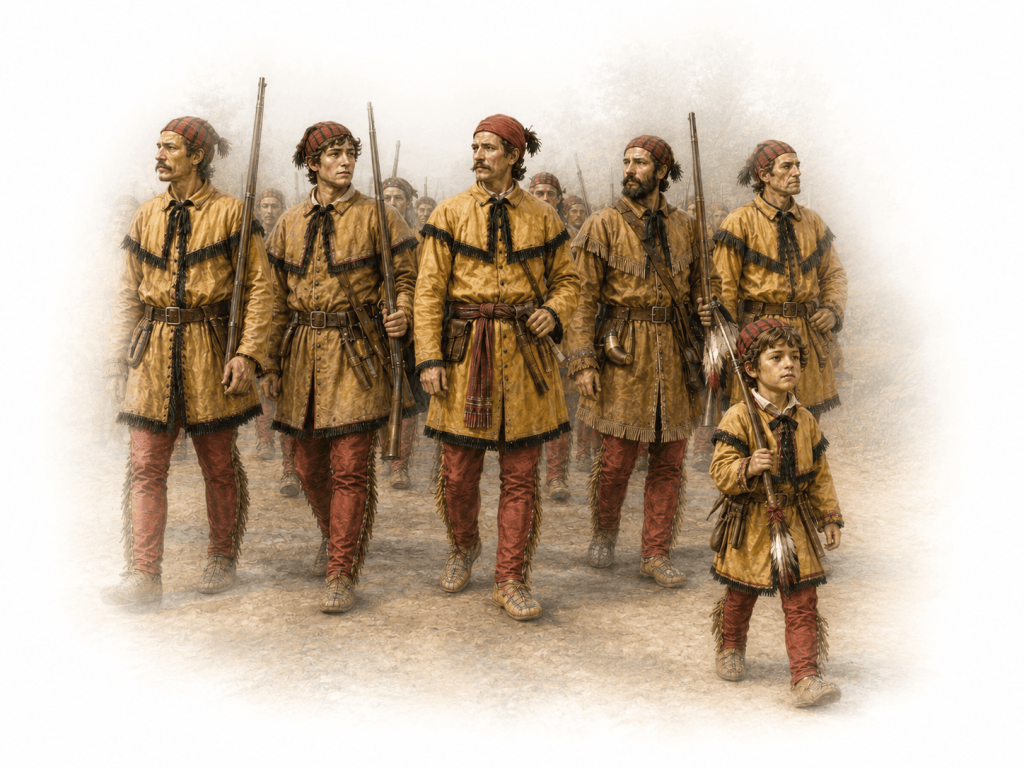
Even so, the experience placed military culture inside Holland’s world almost from the beginning. The company’s officers, uniforms, drills, public appearances, and habits of organization were familiar to him years before he was old enough to enter its ranks formally. Thomas Espy, already part of Holland’s everyday childhood through the neighboring mill and family relationship, also became part of his earliest understanding of military leadership.
The Civil War did not introduce Enoch Holland to the idea of military belonging.
It would instead transform something already deeply familiar.
A Company Reborn
The Cherokee Guards did not survive in their original form.
According to Holland’s later recollection, the company was eventually inspected by a state military official who was favorably impressed with the men but refused to issue arms unless they adopted regulation uniforms.
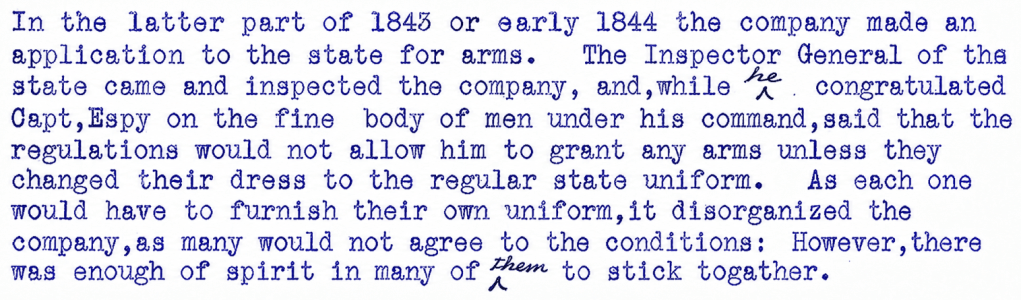
The requirement presented a practical difficulty. Members were responsible for furnishing their own clothing, and abandoning the company’s distinctive frontier-style dress meant paying for an entirely new uniform.
Enough men were unwilling or unable to bear the additional expense that the organization disbanded.
The episode reveals one of the realities hidden beneath the spectacle of antebellum militia service. A volunteer company could not live by enthusiasm alone. Uniforms had to be purchased. Equipment had to be obtained and maintained. Meetings and musters consumed time. Officers had to be elected, money collected, rules enforced, and members persuaded to continue accepting obligations for which there was no certainty of war.
A company endured only so long as enough men were willing to sustain it.
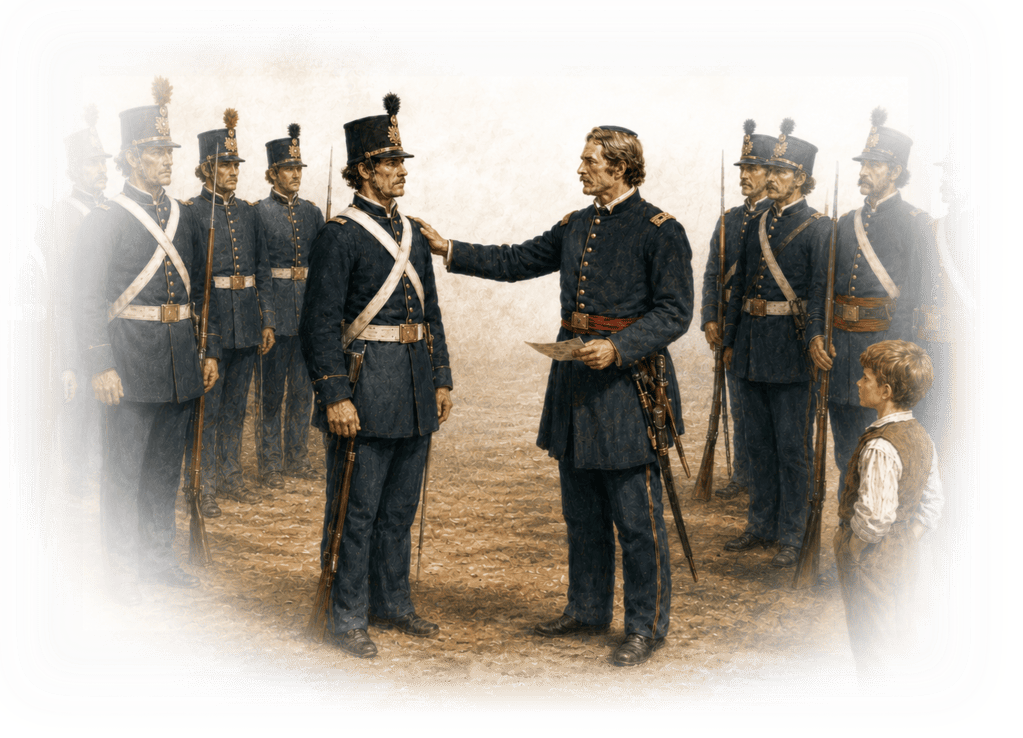
The collapse of the Cherokee Guards did not end the local militia tradition. A core of the old organization remained, and on July 4, 1844, the company reorganized under a new name: the St. Clair Guards. Thomas Espy was elected captain.

The Roll Book begins at this moment of renewal.
One of its earliest entries connects the new company directly to the Holland family. The first recorded muster of the reorganized St. Clair Guards took place on property belonging to Amos Holland, Enoch’s father.
The setting joins the militia to the landscape already familiar from Holland’s childhood. Amos Holland’s tavern, the Holland household, Thomas Espy’s nearby home and mill, the wagon road, neighboring farms, and the families of Sodom were not simply scenery surrounding the company. They were the community from which it drew men, resources, spectators, officers, and identity.
For young Enoch, there would have been no sharp boundary between the geography of ordinary life and the geography of the militia. The same roads and properties along which he knew family, neighbors, travelers, and work also became the places where uniformed men gathered, officers gave commands, and the St. Clair Guards took institutional form.
He was six years old when the company reorganized.
What Survives in the Roll Book
The St. Clair Guards Roll Book is valuable precisely because most of what it records is not dramatic.
Military organizations are easily remembered through battles, commanders, mobilizations, and moments of crisis. Because the St. Clair Guards eventually became entangled with the Civil War, it is tempting to look backward from 1861 and treat everything that came before as preparation for that larger event.
The Roll Book resists that simplification.
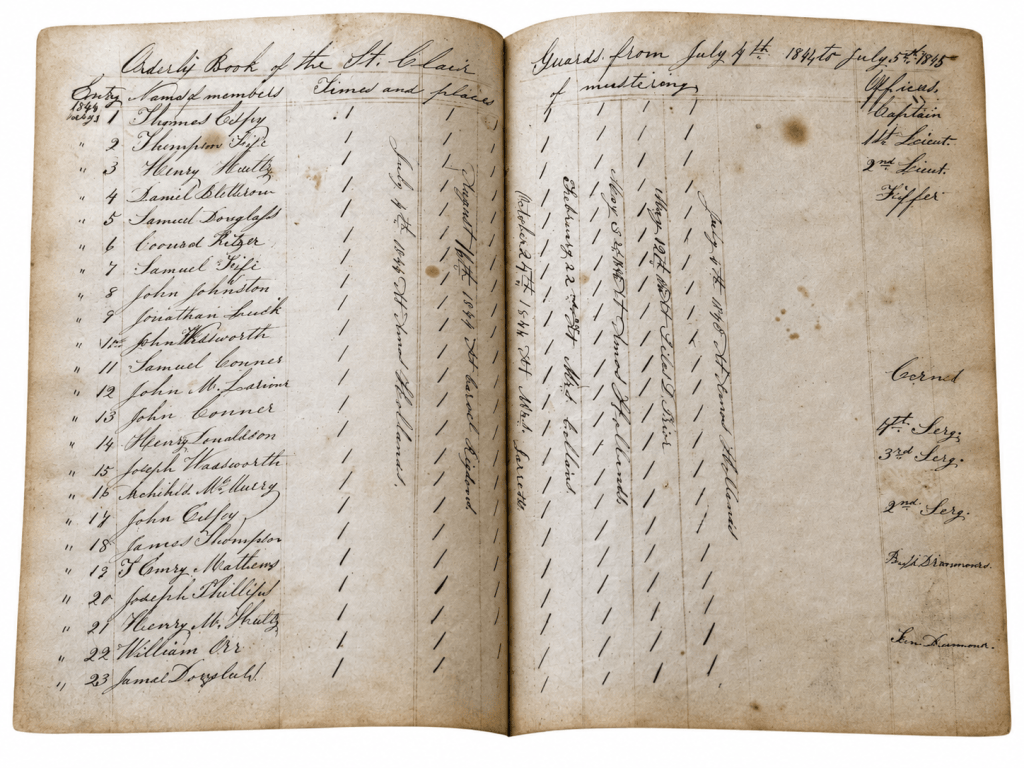
Its pages preserve the routine work of keeping a voluntary company alive. Officers were elected and members enrolled. Meetings were called and attendance recorded. Money changed hands. Uniform requirements were debated or regulated. Fines were imposed. Men resigned, were expelled, or were sometimes “voted out.” Rank carried responsibilities and, in some instances, different financial obligations. Agreements had to be written down because voluntary service still depended upon clearly understood expectations.
The surviving record therefore reveals the St. Clair Guards as both military and civic. Its members drilled and paraded, but they also governed themselves. They chose leaders, created rules, collected funds, disciplined members, and decided what continued membership required.
Voluntary did not mean casual.
Men who entered the company were expected to appear when obligated, contribute financially when required, follow rules, maintain suitable clothing, and submit to the authority of officers whom the membership itself had chosen. Public parades made the organization visible, but the Roll Book preserves the quieter institutional work that made those appearances possible.
It also shows that the St. Clair Guards were never one fixed group of men proceeding unchanged from 1844 toward the Civil War. Membership shifted continually. Some names appear and later disappear. Men resigned, were removed, or returned. Initials and spellings vary across the record, complicating modern attempts to identify individuals with certainty.
That fluidity becomes important when the company’s story reaches 1861. A name appearing in the antebellum Roll Book does not prove that the man remained an active member every year afterward, nor does membership in the St. Clair Guards establish that he ultimately entered federal service with Thomas Espy. Some did. Others followed different military paths. Some may not have served in the Civil War at all.
Holland himself would become one of the clearest examples of how militia affiliation and wartime enlistment could diverge.
The contrast between the Roll Book and Holland’s later Memoir is especially useful. His recollection preserves what institutional minutes cannot: distinctive uniforms, childhood impressions, personalities, crowds, excitement, and the emotional meaning he attached to people and events long afterward. The Roll Book preserves what memory alone cannot supply with equal reliability: dated musters, membership entries, elections, agreements, financial obligations, and the changing administrative life of the company.
One source preserves how the militia was remembered. The other records how it functioned.
Read together, they restore something closer to the institution Holland actually knew.
From Pioneer to Member
Holland later took care to distinguish his childhood association with the militia from the point at which he became a formal member.
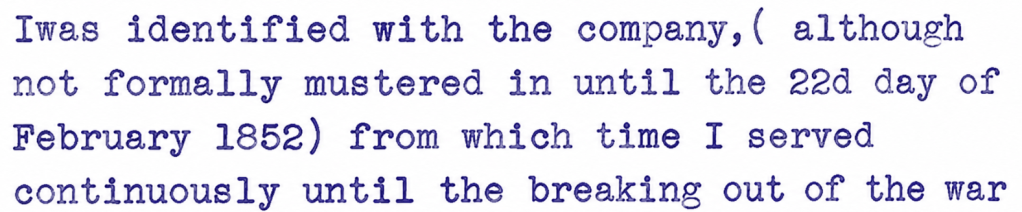
Although he had long been “identified with the company,” he remembered that he was not “formally mustered” into the St. Clair Guards until February 22, 1852.
He was thirteen years old and would turn fourteen that spring.
By then, the St. Clair Guards had existed under that name for more than seven years. Thomas Espy was long established as its captain, and Holland had spent most of his remembered childhood watching the company gather and parade within the same landscape in which his family lived and worked.
The February 1852 entry therefore marks a genuine change in Holland’s relationship to the organization. The child who had marched ceremonially as Pioneer now entered its formal record as a Member.
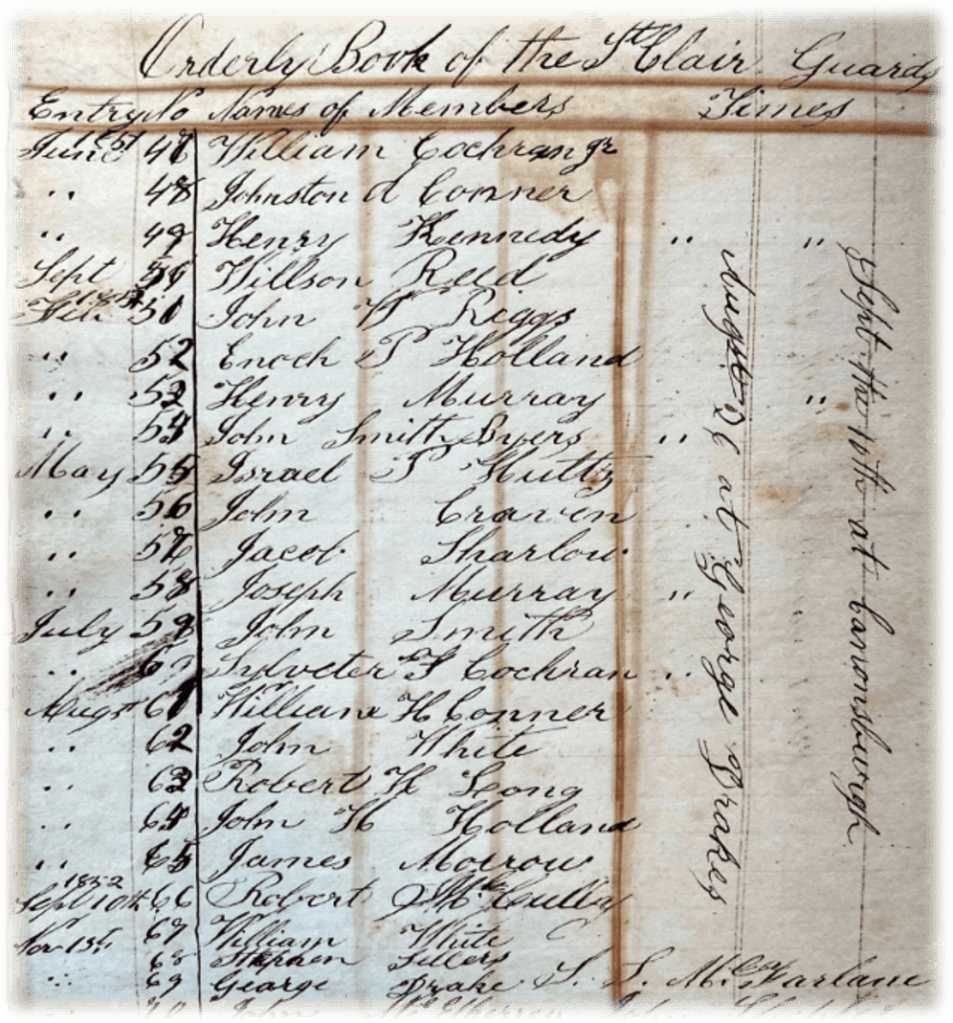
Later descriptions of Holland as one of the company’s earliest members should be understood through this longer association. His connection to the militia reached back to childhood, but his own recollection places his formal muster years after the reorganization of 1844.
The distinction strengthens rather than diminishes the continuity of his experience. Holland did not simply join a militia company as an adolescent. He formally entered an institution whose people, rituals, and officers had already surrounded him for years.
The Roll Book records another stage in that commitment on June 15, 1854.
On that date, Holland’s name appeared beneath an Article of Agreement signed by members who had already served some or all of the militia duty required of them by law but voluntarily pledged themselves to another five-year term with the St. Clair Guards.
The agreement was specific about what that obligation meant. Members were required to parade only four days each year—two in the spring and two in the fall. Additional parades were voluntary, and failure to attend them could not result in a fine. The company also agreed upon a new style of military cap.
In all of this, Holland was sixteen years old.
His signature beneath the agreement is more revealing than a simple roster entry. It shows a young man who was not merely remaining in the company by inertia, but placing his name beneath a written commitment to continue serving within it.
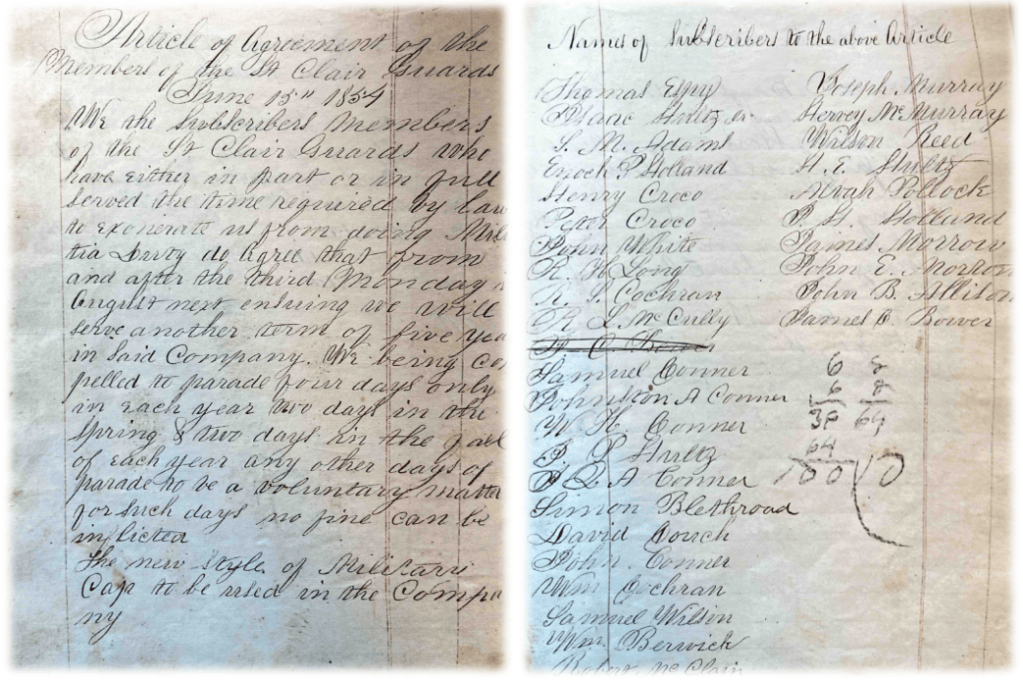
The terms of the agreement also illuminate what militia service demanded. Four required parade days in a year may appear modest beside the continuous obligations of Civil War service, but the commitment was meant to extend across five years. It bound military participation to the rhythms of civilian life—to work, family, farming, travel, and community obligation—rather than replacing them.
For Holland, the St. Clair Guards became one of the enduring structures of adolescence and early adulthood. He had first known the company through childhood pageantry. By 1852 his membership was formal. By 1854 he had voluntarily renewed the obligation.
The company had grown with him.
By the later 1850s, it had become an established institution in the landscape Holland knew. Its men gathered and drilled in the same community where they lived and worked, and Thomas Espy remained closely associated with its leadership.
For years, that military culture existed within the boundaries of ordinary civilian life.
Then came April 1861.
When the World Changed
The bombardment and surrender of Fort Sumter transformed a mounting national crisis into open rebellion. On April 15, 1861, President Abraham Lincoln called for 75,000 militia to suppress the insurrection.
In Holland’s recollection, the effect upon Sodom was immediate.
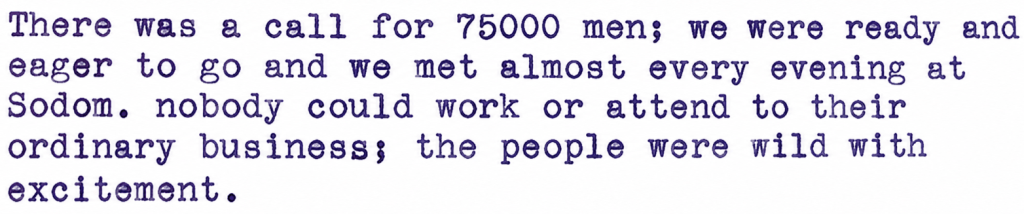
Meetings followed night after night. News arriving from Pittsburgh carried the national crisis into a community whose men had spent years drilling under circumstances in which actual war had remained distant. The familiar rituals of militia life now acquired an urgency they had never possessed before.
At the center of Holland’s memory was the same man who had stood near the beginning of the story.
Thomas Espy.
Holland remembered Espy returning from Pittsburgh on horseback and arriving at his mill, where a large crowd had gathered. Decades later, Holland estimated that perhaps four hundred people were present. The number is a retrospective estimate rather than a contemporary count, but the scale of the gathering remained part of how Holland remembered the moment.
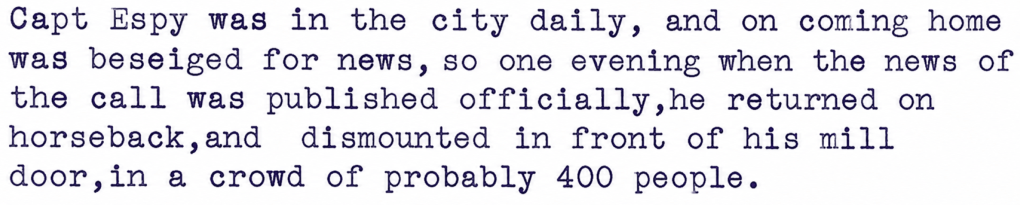
The location joined national crisis to Holland’s most familiar surroundings. This was Thomas Espy’s mill—the working place of the neighbor Holland had known since childhood, only a short distance from the home of his own family.
Now the mill became a place of wartime mobilization.
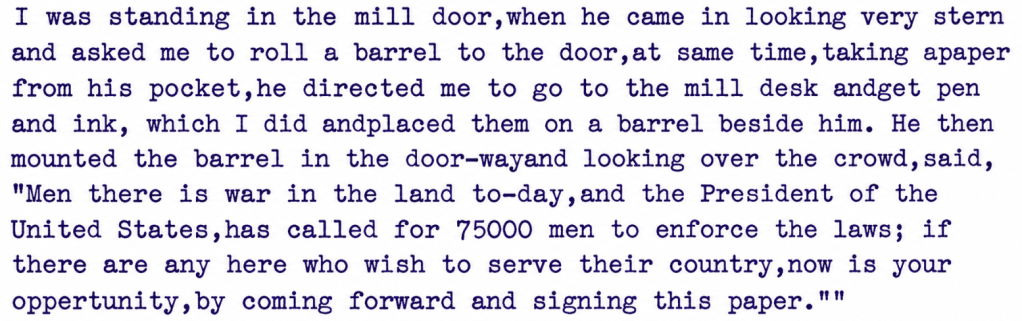
Holland remembered his own small role in what followed. He moved a barrel into position, gathered writing materials, and handed Espy the pen and ink. When men were called forward to volunteer, Holland added his own name.

The scene was built from ordinary things—a barrel, a desk, paper, pen, and ink. Yet in that moment, the familiar rituals of local militia life gave way to something far more serious.
The men were no longer gathering to fulfill an annual parade obligation. They were volunteering for war.
For Holland, the moment joined nearly every strand of his early life. Thomas Espy was there. The local militia was there. The landscape of Sodom was there. So were men from the community with whom Holland had grown up.
It must have seemed entirely natural that, if he entered the war, he would enter it with them.
The Union Army would prove more complicated.
“My Old Company”
The St. Clair Guards traveled to Pittsburgh expecting to enter military service, but local enthusiasm had outrun the federal government’s ability—or willingness—to accept every company being raised.
Holland remembered Pittsburgh already crowded with soldiers and prospective volunteers. Lodging was difficult to obtain. For several nights, officers of steamboats along the river wharf allowed the men to sleep aboard their vessels while they waited to discover whether the company would be accepted.
Then came the answer.
The district quota was already full. The St. Clair Guards were turned away.
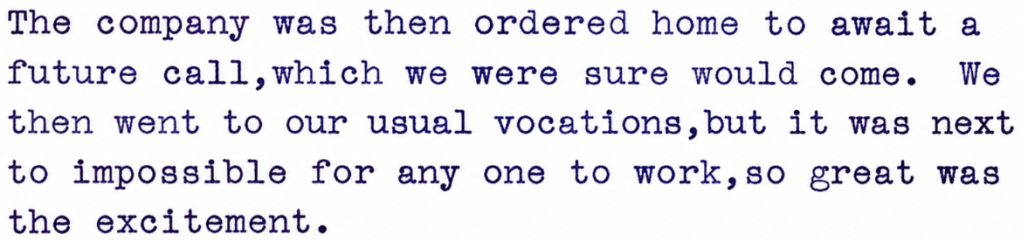
For Holland, the rejection revealed the distance between the militia world he knew and the machinery of wartime mobilization into which he was trying to enter. A local community could organize men, elect officers, drill them, march them into Pittsburgh, and offer their service. None of those things guaranteed that the government would have a place ready for them.
Quotas, timing, organization, and official authority now determined what local enthusiasm alone could not.
Even after the company returned home, Holland continued trying to remain with it.
While spending time around another Pittsburgh organization, Company B of the Duquesne Greys, men he knew encouraged him to enlist with them. Holland declined because he still expected another opportunity for the St. Clair Guards.
His explanation was simple:
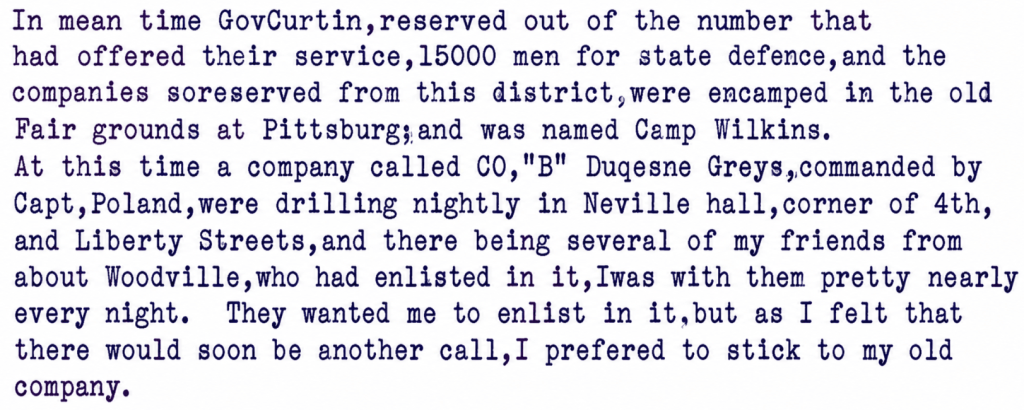
“I prefered [sic] to stick to my old company.”
The phrase is more revealing when read against the years that preceded it.
“My old company” meant Thomas Espy and the men Holland had watched since childhood. It meant the Cherokee Guards and the child Pioneer marching at the head of the column. It meant the reorganization of 1844, musters on his father’s property, formal membership in 1852, and his own signature beneath the five-year agreement of 1854. It meant a military institution whose history overlapped with nearly the whole of his remembered youth.
Holland was not merely choosing one prospective Army unit over another. He was trying to preserve an older belonging inside the new reality of war.
For a time, he waited. Eventually, circumstances made that impossible.
When Loyalty Was No Longer Enough
The failure of the first mobilization did not end Thomas Espy’s effort to enter service. The St. Clair Guards eventually entered Civil War service under Espy as Company H of the 62nd Pennsylvania Volunteers.
Holland did not go with them.
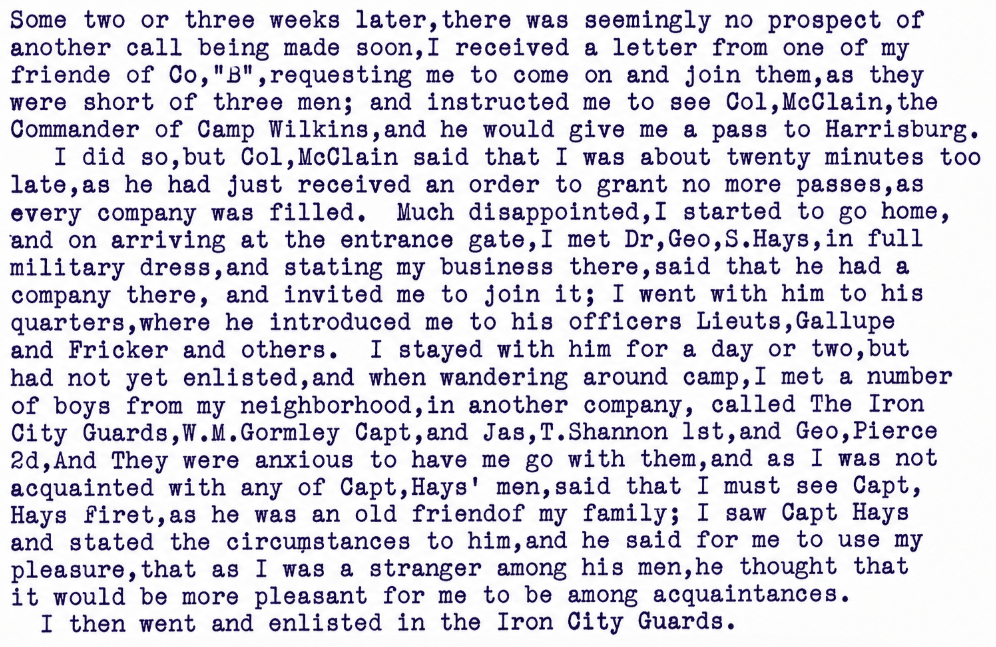
His Memoir preserves the complicated route by which he eventually found another place. After waiting for the expected opportunity with his old company, Holland again tried to reach men he knew in the Duquesne Greys, only to arrive at Camp Wilkins shortly after an order had stopped the issuing of passes because the companies were already full. He then encountered Dr. George S. Hays, an old family acquaintance who offered him a place in another organization.
While moving through the camp, Holland met neighborhood men serving in the Iron City Guards under Captain W. M. Gormley. They wanted him to join them. Holland told Hays that the Iron City Guards contained men he already knew, and Hays reportedly agreed that serving among acquaintances would likely be more pleasant than remaining among strangers.
Holland therefore joined the Iron City Guards.
The company became Company C of the 9th Pennsylvania Reserves, also designated the 38th Pennsylvania Volunteers.
The decision marked one of the first major divergences between Holland’s childhood world and his adult military life.
Antebellum militia membership did not translate neatly into Civil War enlistment. The rush to raise troops, the filling of quotas, shifting calls for volunteers, the organization of new regiments, and the availability of places within individual companies scattered men who had once drilled together. Some St. Clair Guards followed Espy. Holland entered another regiment. Other former members may have followed still different paths.
The Roll Book warns us against imagining the antebellum company as a Civil War roster waiting for 1861 to arrive. What it preserves is a changing local institution whose members passed into wartime service according to circumstances that could not have been foreseen when they first signed their names.
Holland’s enlistment with the Iron City Guards therefore cannot be read as abandonment of the St. Clair Guards. His own recollection shows how hard he had tried to remain with them. He left only when loyalty could no longer determine opportunity.
The separation became permanent.
Thomas Espy entered the war with Company H of the 62nd Pennsylvania Volunteers. Holland entered it with Company C of the 9th Pennsylvania Reserves. Their military paths, divided in Pittsburgh, would one day bring both men into the same far more terrible setting.
For now, however, the separation was complete. The company that had shaped Holland’s youth went forward under Espy, while Holland entered the war through another regiment. What endured was the older relationship: the child who had known Thomas as a neighbor, the young militiaman who had served under him, and the veteran who decades afterward would write down what he remembered of Espy and the company they had once shared.
Holland’s wartime separation from the St. Clair Guards did not end their place in his life. He would later join a Grand Army of the Republic post bearing Espy’s name, and the old militia company would continue to surface in his memories and veteran associations long after the men themselves had grown old.
The Roll Book, too, would eventually return to Holland’s story. Its later history, however, belongs elsewhere in this Series.
Before He Became a Soldier
The Civil War would expose Holland to a scale and form of military life unlike anything the St. Clair Guards could have provided.
The Union Army would carry him hundreds of miles from western Pennsylvania and place him inside enormous camps, sustained marches, battlefield movements, military bureaucracy, recruiting systems, regimental mail, headquarters administration, illness, danger, and the recurring possibility of death. His duties would change repeatedly, and the meaning of military service would change with them.
Yet Holland did not enter that world entirely without preparation.
Before a federal muster roll recorded his name, it had already appeared in a militia roll kept close to home. Before Army officers exercised authority over him, he had watched local officers elected and obeyed. Before war made attendance, hierarchy, uniform, discipline, and written obligation matters of national consequence, he had encountered each of them within the St. Clair Guards.
The difference between militia parade and Civil War service should not be minimized. Nothing in the St. Clair Guards could reproduce what Holland would experience in Virginia, Maryland, or Pennsylvania once armies began fighting. Antebellum militia culture did not prepare a man for artillery fire, battlefield casualties, prolonged campaigning, or the vast administrative machinery of the Union war effort.
What the Guards had given Holland was something more elemental: a familiar structure for military belonging.
For nearly eighteen years, from the child Pioneer at the head of a parade to the young man trying to find his way into the Union ranks, the company had remained woven through his understanding of community, loyalty, discipline, and obligation. That is why the language Holland used in 1861 deserves to be taken seriously.
He did not say that the St. Clair Guards offered better prospects, greater prestige, or a preferable military assignment. He simply called them “my old company.”
By May 1861, circumstances had finally separated Holland from the men he had hoped to follow. The roads, properties, officers, and rituals that had given military service a local and familiar shape were about to give way to something larger and far less predictable.
For the first time in his life, Enoch P. Holland was about to discover what military service meant beyond the roads of home.
And with that, his war began.
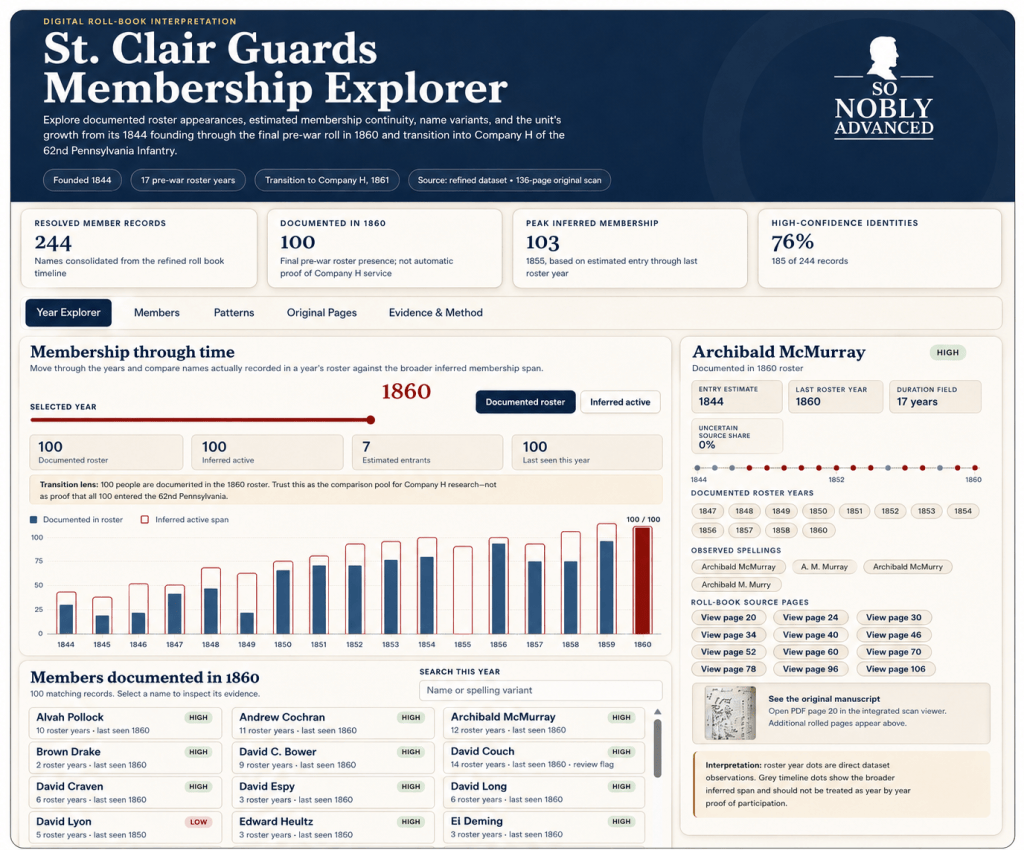
The St. Clair Guards Roll book
As part of this project, So Nobly Advanced is proudly making available a complete digital scan of the St. Clair Guards Roll Book.
To our knowledge, this marks the first time the document has been digitized and made publicly available on the internet.
In addition to this digital release, we are pleased to provide a full transcription of the St. Clair Guards Roll Book, together with an interactive web application that allows readers to examine the volume and explore the company’s surviving membership records in greater detail.
We hope these resources will prove useful not only to readers following the E. P. Holland series, but also to local historians, genealogists, Civil War researchers, and others investigating the people, families, communities, and military institutions of nineteenth-century western Pennsylvania.
Links:
Sources:
- Holland, Enoch P. “Memoir of Capt. Espy by Comrade E. P. Holland.” Undated typescript. Captain Thomas Espy Post No. 153 of the Grand Army of the Republic Collection, Andrew Carnegie Free Library & Music Hall, Carnegie, Pennsylvania, Box 1, Folder 14. Original archival scan and project transcription.
- St. Clair Guards Roll Book. Original handwritten militia volume, organized beginning July 4, 1844. Captain Thomas Espy Post No. 153 of the Grand Army of the Republic Collection, Andrew Carnegie Free Library & Music Hall, Carnegie, Pennsylvania. Digitized by So Nobly Advanced, 2026.
- Captain Thomas Espy Post No. 153, G.A.R. Catalogue of Relics, 1911, Item 174. Andrew Carnegie Free Library & Music Hall, Carnegie, Pennsylvania.
- Compiled Military Service Record of Enoch P. Holland, Company C, 9th Pennsylvania Reserves / 38th Pennsylvania Volunteers. National Archives and Records Administration.
- Lincoln, Abraham. Proclamation calling forth the militia, April 15, 1861.
- Pennsylvania military records relating to Thomas Espy and Company H, 62nd Pennsylvania Volunteers.
 So Nobly Advanced
Leave a comment