
Part of Series: E. P. Holland – The Veteran Who Kept the Record
The first official record of Enoch P. Holland’s war preserves none of the difficulty with which he had reached it.
On May 1, 1861, a military clerk recorded that Holland had enrolled at Pittsburgh for a term of three years. The entry is spare: a name, a date, a place, a period of service. It says nothing of the St. Clair Guards being turned away after the district quota had already been filled, nothing of Holland’s determination to remain with the company he had known since childhood, and nothing of the other opportunities that opened and closed before he finally found a place in the Union Army.
Those experiences belonged to the uncertain human process by which a civilian volunteer became a soldier. The Army needed only the result.
Holland had first spent time around Company B of the Duquesne Greys, where acquaintances encouraged him to join them. He declined because he still expected another opportunity to serve with the St. Clair Guards, explaining later that he had preferred to “stick to my old company.” When that opportunity did not materialize, a friend urged him to join the Greys at Harrisburg, but Holland reached Camp Wilkins shortly after an order stopped the issuance of passes because the companies were already full. He next encountered Dr. George S. Hays, an old family acquaintance who offered him a place in another company. While there, Holland met neighborhood men serving in the Iron City Guards under Captain W. M. Gormley. They wanted him among them, and Holland decided that serving beside men he already knew was preferable to remaining a stranger in another organization.
The Iron City Guards became Company C of the 9th Pennsylvania Reserves, also designated the 38th Pennsylvania Volunteers.
One of the men entering that new military world with Holland was already his friend.
During the winter of 1860–1861, Holland and Robert Taggart had both been teaching school in the Bridgeville district. Taggart later remembered that frequent meetings had developed into a close friendship, and Holland had introduced him to Harriet Nixon, the young woman whose life would eventually become inseparable from his own. When war came, Taggart and Holland entered the Iron City Guards together.
Their paths would remain intertwined even as their responsibilities changed. Taggart rose through the regiment and by the summer of 1862 was serving as acting adjutant, placing him in a position to observe movements, assignments, casualties, and the daily administration of the command. More importantly for recovering Holland’s experience, Taggart wrote home throughout the war and kept a diary during 1862.
No comparable body of wartime correspondence written by Holland is presently known to survive.
His official service record therefore supplies the structure of his military life. Compiled from original Army rolls, it is strongest when recording rank, presence or absence, special assignments, and the dates on which those assignments were reported. It was never intended to preserve what Holland thought as he marched, what he saw from a battlefield, whom he spoke with in camp, or how the war felt to him.
Taggart’s diary and letters occasionally open that administrative structure from within.
Together, these records allow us to follow Holland farther than any could alone.
Into the Pennsylvania Reserves
The 9th Pennsylvania Reserves formally organized in western Pennsylvania during the first summer of the war. Holland’s record places his enrollment at Camp Wilkins in Pittsburgh on May 1, and the regiment subsequently organized at Camp Wright before being ordered east.
On July 22, 1861, the regiment departed for the capital of a nation already fractured by war. Five days later, on July 27, at Camp Jackson near Washington, D.C., Holland was formally mustered into United States service. He was twenty-three years old.
His rank was recorded as Musician.
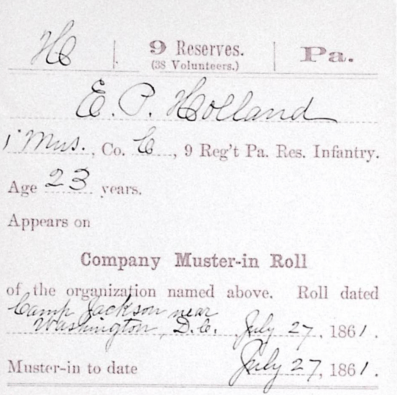
Nothing in Holland’s surviving military record identifies the instrument he played. Later evidence documents him as an accomplished violinist and string-band leader, while the Capt. Thomas Espy Post later appointed him Drum Major, a leadership position associated with the Post’s drum corps. Neither affirmatively establishes his instrument during the Civil War. The Army records identify him only as a ‘musician’, and until a contemporary source specifies otherwise, the instrument he played in Company C must remain unknown.
The title should not be mistaken for a life apart from the regiment. Musicians belonged to the functioning military organization. They shared its camps and movements, followed its marches, and remained subject to the uncertainty surrounding an infantry command in the field. What additional duties Holland may have performed during this early period are not recorded, and later evidence cautions against imagining his role as exclusively musical.
After federal muster, the regiment remained for a time near Capitol Hill, then moved to Tennallytown, Maryland, in early August. In September it undertook picket duty around Great Falls. Holland’s earliest company rolls identify him as a musician but do not affirmatively state whether he was present or absent on every date, so his exact participation in the Great Falls movement cannot be proved from his individual cards. There is, however, no documented detachment or other reason to place him elsewhere.
The same caution helps separate Holland’s probable experience from a simple regimental chronology. A November reconnaissance toward Hunter’s Mills, for example, specifically involved Companies A, B, D, F, and G rather than Holland’s Company C. An expedition toward Gunnell’s Farm in December has no similar company restriction and is therefore more plausibly part of his experience.
The pattern already emerging would define much of Holland’s war: the regiment’s movements provide the larger geography, but his own biography must be recovered from the points where those movements meet evidence specific to him.
In October, the regiment crossed into Virginia and established Camp Pierpont near Langley. Here Robert Taggart’s correspondence begins to reveal the texture of the life surrounding Holland.
The First Winter in Virginia
Taggart wrote from Camp Pierpont on October 11, 1861, shortly after the regiment arrived. The men had been marched into a field with little preparation for the night. Their teams had not yet caught up, rations were short, and a large stack of unthreshed oats quickly became improvised bedding.
When the owner asked that a guard be placed over the stack, Taggart remembered the adjutant replying that he would “put the regiment on it.” Before long, the stack had effectively disappeared beneath the soldiers, each man carrying away enough to soften the ground beneath him.
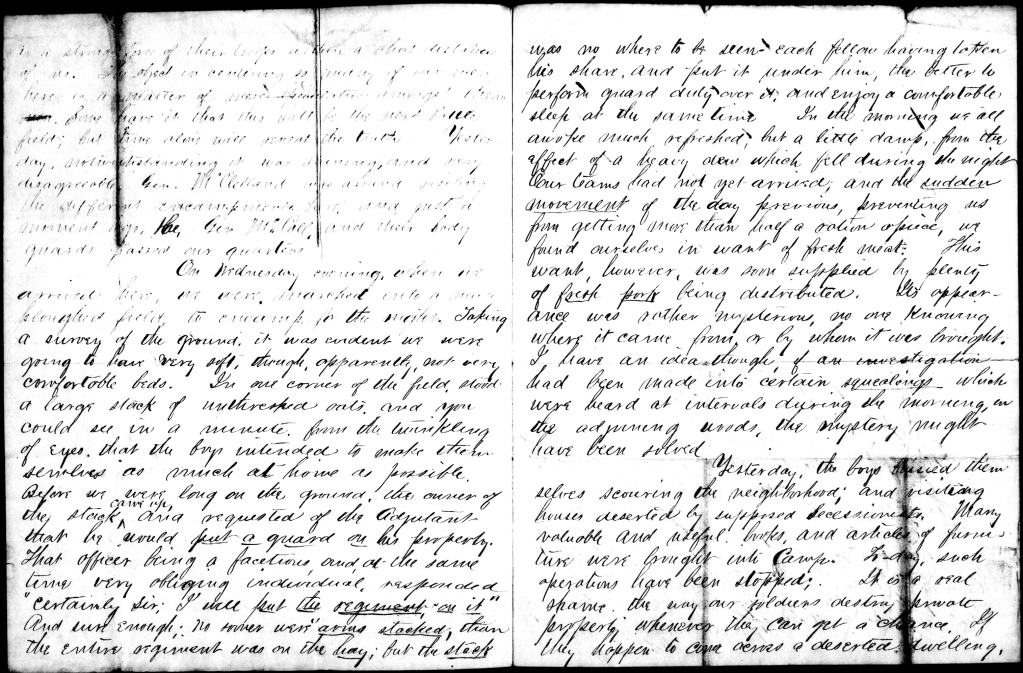
The humor of the episode sat beside less comfortable observations. Taggart described shortages, uncertain mail service, soldiers searching nearby property, and the destruction of civilian possessions. His letter captures a regiment still adapting to the realities of sustained field service: movement without warning, inadequate supplies, wet ground, uncertain communications, discipline that did not always hold, and the need to make temporary camps habitable with whatever could be found.
This was very different from the world of the St. Clair Guards. The local militia had met on known days and familiar ground, within sight of homes and families. Camp Pierpont belonged to an Army whose location could change before the mail knew where to find it.
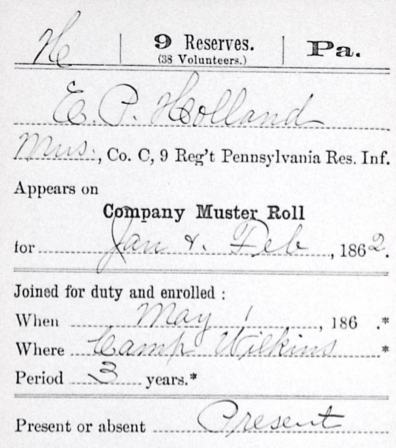
Holland would later connect this winter with the beginning of one of the physical problems that followed him after the war. In pension testimony written much later, he said that he suffered severe inflammatory rheumatism at Camp Pierpont in February 1862. His January–February muster roll marks him present, and the compiled military record contains no corresponding hospital or medical notation. At this point in the chronology, the later statement establishes where Holland himself remembered the trouble beginning; the larger question of what could eventually be proved from that claim belongs to his postwar pension history.
Before that winter was over, Holland had already passed through his first named battle.
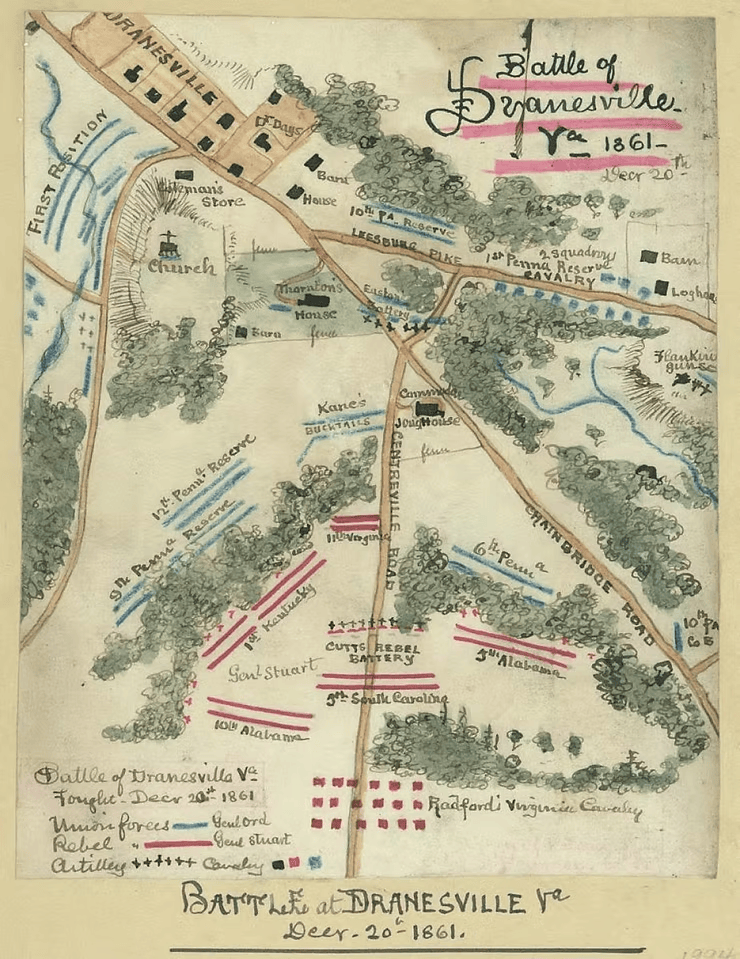
On December 20, 1861, the Pennsylvania Reserves fought at Dranesville.
Taggart wrote home the following day. “The 9th was in advance and came near being surrounded,” he reported, adding that two men in the regiment had been killed and approximately sixteen or eighteen wounded. His description was written while the battle was still immediate, not reconstructed decades afterward.
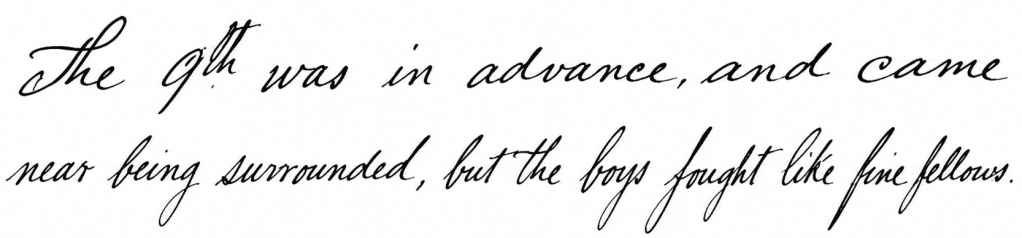
Holland later named Dranesville among the engagements of his own service. In this instance, his retrospective memory, his continuing status as a musician, the absence of any recorded detachment, and Taggart’s contemporary account all converge. The exact actions Holland performed during the fighting remain beyond the surviving record, but his presence with the regiment is strongly supported.
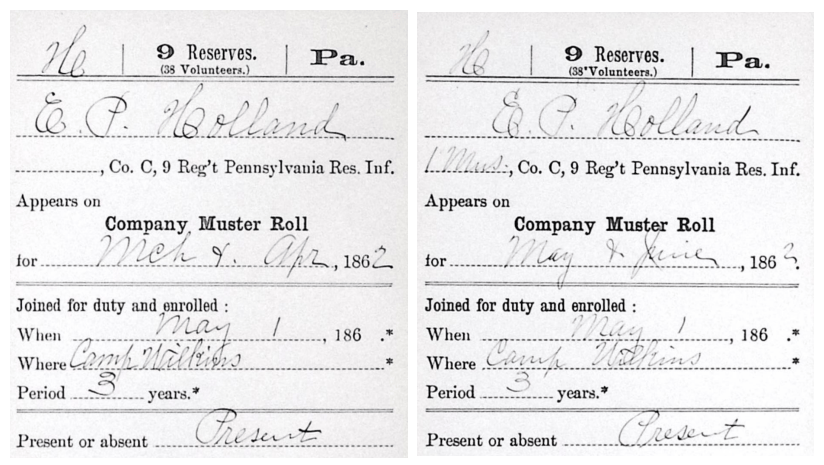
By early 1862, the Army began moving again. Holland’s muster rolls become more explicit during this period: he is carried present through the first half of the year.
In March, the regiment advanced toward Manassas. In April it participated in McDowell’s movement toward Falmouth, then remained in the Fredericksburg area while larger Union plans shifted around it. Somewhere during these movements, Holland later said another physical difficulty began. He associated a condition described in his pension papers as “piles” with service around Catlett’s Station during the spring of 1862. As with his later account of rheumatism, the wartime service record contains no corresponding hospital entry.
Military paperwork still portrayed a soldier present for duty.
By June, that soldier was moving toward the most dangerous period of his service.
Toward Richmond
On May 30, 1862, Taggart wrote from camp opposite Fredericksburg. Company and battalion drill continued despite the heat, while rumors and shifting orders left the men uncertain where they would be sent next.
The answer came in June.
The Pennsylvania Reserves were ordered toward the operations outside Richmond. Taggart’s surviving correspondence reconstructs the movement with a detail Holland’s service cards cannot provide: away from the Fredericksburg region, down the Rappahannock, aboard steamers, then toward White House Landing and the Richmond & West Point Railroad corridor.
By June 22–24, the regiment had moved to within approximately a mile of Mechanicsville and only a few miles from Richmond. The relative quiet of the spring camps had disappeared. Taggart described enemy artillery within range, the sound of firing nearby, repeated alarms, and the regiment forming line of battle again and again as the men waited for the larger fighting that everyone expected.
On June 23, Confederate pickets fired upon Union troops near a bridge. Taggart recorded that Companies C and G were sent forward as skirmishers.
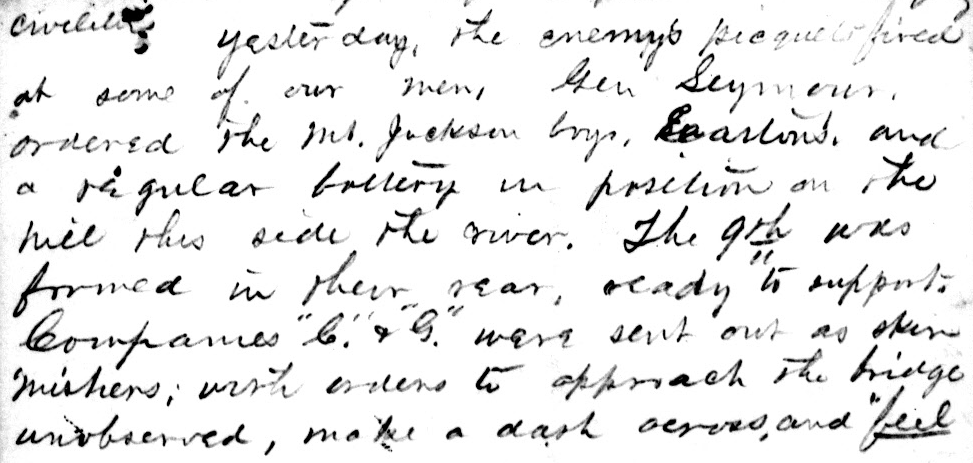
Because the order involved Holland’s own Company C, and because his May–June muster roll explicitly carries him present, it brings us considerably closer to his immediate military circumstances than a general account of the regiment alone. It does not establish that Holland himself occupied the skirmish line at the bridge; individual soldiers could be absent from a particular company movement for duties not preserved in the surviving record. But it does place the company to which he belonged directly into the developing contact with the enemy only days before the Seven Days Battles.
For the child who had once marched ceremonially at the head of the Cherokee Guards, the meaning of military service had changed almost beyond recognition. The militia exercises of his youth had taught structure, obedience, uniformity, and belonging. They could not have reproduced an infantry command repeatedly forming for battle within range of enemy guns.
Taggart’s letter ends just before the violence increased.
Holland’s own later record carries us through what followed.
Through the Seven Days
Holland’s later G.A.R. Personal War Sketch names a sequence of engagements during the Seven Days Battles that gives us the strongest sustained evidence of his campaign experience: Mechanicsville, Gaines’s Mill, Savage’s Station, Charles City Cross Roads, and Malvern Hill.
His official status supports the chronology. Holland was present as a musician through the May–June reporting period, and his recruiting detachment would not begin until August. His own later identification of these engagements therefore does not stand alone; it aligns with a period in which the Army itself gives no indication that he was away from the regiment.
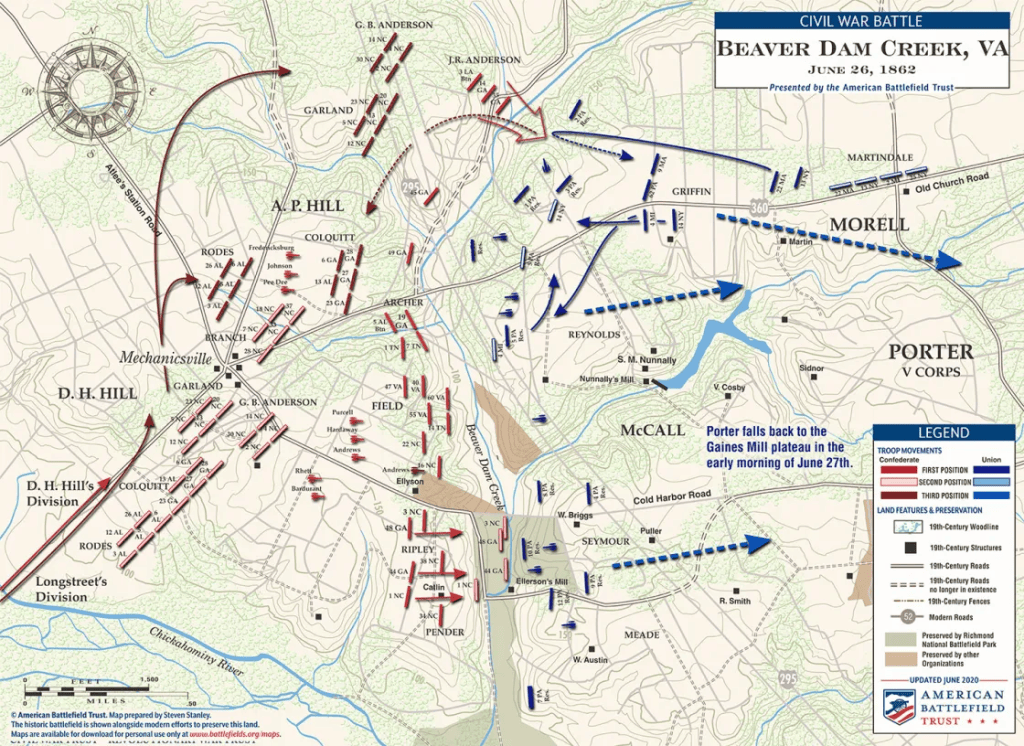
At Mechanicsville (also identified as ‘Beaver Dam Creek’) on June 26, the fighting that Taggart had expected two days earlier finally expanded. On June 27, the struggle continued at Gaines’s Mill. Three days later came Charles City Cross Roads, commonly associated with the fighting at Glendale, followed by Malvern Hill on July 1.
The entry for Savage’s Station is more difficult to interpret. Holland clearly included the name among the battles he remembered, but the surviving movement of the Pennsylvania Reserves and the exact military meaning Holland attached to the place do not align cleanly enough to reconstruct an individual action there. His memory remains evidence of how he understood the campaign without supplying a precise location that the records cannot independently confirm.
Holland himself left one sentence that prevents the word ‘musician‘ from becoming the whole story of his early service. When the G.A.R. Personal War Sketch asked about the important events of his military experience, he wrote:
“Shooting at Rebs and being shot at—and trying to keep from being hit.”
There is no attempt at heroic language in the sentence. It is almost conversational in its compression: firing, being fired upon, survival.
The War Sketch does not attach those words to Dranesville, Mechanicsville, Gettysburg, or any other specific battle, so they cannot responsibly be converted into a reconstructed scene. What they establish is Holland’s own understanding of his service. Whatever his official rank during the first half of the war, he remembered occasions when he fired upon Confederate soldiers and when Confederate fire was directed toward him.
His Memoir of Thomas Espy reveals a similar refusal to embellish his own role. Writing for fellow veterans years later, Holland joked that he had not personally “put down the rebellion,” described himself as “a mighty good sprinter,” and admitted that he had been “mighty badly scared at times.” The humor is revealing because Holland did not need to portray himself as fearless in order to claim the legitimacy of his service. Fear, running, firing, and trying not to be hit could all belong to the same veteran’s memory.
The fighting at Gaines’s Mill also brought Holland’s old and new military lives into the same battlefield.
Thomas Espy, the neighbor and militia captain Holland had tried so hard to follow into service, was there with Company H of the 62nd Pennsylvania Volunteers. Espy was wounded, taken prisoner during the battle, and died soon afterward in Confederate captivity. Holland was with the 9th Pennsylvania Reserves, serving along the different path that circumstance had forced upon him in 1861.
There is no known evidence that Holland saw Espy during the battle, witnessed his capture, or learned his fate immediately. The importance of Gaines’s Mill to Holland does not require such a meeting. Only a year earlier he had waited in Pittsburgh hoping to remain with Espy and the St. Clair Guards. Now both men had reached the same great campaign through different regiments, and only Holland would return home from it.
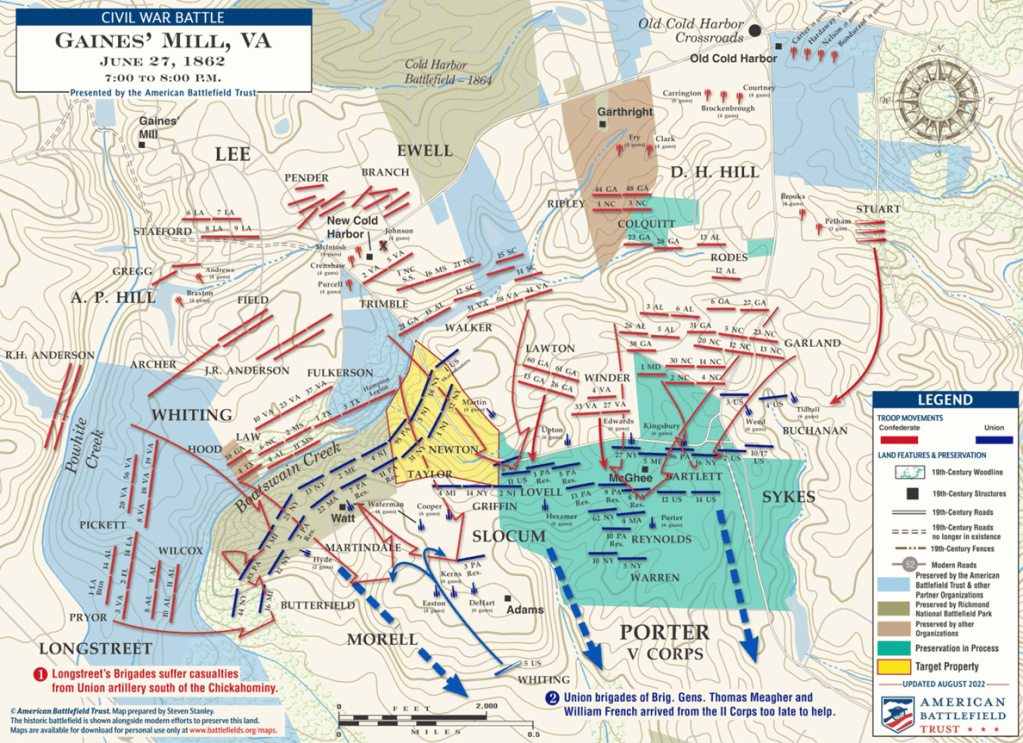
June 27 also acquired a second meaning in Holland’s later account of his health. During his pension effort decades afterward, he said that while falling back from Mechanicsville on horseback, the movement of the horse threw him against the pommel of the saddle and injured his groin. He later connected that incident with the condition for which he sought federal recognition.
Taggart’s contemporary diary does not record Holland’s accident, but it does independently confirm the military circumstances in which Holland later placed it. On June 27, Taggart recorded the regiment being ordered to fall back after other Union forces withdrew and then becoming involved in severe fighting. The diary therefore strengthens the chronology and setting of Holland’s later account without corroborating the injury itself.
No wound or hospital entry appears in Holland’s wartime service cards, and no surviving contemporary source independently documents the accident. It nevertheless belongs in the wartime chronology because this is where Holland himself placed its origin.
The campaign eventually carried the regiment to Malvern Hill and then to the relative shelter of Harrison’s Landing along the James River. By the opening days of August, the Pennsylvania Reserves had passed through months of marching and fighting that transformed the nature of their service.
Holland’s next assignment would take him away from them at exactly the moment the Army began moving toward another campaign.
Sent Back to Pittsburgh
In August 1862, Holland’s service record marks its only explicit absence.
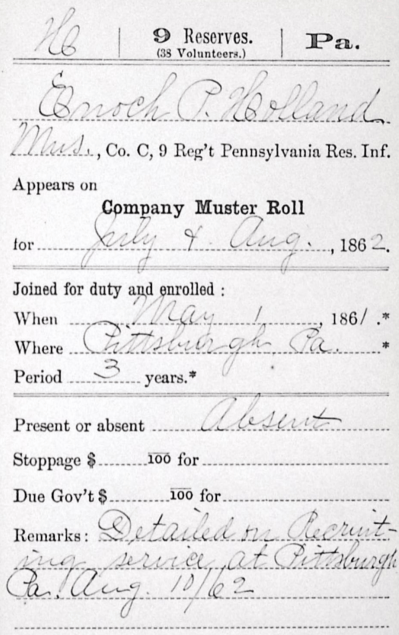
The wording explains it:
“Detached on Recruiting service at Pittsburgh Pa. Aug. 10/62.”
He was not absent through illness, desertion, capture, or leave. He had been removed from the regiment to perform another military duty.
Robert Taggart was directly involved.
By then serving as acting adjutant, Taggart recorded the assignment in his diary on August 6, 1862: “Reported names of men detailed for recruiting service. Holland from Co C & Monshour from Co E. on detail.” It is the earliest known contemporary record of Holland’s recruiting assignment.
On August 12, writing from Coggins Point, Taggart added another detail: “Holland left on Recruiting service yesterday.”
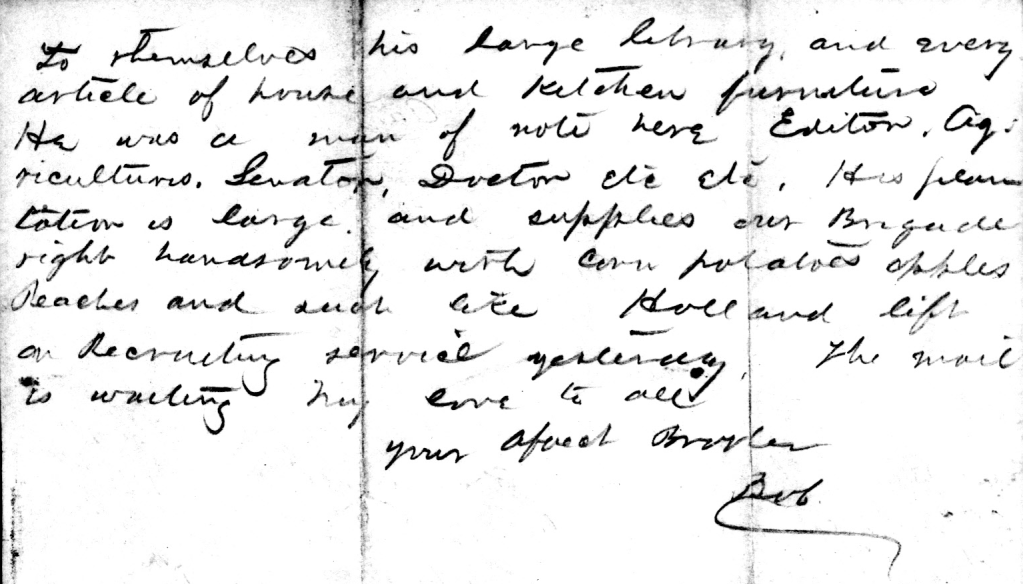
Rather than requiring the dates to be forced into agreement, the surviving records appear to preserve different stages of the same assignment: August 6 for the making or recording of the detail, August 10 as the Army’s official effective date, and August 11 as Holland’s apparent physical departure from the regiment.
For Holland, the practical consequence was much clearer. While the 9th Pennsylvania Reserves moved northward toward the Army of Virginia, he was returning to western Pennsylvania under orders.
Recruiting duty represented another part of how the Union Army sustained itself. After the losses and exhaustion of the Peninsula Campaign, regiments needed replacements, and experienced soldiers could be sent home to assist the effort. Holland’s precise daily tasks in Pittsburgh are not recorded; the surviving cards do not tell us where his recruiting station stood, whom he approached, how many men he helped enlist, or whether he spent more time speaking with prospective soldiers or handling the paperwork surrounding them.
His own enlistment experience must have given the assignment a peculiar symmetry. In 1861, Holland had moved through Pittsburgh searching for a military company that could accept him. In 1862, the Army sent him back there as part of the system seeking men for the ranks.
The detachment also separates Holland from several battles commonly associated with the 9th Pennsylvania Reserves.
He was almost certainly absent when the regiment joined the campaign against Pope and fought at Groveton and Second Bull Run in late August. His individual service record places him in Pittsburgh beginning August 10, which is stronger evidence of his location than the fact that his regiment appears on a battlefield roster.
The recovered Taggart evidence extends that absence with considerable probability through the Maryland Campaign.
Taggart remained with the regiment and wrote from near Sharpsburg on September 18, after the Pennsylvania Reserves had passed through South Mountain and Antietam. His account gives a measure of what the 9th had endured without Holland. At South Mountain, Taggart reported ten killed and thirty-four wounded. At Antietam, he reported sixteen killed and sixty-seven wounded. By the morning after the battle, only 107 men of the regiment were available for duty, and the man commanding Company C was among the dead.
Holland’s official September–October roll eventually marks him present, but it covers a broad reporting period and does not say when he returned. Taggart’s wartime diary provides the missing date: on October 25, he recorded the return of the recruiting detail and specifically named E. P. Holland among the men who had come back to the regiment. Taken together, the evidence strongly supports the conclusion that Holland remained in Pittsburgh during both South Mountain and Antietam.
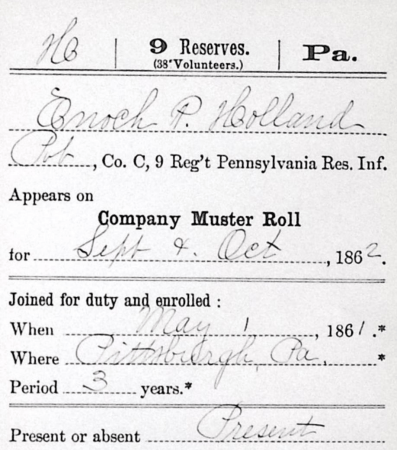
Holland’s own War Sketch fits this reconstruction. After naming the battles of the Seven Days, his list advances directly to Fredericksburg. Second Bull Run, South Mountain, and Antietam do not appear.

While his regiment suffered through them, Holland was still serving the Army at home.
And before he returned, his wartime life changed in another way.
Marriage and Return
Holland’s relationship with Harriet Nixon had begun before he entered the Army.
Robert Taggart knew that much personally. During the winter in which he and Holland taught school around Bridgeville, Holland introduced him to Harriet, and Taggart later remembered that the relationship already appeared to be leading toward marriage.
War interrupted the civilian life in which that relationship had formed. Holland left western Pennsylvania in 1861, moved through camps in Maryland and Virginia, experienced his first battle at Dranesville, and passed through the Seven Days before the recruiting assignment brought him back to the Pittsburgh area.
On October 22, 1862, while still detached from the regiment, Enoch Holland married Harriet Nixon.
The chronology supplies its own measure of how quickly military duty reclaimed him. Three days later, on October 25, Taggart’s wartime diary records the return of the recruiting detail, names E. P. Holland, and adds that he “reports himself married.”
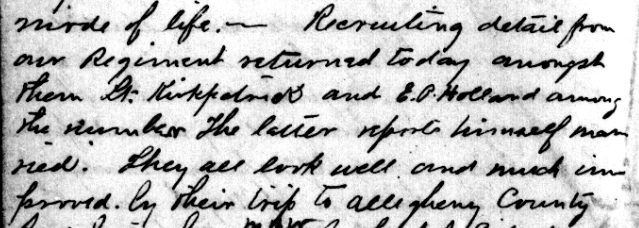
By November 16, Taggart’s surviving letter to his sister Mary provides one of the most personal glimpses of Holland during the entire war, capturing the newly married soldier back in camp near the Rappahannock.
Taggart had been considering the difficulty of obtaining leave and joked that men who succeeded in going home seemed almost certain to return married. He then added:
“Holland says to tell Annie that he couldn’t help it, and that it is all the fault of the girls.”
Whatever private joke passed among Holland, Annie, Taggart, and “the girls” has disappeared with the people who understood it. What remains is the tone of an ordinary exchange among friends. Holland appears for a moment outside the categories of military administration: not as Mus., Pvt., present, absent, detached, or on special duty, but as a newly married twenty-four-year-old being playfully teased by people who knew him.
The Army was changing Holland’s classification at the same time. The September–October roll identifies him as a private, and later rolls continue to do so. A notation on his eventual muster-out card complicates the chronology by stating that he was transferred from musician on September 1, 1863, even though regular muster rolls already called him a private a full year earlier. The sequential rolls provide stronger evidence for his actual recorded status in the autumn of 1862, while the later notation remains an unresolved conflict in the file.
His work was changing as well.
For November and December, the official roll places Holland on “Special duty Regtl. Post master” — special duty as the regiment’s postmaster.
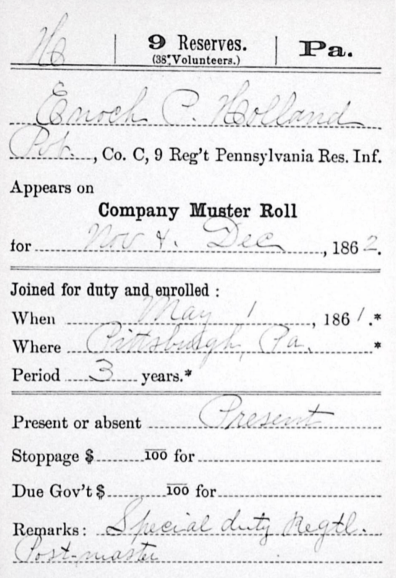
The entry identifies the assignment clearly, but it does not describe Holland’s day-to-day responsibilities. Regimental mail had to be received, sorted, carried, and distributed as the command moved from camp to camp, while outgoing correspondence had to find its way back through an often uncertain military postal system. Holland’s exact routine is not preserved in the surviving record, but the assignment placed him within one of the systems that connected soldiers in the field with families and communities at home.
By the time the Army of the Potomac reached Fredericksburg, Holland’s service had moved well beyond the simple description with which it had begun.
He was no longer merely the company musician.
From Fredericksburg to Headquarters
Holland later listed Fredericksburg among the battles of his service.
His official record supports his presence with the regiment during the campaign. It also directs us away from assuming that presence meant a place in Company C’s firing line.
The November–December roll records Holland on special duty as regimental postmaster. A few weeks after the battle, Robert Taggart supplied another piece of contemporary evidence that further defines Holland’s changing military work.
On January 5, 1863, Taggart wrote his sister Mary from camp near White Oak Church, Virginia. He apologized for failing to mention Holland’s safety in his first letter after “the late battle,” explaining that under such circumstances there had been many things to remember. Now that information could reliably be passed to Mrs. Holland, he indicated that he would try to keep her informed.
Then he described Holland’s assignment:
“he is a Regimental Post Master and is not required to go into battle.”
No other presently known wartime source defines this phase of Holland’s service so directly.
The letter does not preserve the formal date on which Holland became regimental postmaster, so it cannot by itself prove that he held precisely that assignment during every hour of the battle on December 13. Yet it was written only weeks after Fredericksburg, following a roll that already placed him on regimental special duty, and it demonstrates how far his daily responsibilities had moved from ordinary company service.
The mail was itself a military system. Letters connected an army moving across Virginia with families scattered across Pennsylvania and beyond. They carried news of health, death, money, loneliness, promotion, casualties, marriage, and survival. Someone had to receive, organize, and distribute that correspondence as units moved from one temporary location to another.
For Holland, the role carried an especially personal dimension. Taggart’s January letter was itself part of the system it described: a soldier writing home about the man helping manage soldiers’ mail, while assuring Holland’s new wife that her husband had survived Fredericksburg. Then, in a brief postscript, Taggart carried something even more personal from Enoch himself:

The message is only a few words, but it brings Holland unusually close. Weeks after Fredericksburg, recently married and back with the regiment, he was alive, well enough to send word home, and thinking of the people from whom the war had separated him.
At Regimental Headquarters
That brief postscript came at a turning point in Holland’s service. By the time Taggart wrote to Mary, Holland’s duties were already beginning to shift again.
An extended muster roll covering October 31, 1862, through February 28, 1863 records him on daily duty as a clerk at regimental headquarters, placing that assignment alongside the postmaster duty documented during the same general period.
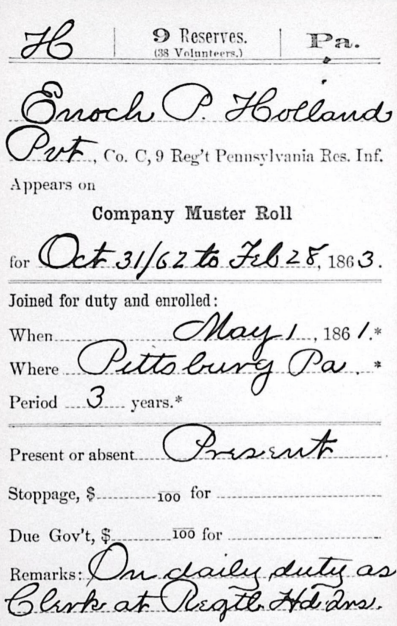
Subsequent rolls continue to identify Holland with regimental-headquarters duty through the spring of 1864, establishing this as a sustained assignment rather than a temporary detail.
The postmaster and headquarters-clerk entries need not represent entirely separate occupations. They may describe overlapping responsibilities within the regiment’s administrative system or a transition that took place around the beginning of January. No surviving order presently explains the relationship closely enough to combine the two duties under a single title. What the records do establish is that, by the opening of 1863, Holland’s daily place within the regiment had shifted decisively away from the ordinary routine of Company C and toward regimental headquarters.
He would remain associated with that work for approximately the final sixteen months of his service.
Clerical duty was an essential part of keeping a Civil War regiment functioning. Orders had to be copied and transmitted, rosters and returns prepared, personnel accounted for, correspondence handled, and reports assembled as the regiment camped, marched, and fought. Supply information, casualty reports, and other records passed through headquarters as commanders attempted to keep track of men and material across an army constantly in motion. The surviving record does not identify a particular document as Holland’s work, so none of those individual tasks can be attributed to him with certainty. The repeated muster entries nevertheless show that his superiors employed him within this written and administrative system for an extended period.
His civilian background makes the assignment understandable, even if it does not explain precisely why he was selected. Before the war Holland had worked as both a teacher and a clerk, occupations that required literacy, organization, and familiarity with written records. No surviving order states that these abilities caused his superiors to place him at headquarters, but the length of the assignment suggests that Holland proved capable of the work expected of him there.
His new duties did not remove him from the movements of the Army. Only weeks after the January appointment came the Mud March of January 20–24, 1863. Holland was carried present during the period and, with his headquarters assignment already in effect, most probably accompanied the regimental command through the operation rather than marching in the ordinary ranks of Company C.
In February, the regiment entered a comparatively stable period around Washington and Alexandria. Holland’s March–April muster roll, the special muster of April 10, and the May–June roll all carry him present and continue to identify him as a headquarters clerk.
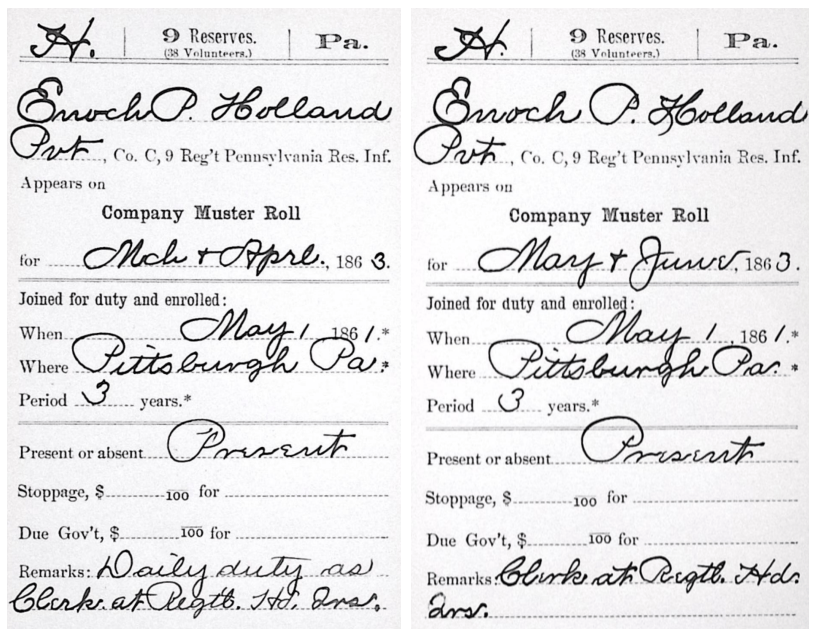
Few stretches of his military service are documented with such administrative consistency. For several months, the Army’s records allow us to place him not merely with the regiment, but within the command structure through which its daily business was conducted.
That stability ended with the approach of summer. In late June, the 9th Pennsylvania Reserves left the Washington defenses and returned to the field as the Army of the Potomac moved northward in response to the Confederate invasion of Pennsylvania.
Holland went with regimental headquarters, and the campaign ahead would carry him to Gettysburg.
A Clerk in a Moving Army
On June 25, 1863, the regiment moved to rejoin the Army of the Potomac as the Confederate invasion of Pennsylvania drew Union forces northward. For Holland, the campaign provides one of the clearest examples of why his military service cannot be reduced to a list of battle names.
He later counted Gettysburg among the engagements of his service. His July–August muster roll carries him present and identifies him as “Clerk at Regtl. Hd. Qrs.” The surviving records therefore place him with the regiment during the campaign and, more specifically, within the regimental headquarters establishment rather than automatically in Company C’s firing line.
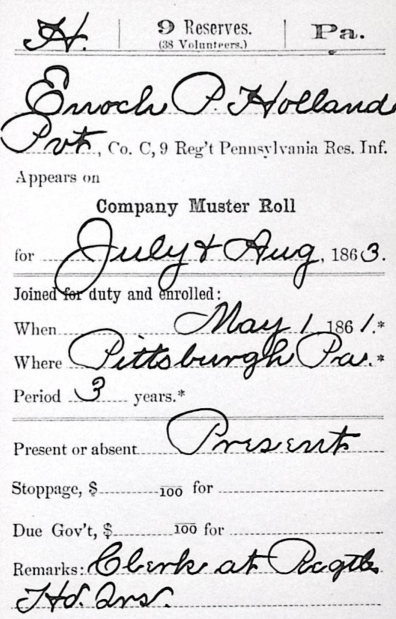
The 9th Pennsylvania Reserves participated in the battle, and there is no evidence of any detachment removing Holland from the command. Taken together, the sources strongly support his presence at Gettysburg with regimental headquarters. They do not place him in Company C’s firing line.
Robert Taggart’s wartime correspondence now brings that setting into sharper focus. Writing on July 5, 1863, from the “Battlefield near Gettysburg,” only two days after the battle ended, Taggart described what the regiment had just witnessed: “The fighting here has been desperate, more so than I ever witnessed.”
Yet he immediately made an important distinction between the violence of Gettysburg as a whole and the experience of the 9th Pennsylvania Reserves itself. “Our regiment did not occupy a very exposed position,” he wrote, “consequently we had only three wounded.”
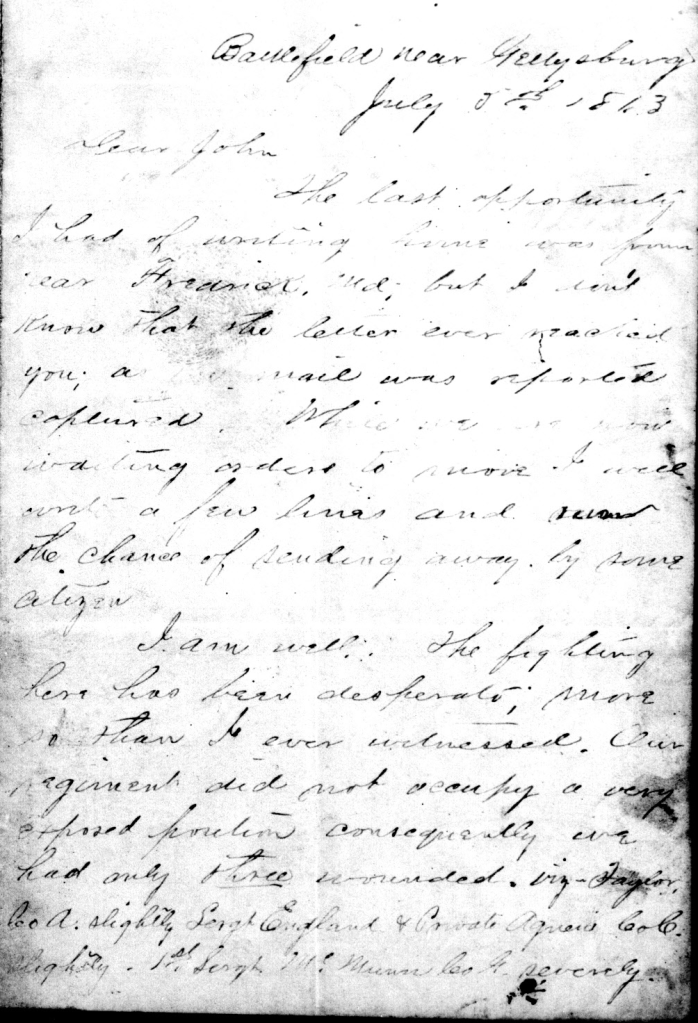
That distinction is especially important for understanding Holland at Gettysburg. His later recollection, the muster roll, and Taggart’s battlefield letter together place him with the 9th Pennsylvania Reserves while identifying his duty as regimental-headquarters clerk and the regiment’s position as comparatively unexposed.
By then, such a distinction had become part of the structure of Holland’s service. He remained a private of Company C, but his daily work belonged to a headquarters that moved with the regiment and operated within the uncertainty of an army in the field. Taggart’s letter nevertheless cautions against imagining Holland amid Gettysburg’s heaviest fighting. The battle around him was desperate; the regiment’s own position was not among the most exposed.
What Holland did on July 1, 2, or 3 remains unknown. As a headquarters clerk, he may have handled orders, reports, correspondence, messages, or returns, but none of those specific tasks can yet be documented.
Even so, Gettysburg is no longer an empty space in his record. Writing from the battlefield on July 5, Taggart remembered fighting more severe than any he had previously witnessed while noting that the 9th had suffered only three wounded. Holland was therefore present within an immense and violent battle, though his experience need not have resembled that of soldiers on its most heavily contested ground.
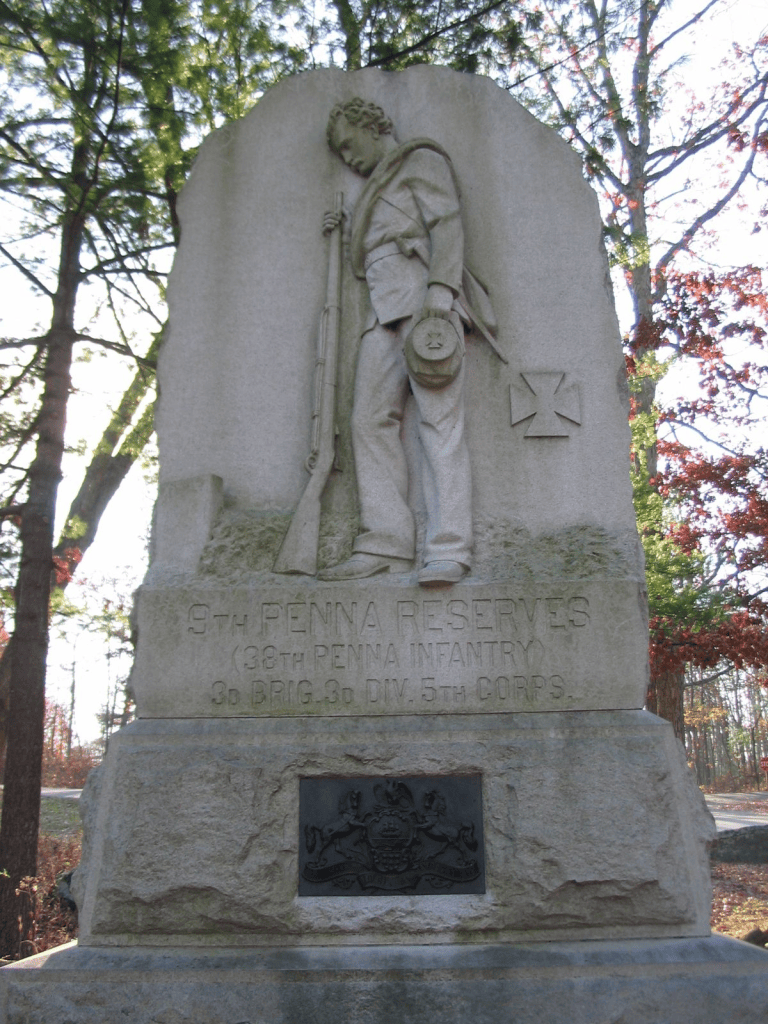
After Gettysburg, Holland appears to have continued with regimental headquarters during the pursuit of Lee. His service record continues to carry him present, and the later September–October entry explicitly confirms that he had been serving as a headquarters clerk since January 1, 1863, by order of Lieutenant Colonel Snodgrass. The campaign did not end for him when the firing stopped at Gettysburg; headquarters moved on with the regiment as the Army of the Potomac followed Lee toward the Potomac and back into Virginia.
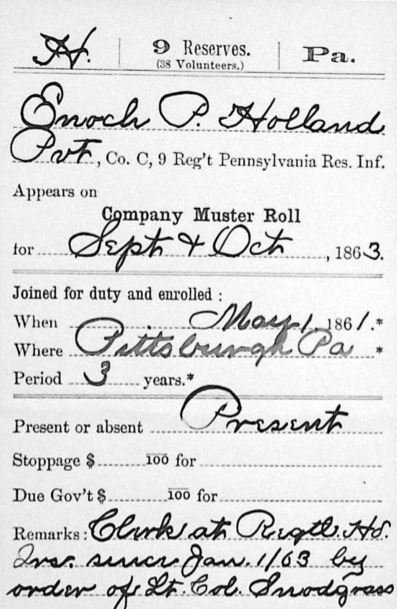
The autumn brought the Bristoe Campaign, another period of marching and maneuver as the Army of the Potomac and Lee’s army moved across northern Virginia. Holland’s assignment and roll status strongly support his presence with the regimental command.
On November 7, the regiment participated in operations at Rappahannock Station. Later that month came the Mine Run Campaign, lasting from late November into early December.
Mine Run was one of the engagements Holland himself chose to remember by name in his later G.A.R. Personal War Sketch.
The significance of his battle list becomes clearer when read beside the service record. Holland did not attempt to reproduce every expedition, movement, picket duty, skirmish, or campaign associated with the 9th Pennsylvania Reserves. He selected Dranesville, a cluster of engagements from the Seven Days, Fredericksburg, Gettysburg, and Mine Run. The list spans nearly his entire service while leaving out both long periods of routine military work and major battles that the newer evidence indicates he probably missed while recruiting in Pittsburgh.
Read together, the surviving sources preserve different parts of the same war. The Army recorded status and duty; Holland remembered particular battles and danger; Taggart preserved the world around them—friends, camp conditions, movements, losses, assignments, concern for soldiers’ families, and, at Gettysburg, the character of the fighting and the relative exposure of their own regiment. None preserves the whole experience, but their differences allow a much fuller one to emerge.
The November–December 1863 muster roll does not repeat Holland’s clerk notation, nor does the January–February 1864 card. Both mark him simply as ‘present’.
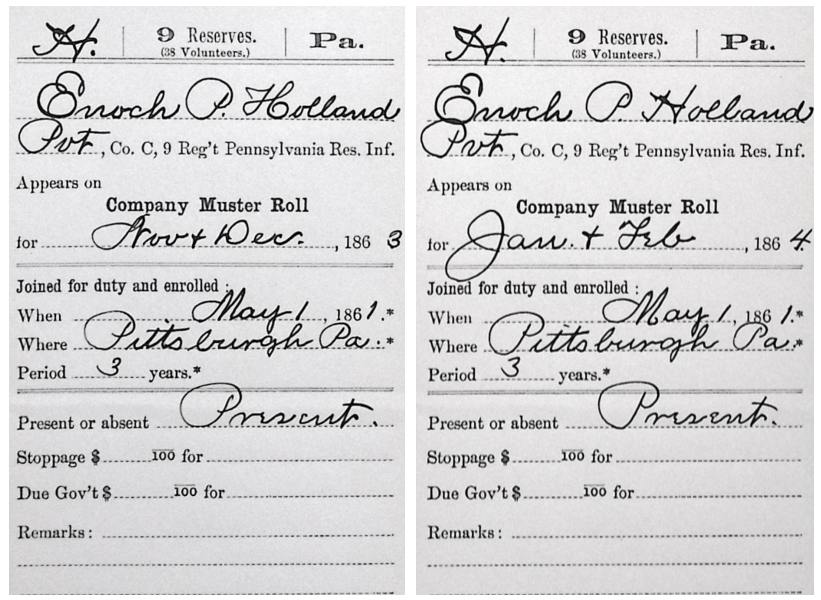
In isolation, that silence might suggest a change of duty, but the March–April 1864 card again identifies his headquarters-clerk service and refers back to its January 1, 1863 beginning.
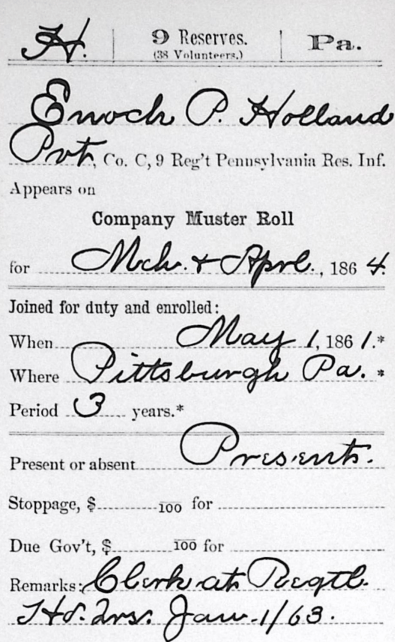
The continuity of Enoch’s record therefore strongly supports headquarters duty through the final spring of his enlistment.
By then the Army was preparing for another campaign.
Holland’s term was nearly finished.
The Road Home
The spring of 1864 placed the Pennsylvania Reserves on the edge of a final major movement before their original enlistments expired.
Holland remained present through the March–April muster period, still connected to regimental headquarters. When the Army began the Rapidan Campaign in May, no intervening absence appears in his record. He therefore probably accompanied the command into the opening operations of Grant’s 1864 offensive.
The regiment’s history records that the Pennsylvania Reserves received orders to return home on May 4, as Grant’s campaign was opening and the 9th stood in the front line in the Wilderness, prepared for the fighting ahead. The journey that had begun at Pittsburgh in 1861 now reversed direction.
The regiment returned to Pennsylvania, reaching Pittsburgh during the second week of May. Holland’s individual muster-out card gives the date that ended his military service: May 11, 1864.
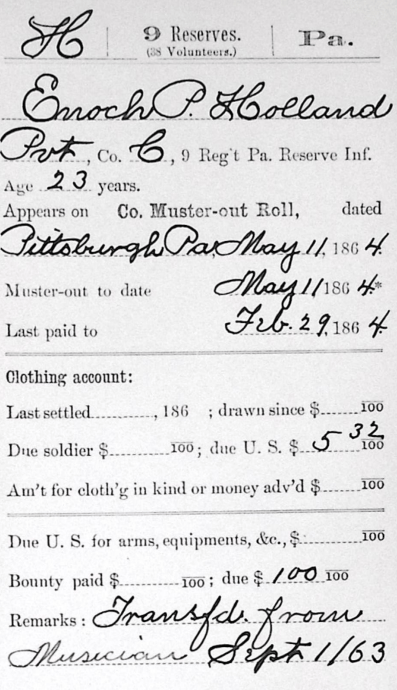
General histories of the 9th Pennsylvania Reserves often give May 12 for the regiment’s muster-out, and even later recollections sometimes use that date. Holland’s own service card is more specific and should control his individual chronology.
The Army closed his account with the same administrative precision that had opened it three years earlier:
He had last been paid through February 29, 1864.
A $100 bounty remained due.
His clothing account recorded $5.32 due to the United States.
The card also contains the conflicting notation that he had been transferred from musician on September 1, 1863, despite earlier rolls identifying him as a private beginning in 1862. Like several other details preserved in compiled military records, it cannot simply be corrected because a cleaner answer would be convenient. The surviving cards instead preserve both versions, with the sequential muster rolls providing the stronger evidence for his earlier transition to private.
What they do not preserve is equally instructive.
Holland later stated that he had never been wounded, confined to a hospital, or taken prisoner. His compiled military service record contains no notation of a battle wound, hospital confinement, capture, desertion, absence without leave, court-martial, or disciplinary action. After the recruiting detachment, every roll that records his status carries him present through the end of his service.
Yet within that apparently clean administrative history were experiences Holland would later describe differently when the government asked him about his health. He would trace severe rheumatism to Camp Pierpont, another ailment to the spring campaigns of 1862, and a groin injury to the retreat from Mechanicsville. Whether those conditions could be proved, how severely they affected him, and what the Pension Bureau ultimately accepted were questions that lay decades beyond the muster-out card. In 1864, the Army had no reason to answer them. The Service Record had been created for another purpose.
The packet that survives today allows us to see how thoroughly Holland’s wartime identity changed between May 1861 and May 1864. He entered federal service as a twenty-three-year-old musician whose previous military experience had been formed within the intimate local culture of the St. Clair Guards. He then followed the 9th Pennsylvania Reserves through camps around Washington and Virginia, experienced Dranesville and the Seven Days, and remembered himself as a soldier who had fired at Confederates while trying to survive their return fire. After the Peninsula Campaign, the Army sent him home on recruiting duty, removing him from several battles in which his regiment suffered heavily. During that assignment he married Harriet Nixon and then returned to military service within days.
From there his war took another form. The rolls identify him as a private and, by November and December 1862, place him on special duty as regimental postmaster—a role independently confirmed by Taggart. Beginning January 1, 1863, repeated official entries place him on daily duty as a clerk at regimental headquarters. He carried that role through the Mud March, months around Washington and Alexandria, the Gettysburg Campaign, the pursuit of Lee, Bristoe, Rappahannock Station, Mine Run, the winter of 1863–64, and the opening movements of the final campaign before his regiment was sent home.
Robert Taggart traveled through much of that war beside him, although the two men’s responsibilities diverged. Holland’s own later recollection confirms how close that relationship remained: when asked to name a few of the comrades he had known most intimately in the service, Taggart’s name appeared first on the list.

Taggart’s diary and letters allow Holland to appear intermittently outside the official categories: a friend leaving for recruiting duty, a newlywed joking with acquaintances at home, a husband whose safety needed to reach Mrs. Holland after Fredericksburg, and a soldier whose work within the regiment increasingly centered upon communication and administration.
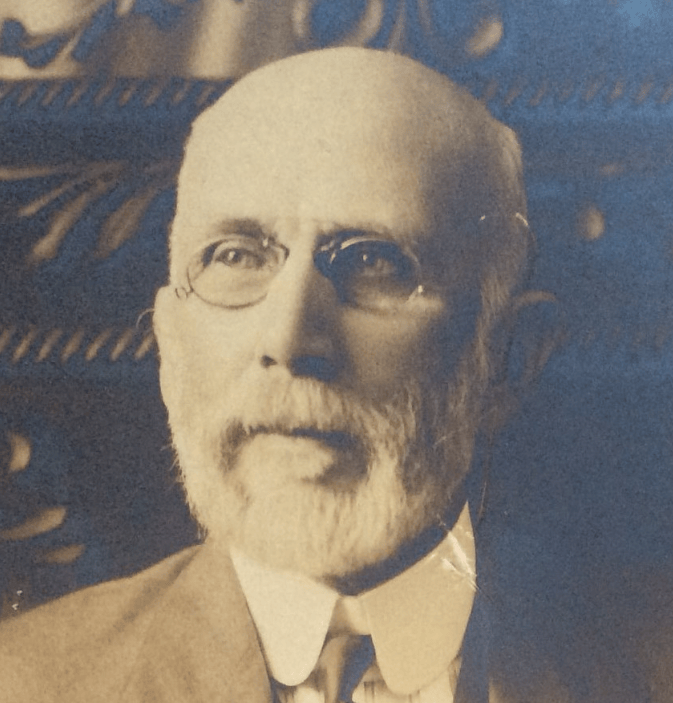
The result is not the conventional biography of a soldier moving from battle to battle with an unchanging role. Holland’s service was more complicated, and therefore more revealing. Combat was part of it, but so were music, recruiting, logistics, mail, clerical work, friendship, marriage, fear, long periods of movement and waiting, and the written systems through which a nineteenth-century army kept itself functioning.
His old militia company had taught him what it meant to belong to a military organization close to home. The Civil War showed him what that obligation became when carried across hundreds of miles and absorbed into an army large enough to depend upon systems no local company could have imagined.
On May 11, 1864, the Army could close Holland’s record with a date, a bounty, a clothing balance, and no official wound against his name. But decades later, when age and illness forced him to explain what those three years had cost him, the war would have to be reconstructed all over again—this time through affidavits, medical examinations, old comrades, contested memories, and the long bureaucracy of a pension claim.
Holland had come home from the war.
Proving what he had carried home with him would take much longer.
As part of this project, So Nobly Advanced is proudly making available a complete digital scan of Enoch P. Holland’s compiled military service record from his service in Company C of the 9th Pennsylvania Reserves / 38th Pennsylvania Volunteers.
To our knowledge, this project marks the first time Holland’s complete service record has been digitized and made publicly available on the internet.
Preserved within the records of the National Archives in Washington, D.C., the file provides the documentary backbone for reconstructing Holland’s Civil War service—from his 1861 enlistment and muster as a musician through recruiting duty, special service as regimental postmaster, sustained work as a clerk at regimental headquarters, and his final muster-out in May 1864.
We hope this resource will not only support the continuing E. P. Holland – The Veteran Who Kept the Record series, but also prove valuable to local historians, genealogists, Civil War researchers, and others investigating the soldiers, regiments, communities, and military records of the nineteenth century.
Sources
- Compiled Military Service Record of Enoch P. Holland, Company C, 9th Pennsylvania Reserves / 38th Pennsylvania Volunteers. National Archives and Records Administration.
- Holland, Enoch P. G.A.R. Personal War Sketch, Capt. Thomas Espy Post No. 153.
- Holland, Enoch P. “Memoir of Capt. Espy by Comrade E. P. Holland.” Undated typescript. Captain Thomas Espy Post No. 153 of the Grand Army of the Republic Collection, Andrew Carnegie Free Library & Music Hall, Carnegie, Pennsylvania, Box 1, Folder 14.
- Robert Taggart Papers, MG-124, Pennsylvania State Archives.


Leave a comment