
By the time he was laid to rest at Lobbs Run Cemetery in January 1906, William Henry Harrison Foster had lived a life shaped by war, recovery, and perseverance. Shot and disabled early in the Civil War, he recovered, reenlisted, and served again until the conflict’s closing months. His story is emblematic of thousands of Pennsylvania soldiers whose sacrifices unfolded far from fame, yet whose lives remain etched – sometimes faintly – into the historical record.
Early Life in Western Pennsylvania
William Henry Harrison Foster was born on November 10, 1839, in Coultersville (Coulter), Westmoreland County, Pennsylvania. He was the son of Frederick Foster (1796–1862) and Elizabeth “Betsy” Trumbell Foster (1802–1877). Raised in western Pennsylvania, Foster came of age in a region that would supply large numbers of volunteers to the Union cause when war erupted in 1861.
At just twenty-one years old, he answered that call.
First Enlistment: Pennsylvania Reserves
Company F, 12th Pennsylvania Reserves (41st Pennsylvania Volunteers)
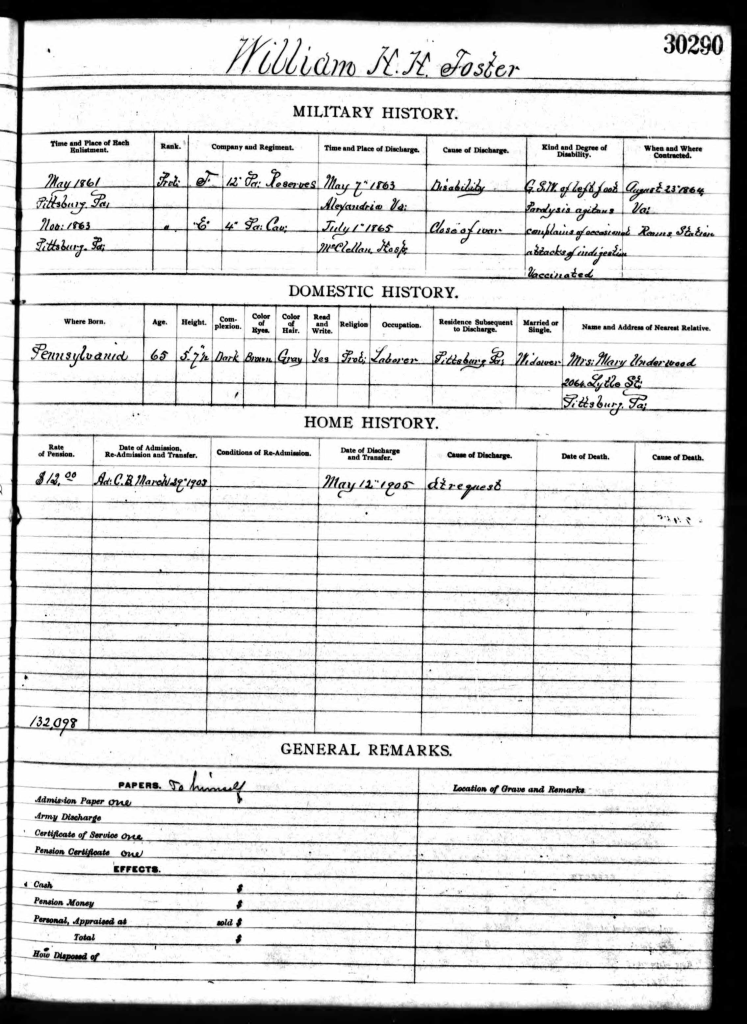
In May 1861, Foster enlisted at Pittsburgh as a private in Company F, 12th Pennsylvania Reserves, a regiment officially designated as the 41st Pennsylvania Volunteer Infantry. The Pennsylvania Reserves were among the Commonwealth’s most active formations, seeing heavy service in the Eastern Theater.
During this enlistment, Foster was wounded at the Battle of Bull Run, suffering a gunshot wound to his left foot. Samuel P. Bates records him succinctly: “Wounded at Bull Run – discharged on Surgeon’s Certificate.” The injury proved serious enough to end his initial term of service.
He was discharged for disability in the spring of 1863, with records variously placing the date as April 3, 1863 (Bates) and early May 1863 (later service abstracts), and the place of discharge at Alexandria, Virginia. Such minor discrepancies are common in Civil War administrative records and reflect different stages of hospitalization, certification, and final paperwork.

For many soldiers, a wound like this would have ended their military service permanently. For William Foster, it did not.
Returning to the Ranks: Union Cavalry
Company E, 4th Pennsylvania Cavalry (64th Pennsylvania Volunteers)
After recovering sufficiently, Foster reenlisted in November 1863, again at Pittsburgh, this time joining Company E, 4th Pennsylvania Cavalry – a regiment recruited heavily from Allegheny County.
The 4th Pennsylvania Cavalry served almost continuously in the Eastern Theater, participating in mounted operations throughout 1864 and 1865. Cavalry service demanded long rides, scouting missions, screening operations, and frequent skirmishing during the Overland Campaign, the prolonged fighting around Petersburg, and the final movements leading to Appomattox.
Bates records Foster’s second service as follows: mustered December 10, 1863; discharged on Surgeon’s Certificate, May 12, 1865. Although the regiment formally mustered out on July 1, 1865, Foster himself appears to have been medically discharged shortly before the end of hostilities, likely due to the lingering effects of his earlier wound and accumulated hardships of service.

Marriage, Family, and Civilian Life
Returning to western Pennsylvania, Foster resumed civilian life and, in 1865, married Rebecca Biddle (1840–1901). Together they raised a large family:
- Joseph H. Foster (1867–1943)
- Mary Jane Foster, later Mrs. Underwood (1870–1942)
- Phoebe Elizabeth Foster, later Mrs. West (b. 1871)
- Charles Foster (b. 1874)
- Margaret Catherine Foster, later Mrs. West (1878–1943)
- Annie Foster (b. 1879)
- John W. Foster (b. 1883)
By the late nineteenth century, Foster lived in or near the Hazelwood area of Pittsburgh, part of the Monongahela River valley shaped by mills, river traffic, and working-class neighborhoods. His occupation is variously listed as noted in institutional records, reflecting the realities of aging veterans whose health limited sustained labor.
Rebecca Foster died in 1901, leaving William a widower in his final years.
Pension, Declining Health, and Death
Like many veterans who carried lasting injuries from the war, Foster relied on a Union pension, recorded at $12 per month. In his later years, he spent time in a soldiers’ home, where records describe a man worn down by age, injury, and exposure.
William Henry Harrison Foster died on January 6, 1906, in Elizabeth Borough, Allegheny County, Pennsylvania, at the age of 65. His death certificate lists the cause as “asthma and results of exposure,” language that speaks to the long-term toll of wartime service on Civil War veterans.
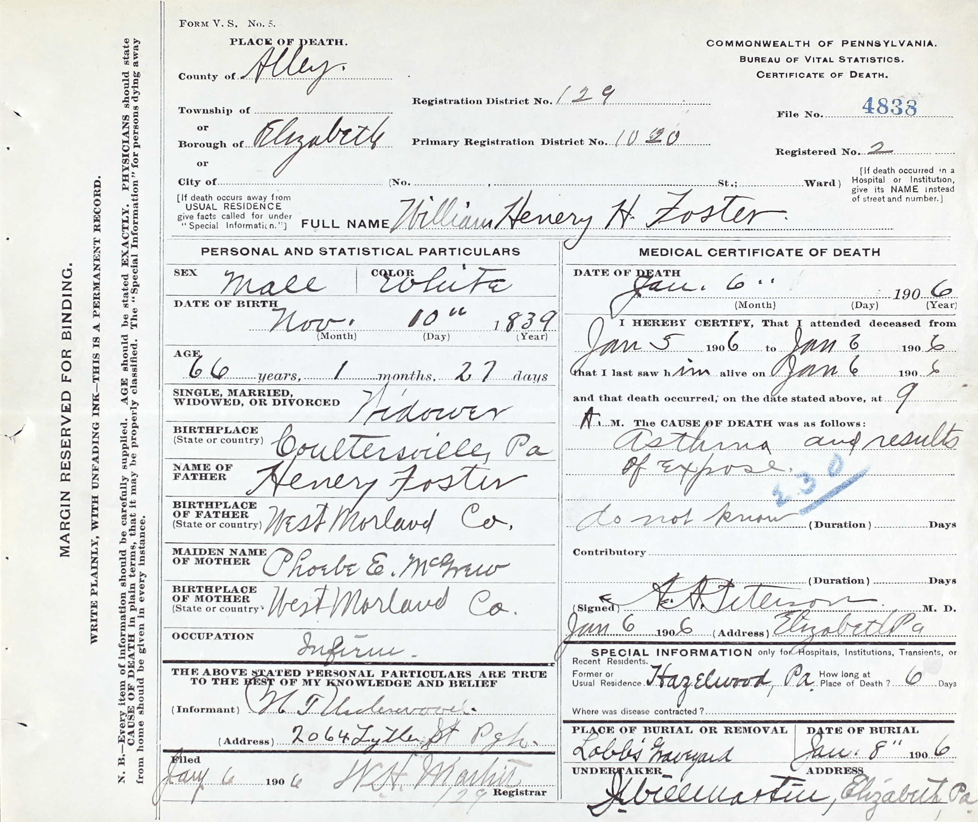
He was buried on January 8, 1906, at Lobbs Run Cemetery in West Elizabeth, among veterans of the American Revolution, the War of 1812, and the Civil War.
A Stone Rediscovered
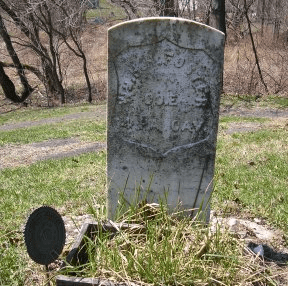
More than a century after his burial, Foster’s gravestone – inscribed simply as
WM. H. H. FOSTER
CO. E
4 PA. CAV.
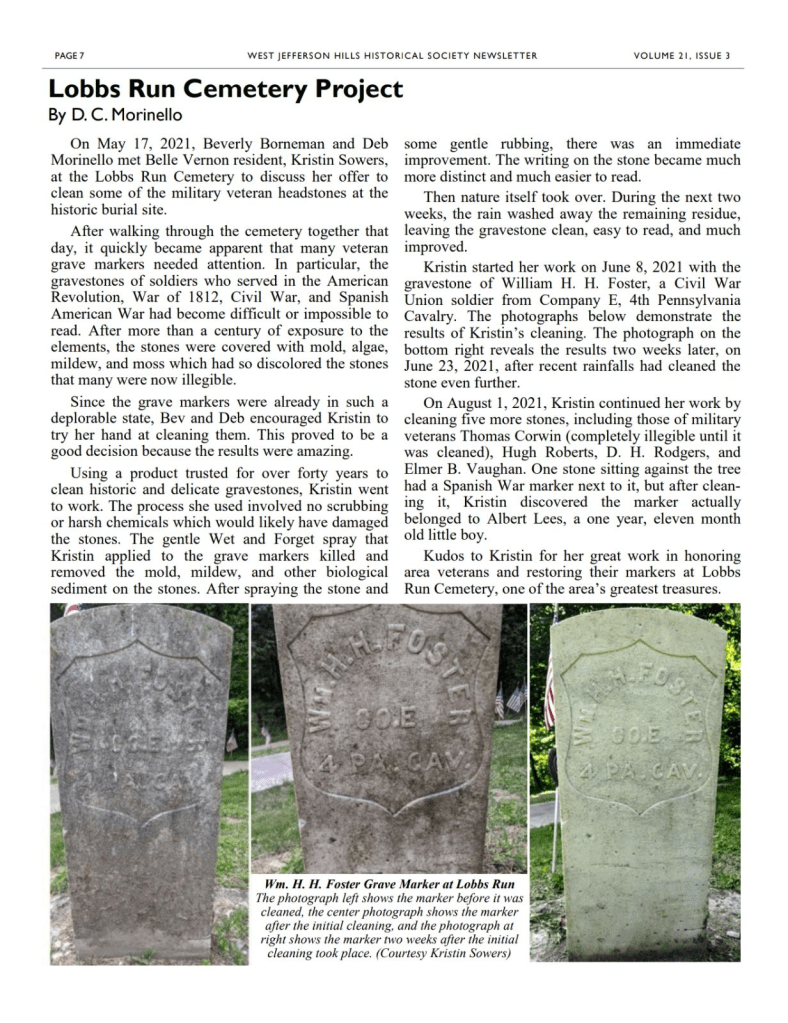
had become weathered and difficult to read. In 2021, it was cleaned and restored, allowing his name and service to once again stand clearly among those he served beside.
Legacy
William Henry Harrison Foster’s life reflects a quiet resilience shared by countless Pennsylvania soldiers. Wounded at Bull Run, discharged for disability, he recovered and reenlisted – serving again until the final months of the war. He returned home, raised a family, and lived with the enduring consequences of his service.
At Lobbs Run Cemetery, his restored marker stands as a reminder that even the most weathered names still have stories worth telling – and remembering.
Sources
- Bates, Samuel P. History of the Pennsylvania Volunteers, 1861–1865.
- Roster entry, Company F, 12th Pennsylvania Reserves (41st P.V.): “Foster, William … Wounded at Bull Run—discharged on Surgeon’s Certificate, April 3, 1863.”
- Roster entry, Company E, 4th Pennsylvania Cavalry (64th P.V.): “Foster, Wm. H. … Discharged on Surgeon’s Certificate, May 12, 1865.”
- Pennsylvania Bureau of Vital Statistics, Certificate of Death for William Henry H. Foster, 6 January 1906; burial at Lobbs Run Cemetery, West Elizabeth, Allegheny County, Pennsylvania.
- West Jefferson Hills Historical Society Newsletter, Vol. 21, No. 3 (2021): “Lobbs Run Cemetery Project,” documenting restoration of William H. H. Foster’s gravestone.
- FamilySearch Tree and Records, profile William Henry Harrison Foster (9V4F-XC5),
https://www.familysearch.org/en/tree/pedigree/landscape/9V4F-XC5 - U.S. Civil War Soldiers’ Home / Service Abstracts, documenting enlistments, wounds, pension, and later-life institutional residence.
 So Nobly Advanced
Leave a comment