
From Civil War parade-ground to a monument built of stone, space, and words
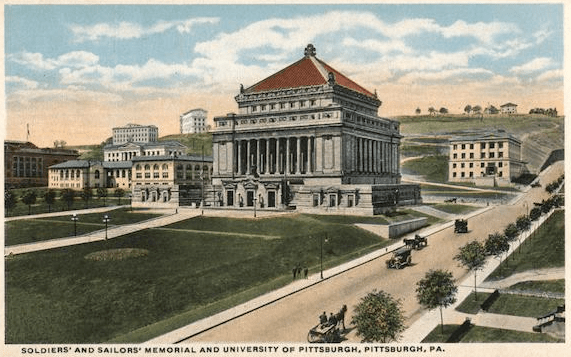
Standing along Fifth Avenue in Oakland, Soldiers & Sailors Memorial Hall and Museum presents itself not simply as a memorial, but as a declaration. Its monumental classical form, elevated lawn, and commanding siting announce permanence and purpose. Yet the meaning of this place runs deeper than architecture alone. The Hall stands on ground long associated with the Civil War, was conceived and guided by veterans themselves, and was deliberately designed to preserve not only who fought, but why the war was fought at all.
This is not a monument placed at random. It is a memorial rooted in place, intention, and national meaning.
Before the monument: Oakland as a Civil War training landscape
During the Civil War, Pittsburgh served as a vital Union hub – industrial, logistical, and human. Its iron works, rail connections, and river traffic sustained the Union war effort, while thousands of western Pennsylvanians passed through the city on their way to military service.
Oakland, then still characterized by open land and estates, became part of this wartime geography. Several training and mobilization camps operated in or immediately adjacent to the neighborhood. Camp Fremont, established in 1861, is clearly documented as being located in what is now Oakland, serving as a rendezvous and training point for Pennsylvania volunteers. Camp Howe, associated with the Linden Grove area and named for Thomas Marshall Howe, functioned as another organizing and drilling ground during the war. Camp Montgomery is also consistently cited in Pittsburgh-area Civil War summaries as operating in or near Oakland.
These camps were places where civilian volunteers assembled, drilled, received equipment, and were transformed into soldiers. Oakland thus functioned as a true parade-ground of war – where service began long before the battlefield.
For the veterans who survived, these spaces were not abstractions. They were remembered places of formation, anticipation, and departure. When the time came to select a site for a permanent county memorial, Oakland carried a powerful symbolic continuity: it was ground where soldiers had once been made.
A veteran-led vision: More than a statue
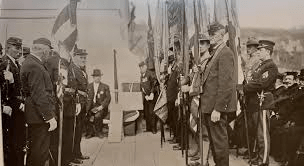
By the late nineteenth century, Union veterans were keenly aware that their numbers were dwindling. Through local posts of the Grand Army of the Republic, they pressed for a memorial that would endure beyond their lifetimes.
Rather than erecting a single statue or obelisk, they envisioned something more ambitious: a living memorial. The idea of a memorial hall emerged locally in the early 1890s and was shaped by veterans who wanted a space that would serve the public, preserve records and relics, and remain active in civic life.
Their aims were clear:
- To honor the soldiers and sailors of Allegheny County who served the Union
- To create a permanent home for flags, artifacts, documents, and veteran organizations
- To ensure that the Civil War remained visible and meaningful within everyday civic life
The memorial was conceived not as a passive object, but as an institution – one that would speak across generations.
Choosing Oakland: Memory placed in the civic future
At the turn of the twentieth century, Oakland was rapidly emerging as Pittsburgh’s cultural and educational center. Land from the former Schenley estate, reshaped through the Schenley Farms development spearheaded by Franklin Nicola, was transforming the area into a planned civic landscape.
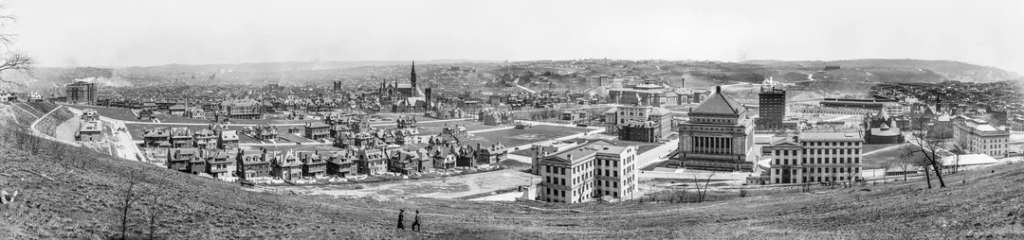
In 1906, Allegheny County purchased a prominent site along Fifth Avenue specifically for the memorial. The selection fused past and future. Veterans placed their monument on Civil War–associated ground, but also within a district destined to shape Pittsburgh’s intellectual and cultural identity. Memory would stand alongside universities, museums, and libraries – embedded in the daily life of the city.
Design and construction: A “monument in the form of a building”
Architect Henry Hornbostel was selected to design the memorial, prevailing over several nationally prominent competitors. Hornbostel rejected the notion of a static monument and instead designed a building meant to be used.
Construction took place between 1908 and 1910. The resulting structure employed a monumental classical language inspired in part by ancient mausolea, architecture intended to convey dignity, endurance, and solemn purpose. Hornbostel famously insisted that the building be oriented toward Fifth Avenue and approached across a broad ceremonial lawn—an intentional echo of the parade-grounds where soldiers once assembled.
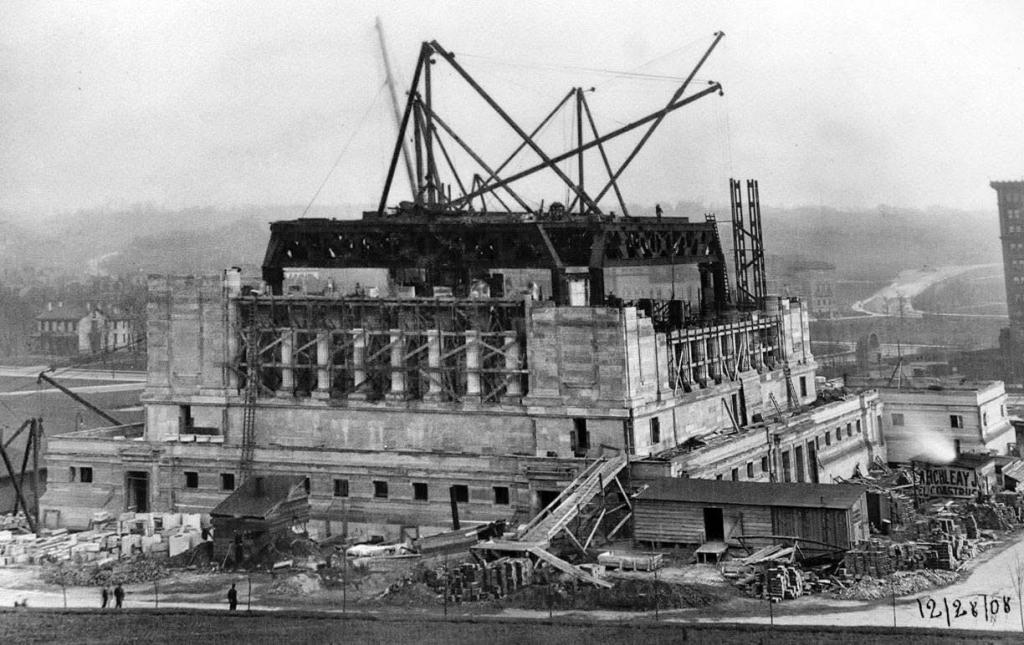
Dedicated in 1910, Soldiers & Sailors Memorial Hall honored the soldiers, sailors, and marines of Allegheny County who served in defense of the Union. In keeping with its founding vision, the building was initially governed by Civil War veterans themselves, ensuring that those who had lived the war shaped how it would be remembered.
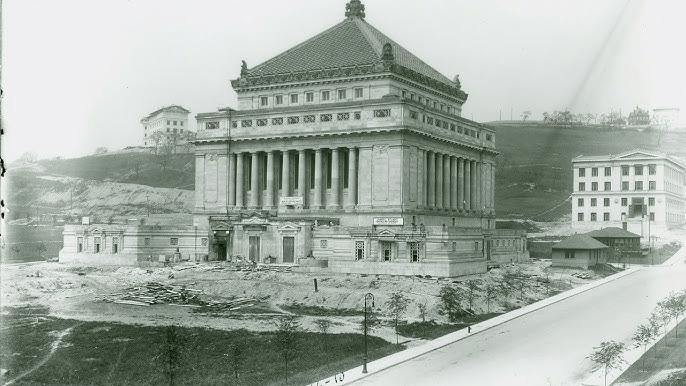
“Thus Far So Nobly Advanced”: The Gettysburg Address at the center of the Hall
At the heart of Soldiers & Sailors Memorial Hall lies its most profound interpretive choice – one that elevates the building from memorial to moral statement.
The Hall contains a large auditorium, commonly described as seating approximately 2,300 to 2,500 people. Dominating the rear wall of its stage is the full text of the Gettysburg Address, displayed in monumental scale. According to the Hall’s own description, it is presented as the largest known hand-painted canvas version of Abraham Lincoln’s speech.
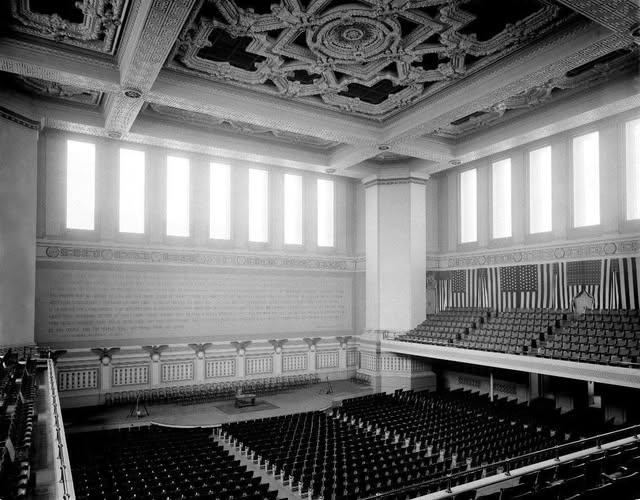
This placement was deliberate. By positioning the Gettysburg Address directly behind the stage, the memorial’s founders made clear that remembrance must begin with meaning. The Civil War was not only about sacrifice; it was about purpose.
When Abraham Lincoln spoke at Gettysburg in November 1863, he reframed the conflict as a test of whether a nation founded on liberty and equality could endure. His words articulated the moral center of the war. The phrase “thus far so nobly advanced” – which gives this blog its name – comes directly from that address, and its presence here is no coincidence.
Inside the auditorium, audiences do not simply read Lincoln’s words; they sit beneath them. Every speaker stands before them. Every lecture, ceremony, performance, and commemoration unfolds in their shadow. The Gettysburg Address is not decorative backdrop – it is a standard.
By placing these words first and foremost, the veterans ensured that future generations would encounter the Civil War not merely as distant history, but as an unfinished civic obligation. The Hall becomes, in this sense, a classroom as much as a memorial – quietly reminding the living that remembrance carries responsibility.
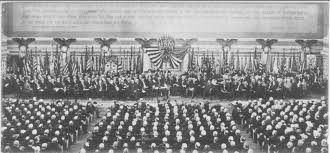
Legacy: A living memorial across generations
In 1963, Soldiers & Sailors Memorial Hall was rededicated to honor veterans of all American wars, expanding its mission while preserving its Civil War foundation. The building is often described as the largest memorial building in the United States dedicated solely to honoring military service – a claim that reflects both its scale and its ambition.
Today, the Hall continues to function as its founders intended:
- A museum preserving Civil War artifacts, flags, and veteran records
- A civic gathering space for education, performance, and commemoration
- A moral landmark anchoring public memory in Lincoln’s definition of national purpose
What began as parade-ground became monument. What began as monument became institution. And at its center remain the words that explain why it all mattered.
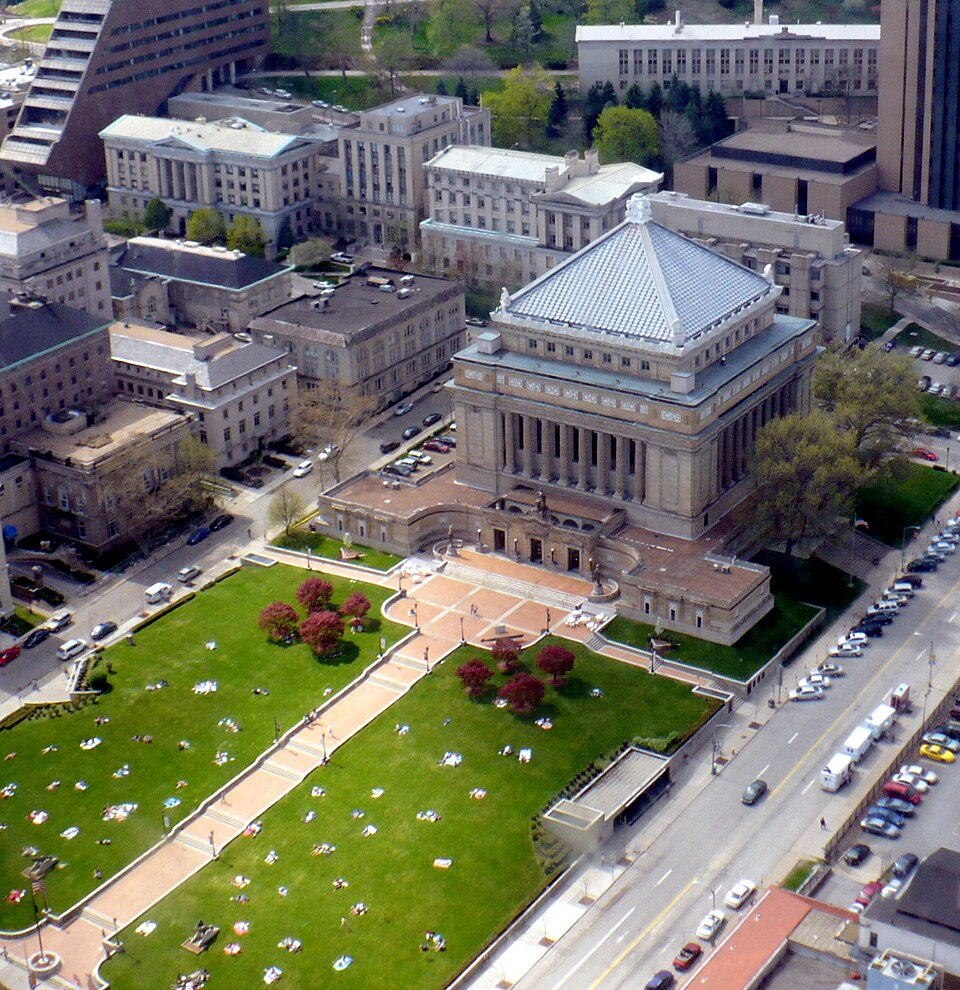
The veterans who built Soldiers & Sailors Memorial Hall understood something essential: stone can honor sacrifice, but words give it meaning. By placing the Gettysburg Address at the heart of the Hall, they ensured that Allegheny County’s Civil War memorial would never be silent – and never be finished.
Sources:
- Soldiers & Sailors Memorial Hall & Museum (Official Site) — History, mission, auditorium description, and Gettysburg Address installation (including identification as the largest known hand-painted canvas version). https://www.soldiersandsailorshall.org
- Soldiers & Sailors Memorial Hall & Museum — Auditorium specifications and capacity information. https://www.soldiersandsailorshall.org/rentals
- Pittsburgh History & Landmarks Foundation (PHLF) — “Important Moments in the History of Soldiers & Sailors Memorial Hall.” https://phlf.org/education-department/historic-landmarks/soldiers-sailors-memorial-hall/
- Society of Architectural Historians – SAH Archipedia — Soldiers’ and Sailors’ National Military Museum and Memorial Hall (Pittsburgh). https://sah-archipedia.org/buildings/PA-01-003-0034
- Bates, Samuel P. — History of Pennsylvania Volunteers, 1861–1865. Harrisburg: B. Singerly, 1869–1871. (Primary source for Pennsylvania regiments, mobilization, and training contexts.)
- Regimental histories of the 101st Pennsylvania Infantry — References to Camp Fremont in what is now Oakland, Pittsburgh. Digitized editions available via Internet Archive and Google Books.
- Regional Civil War camp compilations (Allegheny County / Pittsburgh area) — References to Camp Fremont, Camp Howe (Linden Grove), and Camp Montgomery operating in or near Oakland during the Civil War.
 So Nobly Advanced
Leave a comment