
Part of Series: “The Kittanning Regiments – A Portrait of Service”
This post is a continuation of our series on the Kittanning regiments. Here we’ll take a look at Col. Theodore Friedrich Lehmann, commander of the 103rd Pennsylvania Volunteers, in an attempt to uncover the varied details of his life and piece together his possible motivations for taking up arms in the American Civil War.
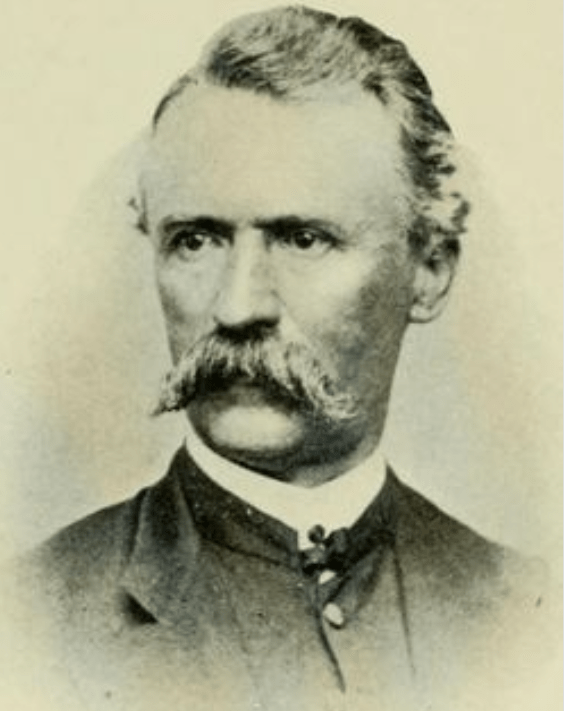
Theodore Friedrich Lehmann (1812-1894) is a man who defies easy categorization. Throughout his life he was a German immigrant, artist, musician, and a teacher. He was a father, civil engineer, patent attorney, and even an acquaintance of Sam Houston’s.
From 1861 to 1865, he commanded the 103rd PA volunteers.
Lehmann’s civil war service began with a different Pittsburgh area regiment – the 62nd. Readers of the blog will note this unit for its connection to Jacob Sweitzer, the Thomas Espy GAR post, and its action at Gettysburg. In an alternate history, T.F. Lehmann may have become a casualty of the Wheatfield. As fate would have it, he was captured with his regiment at Plymouth, NC and spent 5 months as a prisoner of war.
So who was T.F. Lehmann, and why did he fight?
Early Life in Europe
Lehmann was born in 1812 in Eystrup, Germany. After receiving a classical education at the Gymnasium in Oldenburg, he gained experience at a German military academy. In 1833, he resigned his commission as a second lieutenant to pursue artistic studies in Düsseldorf and later in Paris. He quickly rose to superintendent of the Academy of Fine Arts in Nantes, France.
Even in these early years, Lehmann demonstrated the blend of discipline and intellectual curiosity that would define his entire life.
America: Opportunity and Tragedy
In 1837, Lehmann emigrated to the United States, settling first in New York City. After health difficulties affected both him and his first wife, he accepted a position as a civil engineer in Texas, where he surveyed lands and helped lay out towns. During this period, he formed a friendship with Texas governor Sam Houston.
Widowed in 1839, Lehmann later moved to Kentucky, where he became an educator and operated schools for young women in Frankfort, Henderson, and Morganfield. Personal tragedy struck again in 1856 when his second wife and young son died of cholera on the same day.
Pittsburgh: From Educator to Soldier
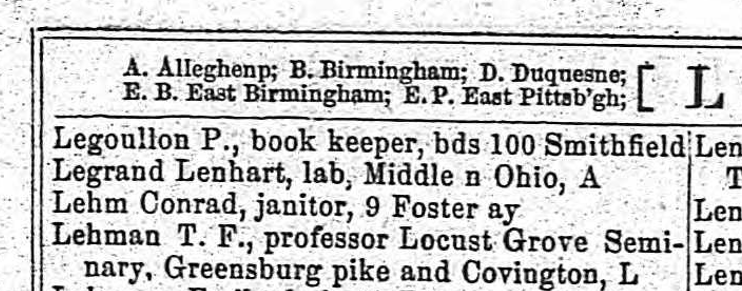
Lehmann married for a third time in 1858 and relocated to Pittsburgh, where he became superintendent of a public school. I was able to locate him in an 1861 city directory, which lists his occupation as a professor at Locust Grove Seminary.
After some research, I found that this was a boarding school for young women run by the local Protestant Episcopal Church. An ad from an 1858 Cleveland newspaper describes it below:
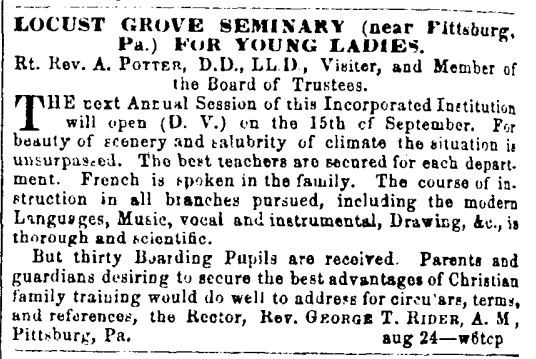
I’ll admit I raised an eyebrow at “beauty of scenery and salubrity of climate…unsurpassed.” The reverend stretches the truth a bit here on the Pittsburgh climate – both then and now.
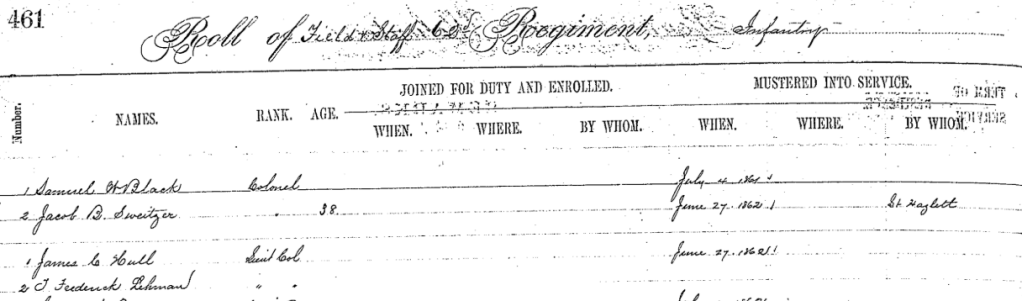
By the summer of 1861 volunteer regiments were being organized all across the city of Pittsburgh. Lehmann’s background and connections enabled him to enlist in the 62nd PA volunteers as a Lieutenant Colonel. He appears on the 62nd’s muster roll below with an enlistment date of June 27, 1861.
Pittsburgh to Kittanning: Service with the 103rd
But men with Lehmann’s reputation and background were hard to come by. Some 40 miles north up the Allegheny River, prominent citizen J.B. Finlay (a self-appointed Colonel) was organizing a second Kittanning unit known as the 103rd. He wrote to Governor Andrew Curtain asking:

The request was granted, and on Oct 21st Finlay wrote to Lehmann:
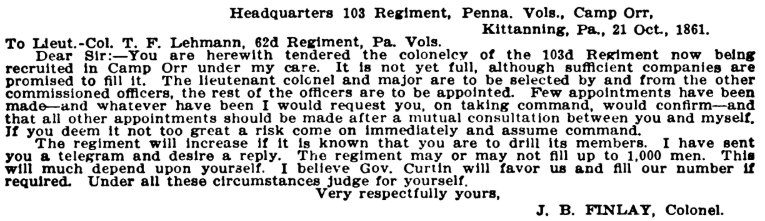
By November 4th, Lehmann was at Camp Orr to review the troops he had just been appointed to command.
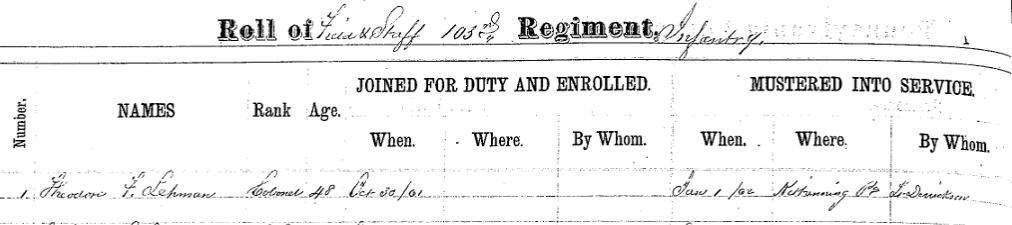
What Kind of Leader Was He?
With this background established, I had more questions about T.F. Lehmann. What kind of leader was he? And what motivates a man of this nature to fight?
Throughout the records of the 103rd his men describe him as a strict disciplinarian, and he seems to have had a quick temper. But he held himself to a high standard, and expected as much from his men.
When the Civil War broke out in 1861, Theodore Frederick Lehmann was nearly fifty years old.
He was not a young man looking for adventure. He had already lived a full life as an immigrant, an educator, an artist – and a widower twice over. He was uniquely well travelled, having lived in Germany, France, Texas, Kentucky, and Pennsylvania.
He was engrained with European discipline from his time in the German army. To a European-trained officer, secession would not simply have been a political disagreement. It would have looked like rebellion against lawful authority. Military men of his background believed deeply in constitutional order. Disunion threatened the structure of government itself.
His Time in the South
His time as a land surveyor in Texas is particularly interesting. Dickey wrote that Lehmann developed a friendly association with Sam Houston, which suggests they may have been simpatico in terms of Unionist sentiment. Around that time, Houston was a strong proponent of Texas joining the United States, and when the civil war broke out in 1861 Houston was removed as the governor of Texas for refusing to swear allegiance to the Confederacy.
After living in the slaveholding states of Texas and Kentucky, Lehmann understood Southern society firsthand. If his sympathies had aligned strongly with secessionist views, he might easily have remained in Kentucky when tensions escalated.
Instead, Lehmann packed up again and relocated to Pittsburgh – an industrial, strongly Unionist city with a large German-American population.
While we have no surviving letters explicitly stating his views on slavery, many German-American communities in Pennsylvania were overwhelmingly Unionist. Many opposed the expansion of slavery and supported preservation of the Republic above sectional loyalty.
Lehmann’s associations, geography, and actions place him firmly within that world.
Educational Views and Progressive Thought
His time as an educator also helps illuminate his views. Before the war, Lehmann taught at the all-female Locust Grove Seminary and led academies for young women in Kentucky. His advocacy for women’ s education is significant because it ties Lehmann to reformist and progressive schools of thought. He would have aligned himself with republican virtue, opportunity for all, and civic nationalism.
Lehmann was also a man of science. After the war, he returned to Pittsburgh and later worked as a civil engineer and patent attorney.
In a letter to Corporal Dickey after the war, Lehmann’s son described one of his flaws:
“The fly in the ointment” was his utter lack of all business ability. One night in New York City, among a party of gentlemen, he made a remark I have never forgotten. Said he, “The German scientist is nearly always like a blind hen: She scratches for her chick- ens, but cannot scratch for herself,” and therein lay his own story. He lacked the element of business to turn his own work of chemical investigation and inventions to advantage and others reaped the benefit or they were lost.”
We are left with an image of Lehmann as an idealist. He was not commercially motivated, but driven by principles of liberal education and citizenship.
In the war he fought not for himself, but for others. Not for his homeland, but for his adopted people.
Reflecting on the Cost
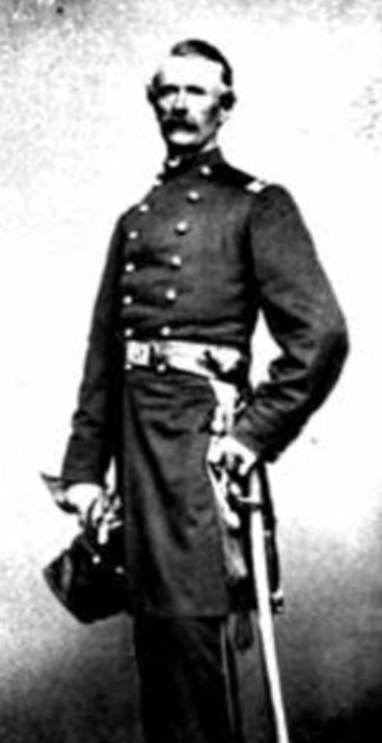
One final note – Corporal Dickey provides a telling personal interaction with Lehmann at a pivotal time. It was 1865. With the war at an end and the trials of Andersonville behind them, the 103rd was waiting out the final days in North Carolina before heading home. Dickey was working as a clerk, and on the afternoon 15th of April he was riding at a wild gallop, telegraph in hand, in search of the Colonel.
“As I was flying on a narrow road bordered on either side by a dense wood I ran into the colonel and an accompanying cavalcade. Before I could get my voice he started to upbraid me for frightening his horse which was rearing and plunging from the shock I had given it by almost colliding my horse with it. “President Lincoln is dead” was all that I could utter. The Colonel raved and swore, and then cried like a child.”
It was the only time throughout the war that Dickey witnessed such a reaction from his colonel. For a man who had known the cost of war, the news was almost too much to bear.
American by Choice
Despite the inevitable gaps in the historical record, we are fortunate to know so much about Theodore Friedrich Lehmann. After arriving in America in 1837, he lived a life of public service and civic commitment. He embodied Enlightenment ideals of reason, education, and constitutional order.
When the moment of crisis came, he made a deliberate choice. For him, the American republic represented something worth defending – even at nearly fifty years of age.
His choice still resonates today.
Sources
- “Multiple Classified Advertisements.” National Intelligencer, 31 Aug. 1858. Nineteenth Century U.S. Newspapers.
- Ancestry.com. U.S., City Directories, 1822–1995 [database on-line]. Lehi, UT: Ancestry.com Operations, Inc., 2011.
- Dickey, Luther S. History of the 103rd Regiment, Pennsylvania Volunteers. 1910.
 So Nobly Advanced
Leave a comment