
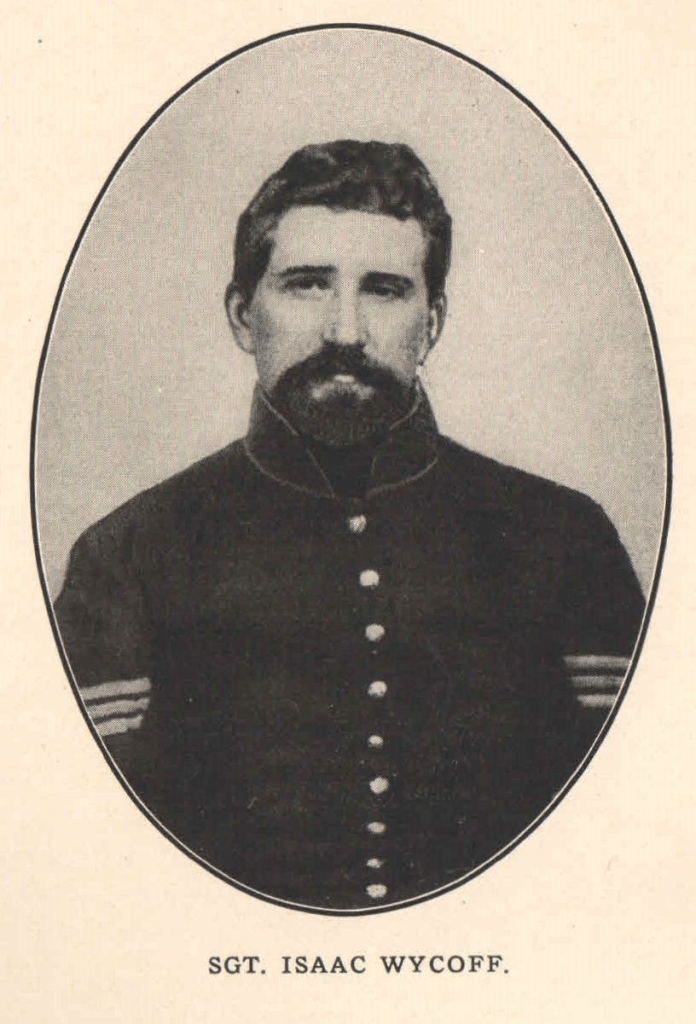
In one record he appears as Wykoff, in another as Wycoff. The letters shift, the spelling unsettles – but the man remains.
His likeness survives in a regimental history printed decades after the war. His death is fixed to a single day, though even that day is not entirely agreed upon. And years later, even his body would be brought home and set among his family, where the name, however written, could still be read.
The Human Story
Isaac Wykoff, Jr. was born on 6 December 1833 in Elizabeth Township, Allegheny County, Pennsylvania, the son of Isaac Wykoff and Gertrude Van Kirk. He belonged to a community that would send its men into the war not as distant figures, but as neighbors – known by face, by family, and by name.
On 22 August 1862, he entered service in Company E of the 155th Pennsylvania Infantry. He rose to the rank of sergeant. Less than a year later, he would be dead.
He was twenty-nine years old.
The Ground / Context
In the summer of 1863, the Army of the Potomac moved north to meet the Confederate advance in Pennsylvania. The 155th Pennsylvania Infantry, part of the Fifth Corps, was brought onto the field at Gettysburg and directed toward the Union left – a position whose importance became clear only as the moment demanded it.
That ground was Little Round Top.
The regiment advanced at the double-quick with Weed’s Brigade toward the crest, taking position among the rocks and timber along the upper slopes of the hill. Below them, in the broken ground of Devil’s Den, “Confederate sharpshooters concealed in the rocks of Devil’s Den… picked off exposed men.”
It was not a field of sweeping movement, but of position – of holding ground under precise and constant threat. The hill itself was broken and irregular, “covered with immense rocks and boulders,” forcing the men to fight from behind stone and timber, exposing only what was necessary to return fire.
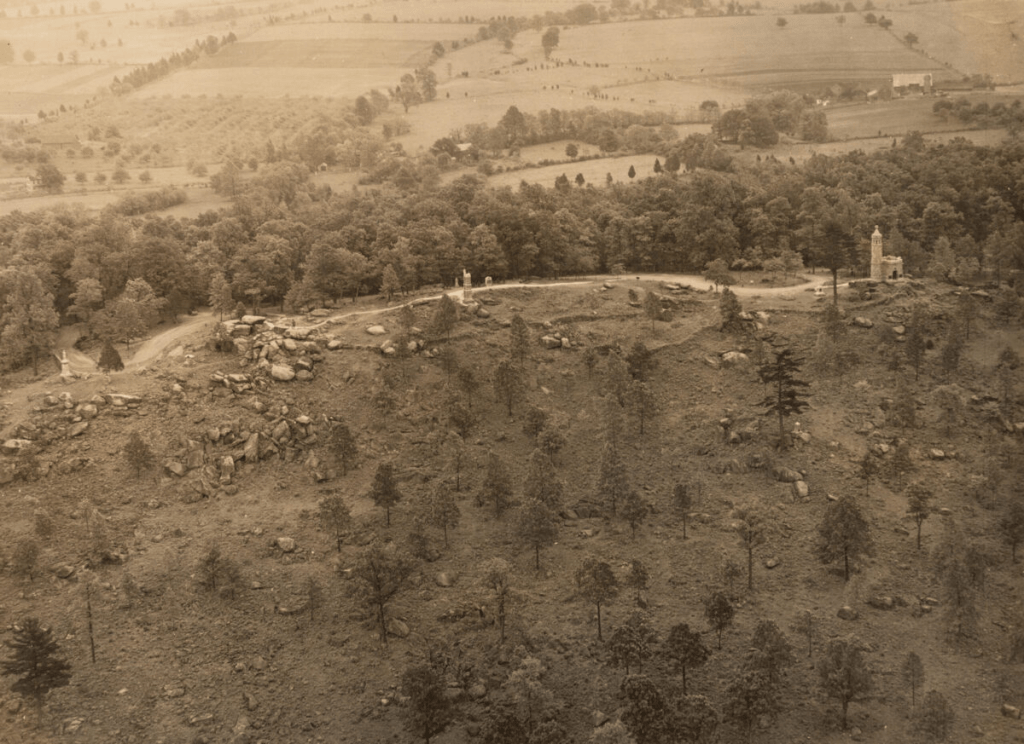
It was also a position where command itself was exposed. Officers and men alike were subject to the same fire, and the loss of leaders on that ground came as suddenly as that of the rank and file.
The regiment’s losses were comparatively light – six men killed and thirteen wounded – but each fell where the ground mattered most.
Among those struck was Sergeant Isaac Wykoff of Company E.
What the Records Actually Say
The record preserves him, but not without fracture.
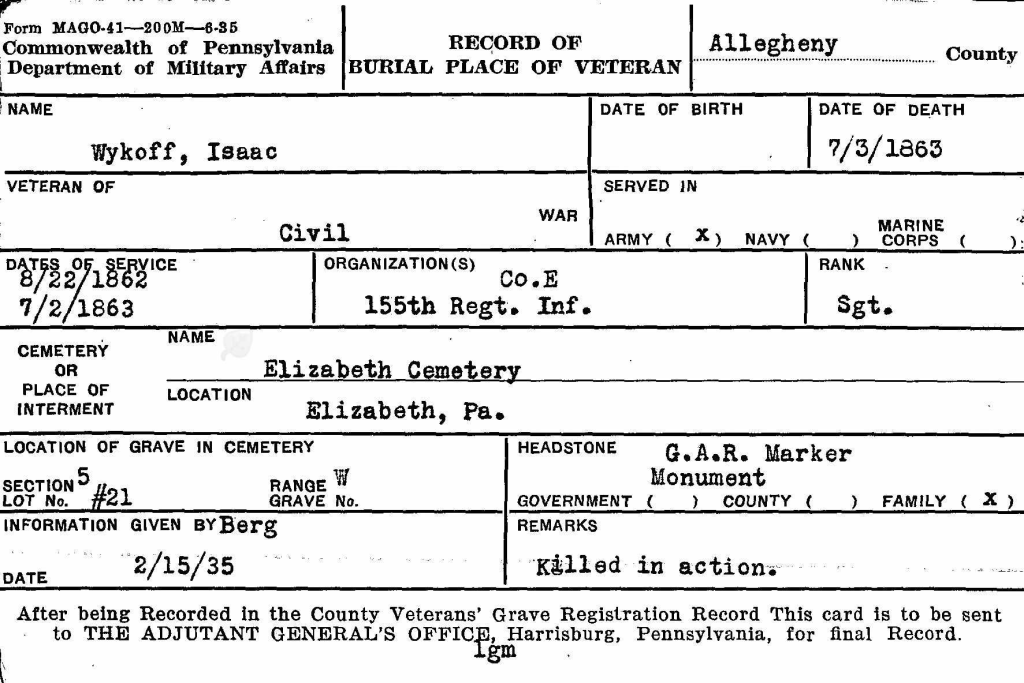
A Pennsylvania Department of Military Affairs burial card identifies Isaac Wykoff, Company E, 155th Pennsylvania Infantry, as a sergeant ‘killed in action‘, with a recorded death date of 3 July 1863. His place of burial is given as Elizabeth Cemetery in Elizabeth, Pennsylvania.
His headstone provides a sequence: that he was wounded at Gettysburg on July 2, 1863, and died the following day, and identifies him as the son of Isaac and Gertrude Wykoff.
The regimental history provides a more immediate account. It records that Sergeant Isaac Wycoff, standing “a little higher up on the hillside” near Private William Welton, was instantly killed by a minie ball entering his forehead during the fighting on Little Round Top. The same account attributes their deaths to sharpshooters firing from the rocky ground below.
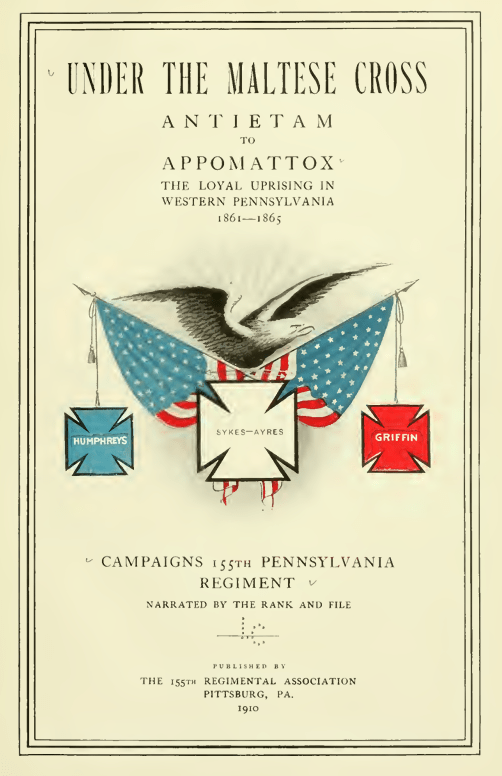
Within this same record, his death is listed among the casualties of the battle as occurring on July 2, 1863, reflecting the day of the action in which he fell. In the immediate aftermath, the dead were gathered where they lay. Wykoff’s body was carried from the line to the rear by order of Lieutenant Powers and there placed in a temporary grave. The conditions of the field allowed little time for permanence. As the record notes in the case of his comrade Welton, such burials could be imperfectly marked, leaving their exact resting places to memory rather than to formal record.

A later newspaper notice, dated 1893, records that the bodies of the Wykoff family – including “Isaac Wycoff, Jr., … killed at Gettysburg” – were removed from a family burying ground and reinterred in Elizabeth Cemetery.
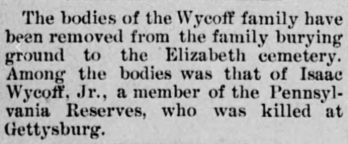
Even in these records, the name does not remain fixed. It appears as Wykoff and Wycoff, each preserving the same man in a different form.
What can be stated with confidence is this:
He served as a sergeant in Company E of the 155th Pennsylvania Infantry.
He was killed in the fighting on Little Round Top on July 2, 1863.
And he was returned home.
Memory & Meaning
There are soldiers whose stories survive in detail – letters, reports, and long accounts of action. Others are preserved in fragments: a name that shifts in the record, a date that reflects different moments of the same event, a single line that confirms only that they did not return.
Isaac Wykoff is one of those men.
What remains is not an extended account of his life, but a moment – standing on a hillside, exposed to fire, struck down where he stood. It is enough to know the ground, and the cost of holding it. He was not one among many. In a regiment that lost few, each loss marked a point where the line had been tested.
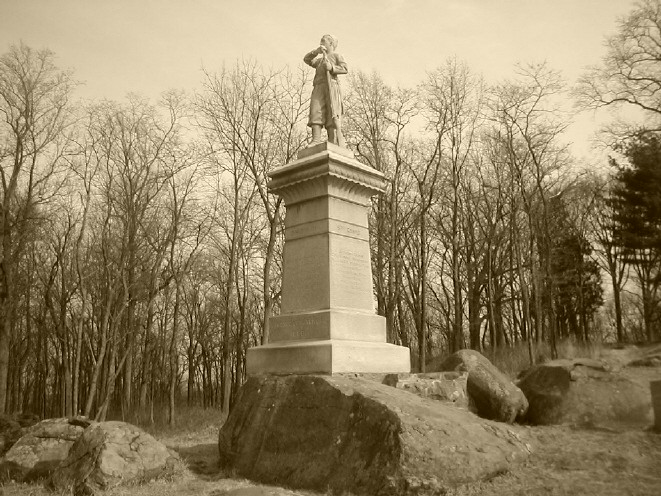
What remains as well is the act that followed. Years after the war, he was brought home and placed among his family, where his name could continue to be spoken, even if not always written the same way. The record does not preserve him completely. It does not need to.
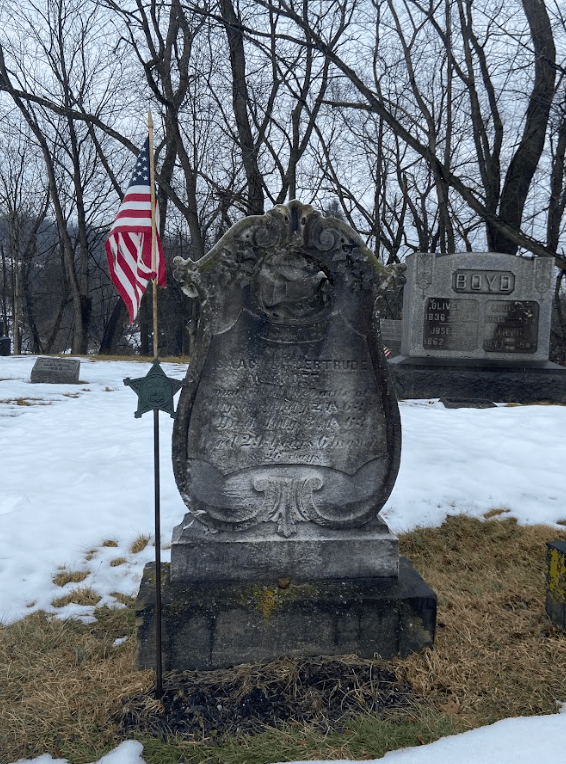
Memory does not depend on perfection. It depends on continuation.
He endures where he is carried – on a stone that names him as a son, on a hillside where he did not leave his post, and in the act of noticing him still. The name may shift, but the man remains. To read it, even imperfectly, is to complete the work left to the living – to carry forward what was given, and to do so, as they did, so nobly advanced.
Sources
- Pennsylvania Department of Military Affairs, “Record of Burial Place of Veteran,” Isaac Wykoff, Co. E, 155th Pennsylvania Infantry
- Headstone inscription, Elizabeth Cemetery, Elizabeth, Allegheny County, Pennsylvania
- The Daily Republican (Mon, July 3, 1893), notice of reinterment of Wykoff family remains
- Under the Maltese Cross: Antietam to Appomattox: Campaigns of the 155th Pennsylvania Volunteers (Regimental Association, Pittsburgh, 1910)
- Busey, John W.; Martin, David G. Regiment Strengths and Losses at Gettysburg, 4th ed. (2005), p. 135
- FamilySearch, “Isaac Wykoff”
 So Nobly Advanced
Leave a comment