
Part of Series “The Architecture of War”
War is often remembered by its collisions….
Armies meet. Lines break. Commanders decide. Men advance into smoke.
But beneath those visible moments lies another kind of war: the war of movement. Before an army could fight, it had to arrive. Before it could remain, it had to be supplied. Before it could pursue, it had to be fed, reinforced, and connected to the world behind it.
In the Civil War, that hidden war increasingly ran on rails.
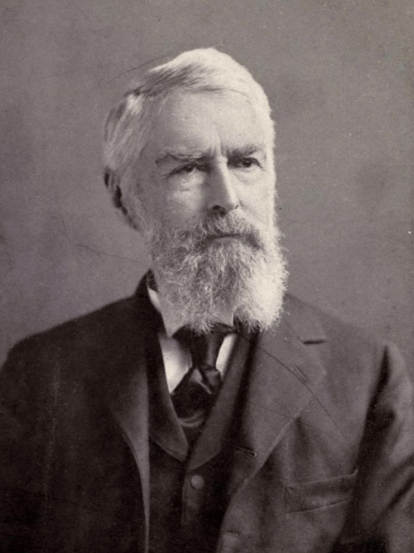
Herman Haupt understood this with distinct clarity. He was not merely a railroad engineer attached to the Union army. He was one of the men who helped transform railroads into instruments of war and impose operational order upon military movement itself.
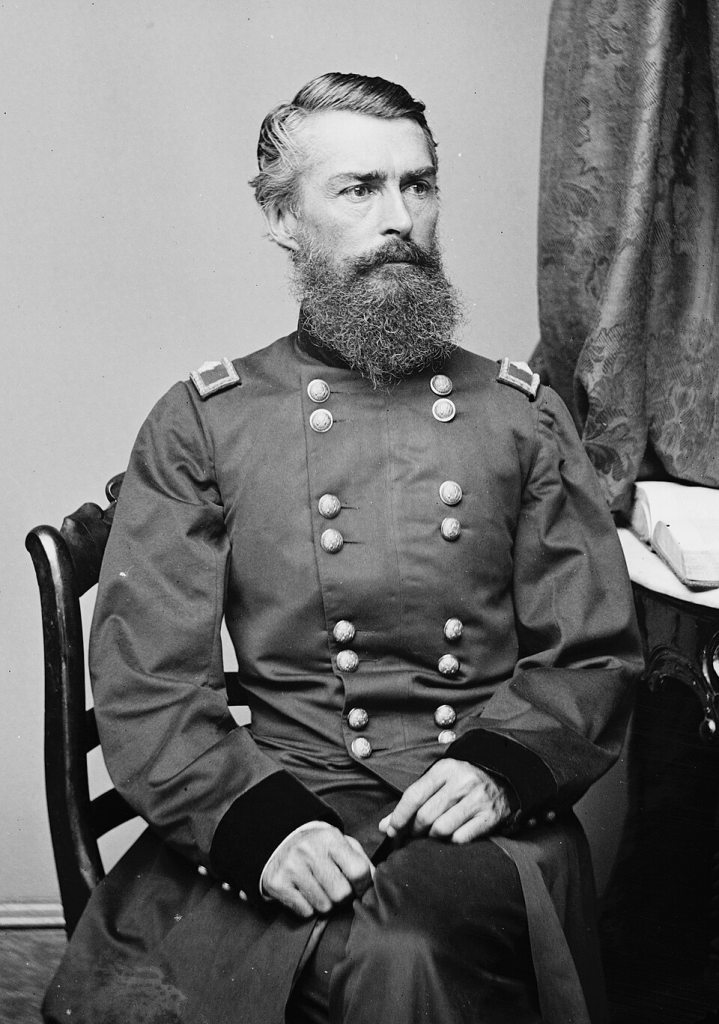
His Reminiscences reveals a man who thought in systems. Rails, bridges, depots, crews, rolling stock, telegraph lines, schedules, and command authority were not separate matters to him. They were interdependent parts of a single machine. If one failed, the army slowed. If the system held, armies could move.
That was Haupt’s architecture: Mobility.
The Engineer Before the War
Haupt’s Civil War usefulness began long before Fort Sumter.
The biographical sketch that opens Reminiscences describes him as “a designer and builder of roads and bridges; a constructor of railroads and tunnels; a professor and author; an inventor and master mechanic; a military strategist and civil counsellor; a railway manager and canal engineer.”
The description explains why Edwin M. Stanton later summoned him to Washington. Haupt was not simply a technician. He had spent his life studying how structures carried weight, how transportation systems functioned, and how movement could be organized at scale.
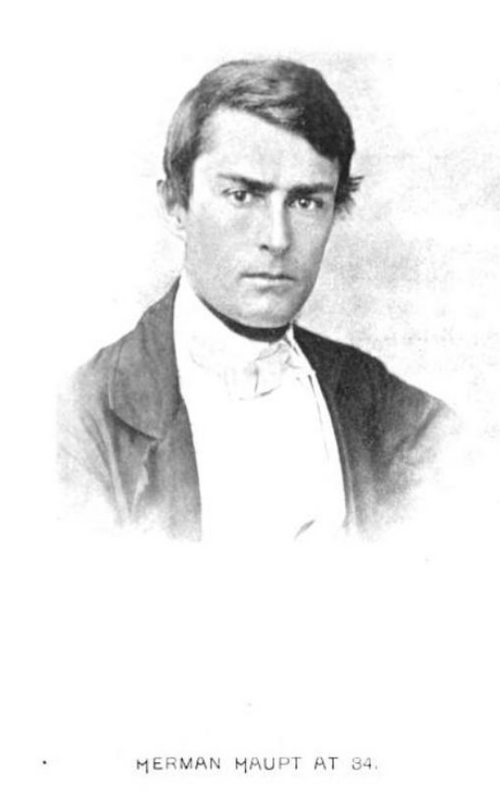
As a young engineer on the York & Wrightsville Railroad, Haupt became dissatisfied with existing bridge designs and methods for calculating truss strength. According to the memoir, he found that many engineers did not fully understand how strains moved through bridge systems. Rather than accept inherited practice, he “continued to search for the laws governing the transmission of strains” and sought methods by which “the strength of any truss, however complicated, might be accurately determined.”
That background mattered profoundly in wartime.
The Civil War became a war of damaged infrastructure. Bridges were burned, rails torn up, wharves destroyed, and supply lines repeatedly disrupted. In such a war, engineering was not merely support work. It became operational necessity.
Haupt’s prewar railroad experience also taught him organization and management. He studied operating systems, freight movement, schedules, and transportation economics. This combination – engineer, manager, organizer, and West Point graduate – made him unusually suited for the Union’s emerging logistical crisis.
The Union did not merely need railroads. It needed railroads governed as instruments of war.
Called to Washington
In April 1862, Stanton summoned Haupt to Washington.
The immediate problem was operational. The Army of the Potomac was before Yorktown, while the Army of the Rappahannock remained near the Potomac. Haupt later wrote that effective cooperation between them was considered “impossible without the railroad as a means of communication with the depots on the base of the Potomac.”
That sentence reveals the core of Haupt’s significance.
The railroad was not an accessory to military operations. It was what made large-scale operations possible.
Haupt found the railroad from Acquia Creek to Fredericksburg heavily damaged. In his final report, he described burned wharves and buildings, torn track, consumed ties, removed rails, destroyed bridges, and unsafe strap rail requiring replacement.
War had turned infrastructure into wreckage.
His task was to restore motion.
The Potomac Creek Bridge
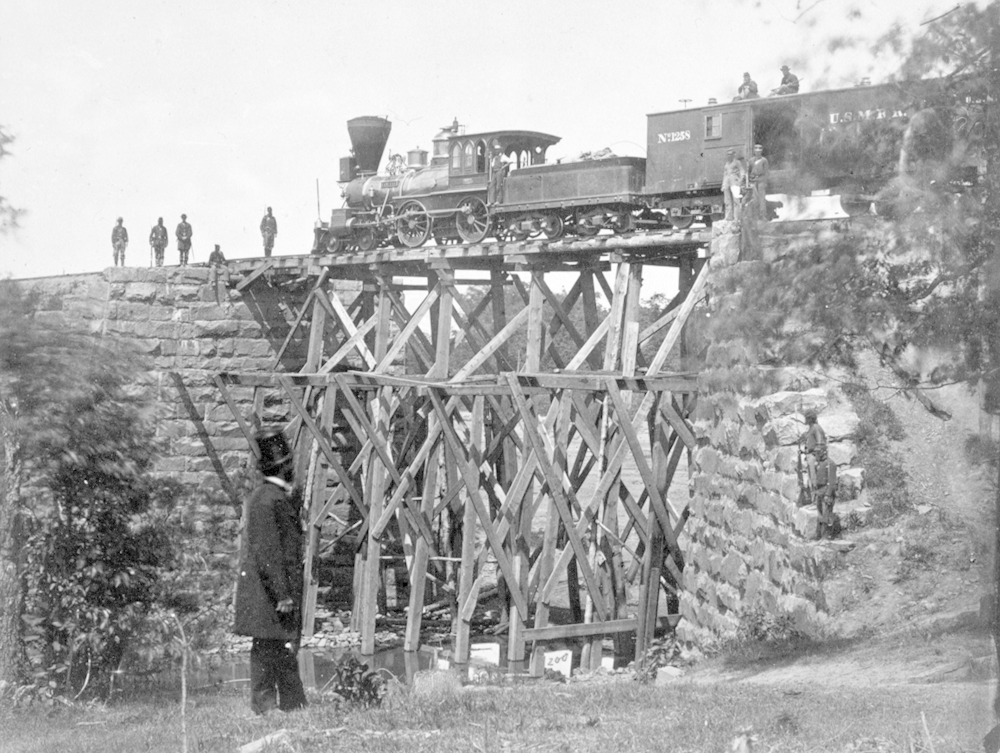
Haupt’s most famous wartime achievement was the Potomac Creek Bridge.
The structure became legendary partly because of Abraham Lincoln’s reported remark that it appeared to be built of “cornstalks and beanpoles.” The phrase survived because it captured the improvised appearance of wartime engineering. Haupt’s bridges could look temporary while carrying enormous military weight.
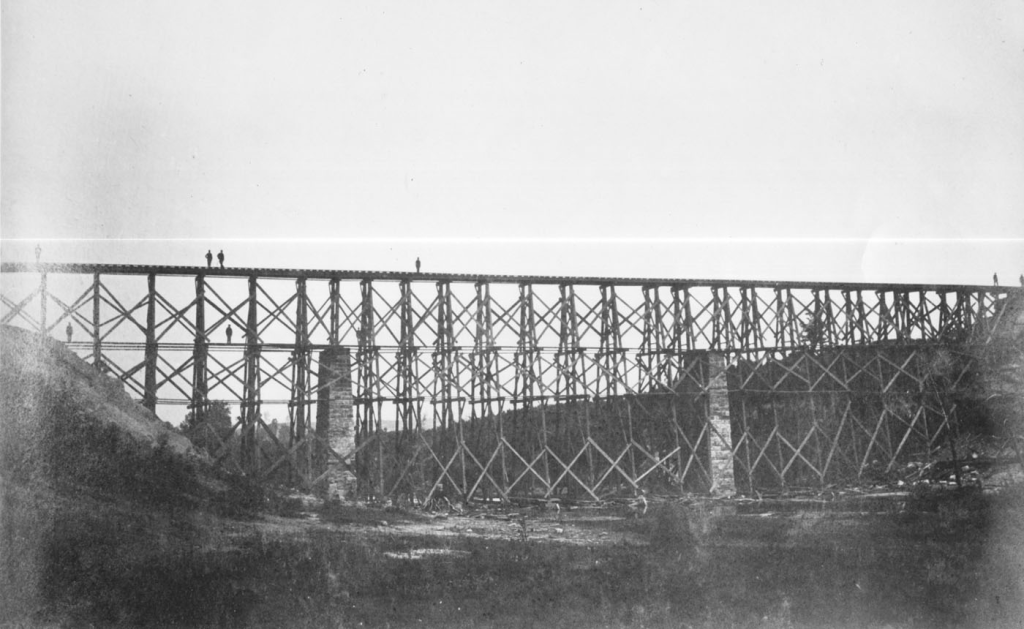
The memoir gives the practical details. The bridge stood nearly eighty feet high and four hundred feet long. It carried ten to twenty heavy trains daily in both directions and “withstood several severe freshets and storms without injury.” Most remarkably, it was completed in May 1862 “in nine working days,” while the original bridge it replaced had required “as many months as this did days.”
That comparison reveals Haupt’s deeper contribution. He altered the relationship between destruction and recovery.
In conventional thinking, a destroyed bridge could halt operations for weeks or months. Haupt treated reconstruction as part of operational tempo itself. A bridge did not have to be permanent to be decisive. It had to be strong enough, fast enough, and ready when needed.
That practical mindset became one of the Union’s great wartime advantages.
The Union Learns to Move
The Civil War was not simply a larger version of earlier American wars.
Its armies were enormous by previous national standards, and their needs were continuous. Food, ammunition, forage, medical supplies, reinforcements, prisoners, and information all had to move through increasingly complex networks.
Wagon trains remained essential, but wagons alone could not sustain armies at the scale and speed the war increasingly demanded. Railroads compressed distance and accelerated concentration of force. They also created new vulnerabilities. A single destroyed bridge or blocked line could disrupt an entire campaign.
Haupt understood both realities. Railroads multiplied military power, but only if disciplined and properly managed.
This was where his contribution became more than technical. He helped professionalize military railroad operations.
“The Primary Cause Being Military Interference”
One of the clearest expressions of Haupt’s philosophy appears in his account of General John Pope’s Virginia campaign.
After briefly returning to Massachusetts, Haupt was recalled because, as he later wrote, “without my aid to organize and manage the operations of the Military Railroads it was impossible to keep the army supplied.”
What he found was chaos.
“The road was in a state of blockade,” he wrote, with “very few trains moving, everything in great confusion; the primary cause being military interference.”
That phrase – “military interference” – became central to Haupt’s thinking.
To him, railroads could not be effectively managed through improvisation or rank alone. Tracks had limited capacity. Cars had to be unloaded and returned. Crews required direction. Schedules mattered. Sequence mattered.
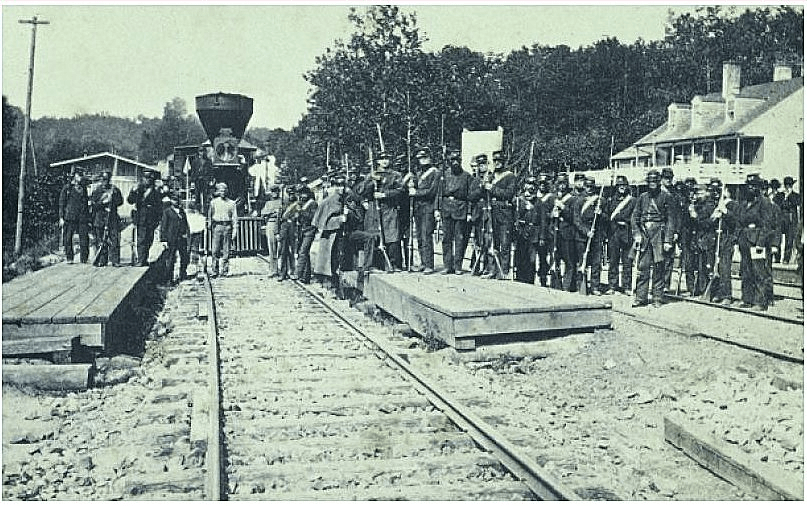
Pope issued orders forbidding officers from interfering with railroad operations. Haupt established rules, enforced punctuality, and imposed operating discipline. Within “two or three days,” he wrote, “regularity was again restored.”
This is the architecture of mobility in its purest form.
Not battlefield heroics. Authority, expertise, sequence, and flow.
Haupt believed modern armies required specialized systems governed by people who understood them. A general could command an army and still mismanage a railroad.
Haupt refused to allow that confusion to continue.
Second Bull Run and the Railroad Under Fire
The Second Bull Run campaign tested the system under crisis.
Haupt recorded severe losses after Confederate operations disrupted Union communications. He wrote that seven locomotives fell into Confederate hands and 277 freight cars were destroyed.
Yet the more revealing portion of the account concerns the effort to maintain movement during danger.
“Great exertions were made,” Haupt wrote, “to preserve and maintain intact the communications with the army.” Troops were sent by rail to protect bridges. Supplies continued forward. Telegraph operators and scouts gathered information. Railroad employees remained at stations loading cars and removing stores even after guards had withdrawn.
Haupt especially praised those workers. “Night and day,” he wrote, railway employees remained at their posts, performing “the most dangerous duties without rest or regular food.”
That passage reveals something often overlooked in Civil War memory.
The architecture of mobility depended not only upon engineers and generals, but upon exhausted railroad men working under threat to keep armies functioning.
After Antietam
After the Maryland Campaign, Haupt’s attention again turned to the practical limits of movement.
In October 1862, McClellan asked him to examine the Leesburg Railroad, prepare supply arrangements through the Orange & Alexandria and Manassas Gap Railroads, rebuild the Rappahannock bridge at Fredericksburg, restore wharves at Acquia, and provide rolling stock.
Haupt’s reply was direct: “Your commands will receive prompt attention.”
He then assessed the actual condition of the lines. Eighteen miles of the Leesburg Railroad remained usable. Beyond that, track had been destroyed, ties burned, iron scattered, and bridges damaged in six locations.
This exchange captures Haupt’s real value. He translated military desire into operational reality. Generals could formulate plans. Haupt determined whether the physical network could sustain them.
Wreckage and Restoration
Confederate forces understood that railroads were military targets. Bridges could be burned, rails twisted, depots destroyed, and communications severed.
Haupt understood the counter-principle. Destruction mattered only if restoration could not keep pace.
The illustrations in Reminiscences reveal how deeply he studied this problem. The volume includes military bridges, bridge trusses, track-wrecking apparatus, twisted rails, methods for destroying track, methods for straightening rails, blanket boats, arks, and canal boats transporting loaded cars.
This is the visual record of a mind studying mobility as an integrated system.
Haupt was interested in how to build, repair, transfer, protect, improvise, and resume movement under wartime conditions.
His battlefield was the network itself.
The Gettysburg Emergency
While Gettysburg should not dominate Haupt’s story, the campaign offers one of the clearest examples of his operational method.
During Lee’s invasion of Maryland and Pennsylvania, Haupt replenished the Army of the Potomac through the Orange & Alexandria Railroad before the pursuit resumed toward Frederick. Near Frederick, the Baltimore & Ohio became the principal supply line.
There Haupt encountered what he called “that prolific source of Military Railway troubles” – the detention or appropriation of trains by military authority independent of railroad supervision.
Again, the problem was interference.
After relieving the blockade, Haupt assumed military control of the Western Maryland Railroad from Relay House to Westminster. The line lacked adequate sidings, turntables, fuel, and water stations. It was designed for perhaps two or three trains daily. The army required approximately thirty trains per day in both directions.
Haupt responded with improvisation and systems management. Engines, crews, coal, and wood were brought from Alexandria. Water was carried by buckets from a nearby dam. An abandoned turntable was restored. Cars were unloaded rapidly on the main line to avoid congestion.
“The extraordinary service so suddenly required of the road,” Haupt wrote, “was satisfactorily performed.”
That sentence captures Haupt’s entire wartime approach.
Identify the constraint.
Import capacity.
Restore flow.
Keep the army moving.
The Final Report
Haupt’s final report, dated September 9, 1863, was his last official act connected with the Bureau of United States Military Railroads.
The report is factual, compressed, and operational. It reviews the reconstruction of the Acquia Creek line, the repair of bridges and track, the disorder during Pope’s campaign, the railroad work after Antietam, and operations connected with Lee’s invasion of Maryland and Pennsylvania.
Near the end, Haupt made his strongest claim. The Armies of the Rappahannock, Virginia, and Potomac, he wrote, “while dependent on the railroads under my charge, have never suffered inconvenience or been delayed in their movements from any deficiency.”
Because the report is self-authored, the claim should be read critically. Haupt was defending his record. Yet the statement remains important because it reveals how he defined success.
Not by battlefield glory. But rather, by the absence of failure.
No deficiency.
No interruption.
No operational paralysis.
Period.
Successful logistics often disappears into the operations it enables. When it fails, everyone notices. When it works, armies simply move.
That is why Haupt’s contribution can be difficult to see. His monument was continuity.
A Difficult but Necessary Figure
Haupt’s memoir also reveals impatience, sharp judgments, and recurring conflict with military authority.
He disliked interference, criticized inefficiency, and defended technical expertise. Those qualities made him highly effective, but not always easy within a military hierarchy still adapting to industrial systems.
In September 1863, Stanton relieved Haupt from further War Department duty and directed him to transfer his office and papers to Colonel D. C. McCallum.
The episode reflects an important tension within the Civil War itself.
The conflict increasingly required technical specialists, but armies still operated through rank, personality, politics, and departmental authority. Haupt stood directly at that point of friction between military command and industrial expertise.
He was necessary because the war was becoming modern. He was difficult for the same reason.
Why Haupt Matters
Herman Haupt’s contribution was not that he singlehandedly won the Civil War. His contribution was more precise and even more significant.
He helped transform mobility from an auxiliary function into a governed operational system.
He brought engineering discipline to bridge repair, organizational discipline to military transportation, and operational discipline to railroad management. He understood that command intention meant little unless armies could be physically sustained.
The Union did not merely possess greater industrial resources than the Confederacy. Under men like Haupt, it increasingly learned how to operationalize them.
That was one of the great structural advantages of Union victory.
The Armies Continued Moving
Herman Haupt’s war was fought in the interval between destruction and restoration.
It was fought where bridges had to rise again, where rails had to be relaid, where exhausted railroad men continued working without sleep, and where military plans had to be translated into physical possibility.
He gave the Union more than bridges.
He gave it motion.
And motion gave strategy its body.
Without mobility, armies became stranded masses. With it, they became instruments of national purpose. Haupt’s achievement was helping convert Northern industrial strength into operational reach – making the power of the Union move.
His work was often invisible because it succeeded.
But the trains reached the depots.
The supplies came forward.
The wounded went back.
The armies continued moving.
That was the architecture of mobility. And through it, Herman Haupt helped carry forward the unfinished work – So Nobly Advanced.
Primary Source
– Haupt, Herman. Reminiscences of General Herman Haupt. Milwaukee: Wright & Joys Co., 1901. (Download available above)
 So Nobly Advanced
Leave a comment