
On the morning of July 1, 1863, the Army of the Potomac stood at a moment when authority itself would determine survival.
Its advance elements were engaged at Gettysburg. Its commander, Major General George G. Meade, remained miles away. And the officer upon whom the army’s forward direction depended – Major General John F. Reynolds – was dead. With his fall, the question of command did not resolve – it multiplied.
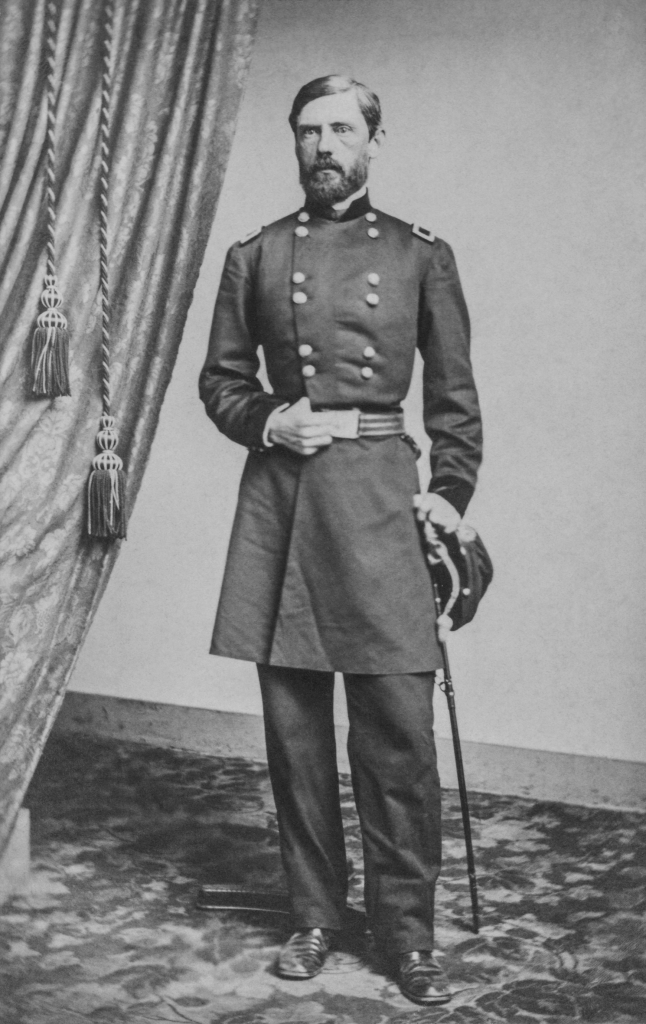
What followed would not be decided by rank alone, but by how command could adapt under pressure – and whether that adaptation could hold.
In most armies, the system would have carried forward on its own. Rank would determine succession. Seniority would establish authority. Orders would follow established channels.
But the Army of the Potomac in the summer of 1863 was not operating under most circumstances.
For much of the war, its commanders had been constrained – by Washington, by politics, and by a structure that did not easily allow for independent action. Under Major General Joseph Hooker, that tension had reached a breaking point. His relationship with General-in-Chief Henry W. Halleck had been marked by friction, mistrust, and constant negotiation over authority. Decisions that might have been made in the field were instead shaped – and at times constrained – by oversight from afar.
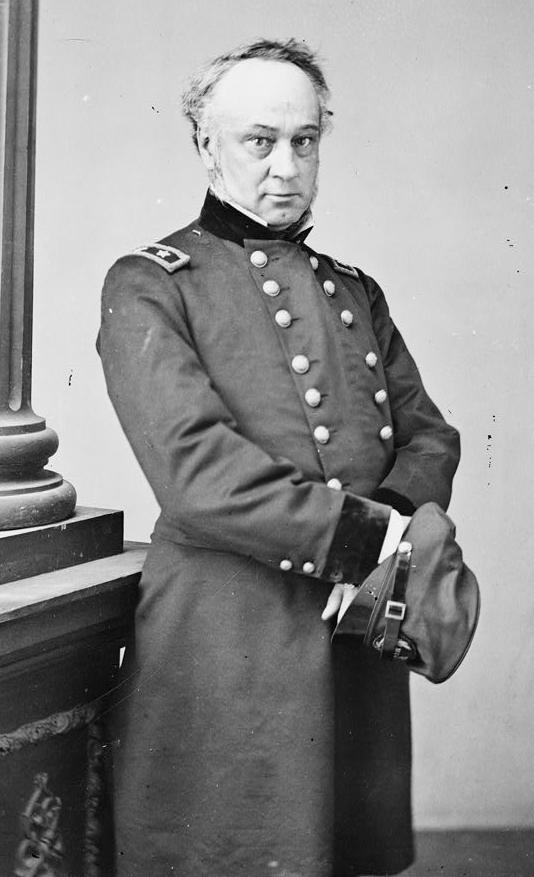
When Meade was appointed to command on June 28, that dynamic shifted. Halleck did not impose the same operational constraints, nor did he immediately reassert them.
Meade was given broader discretion – less interference, fewer immediate limitations, and a greater expectation that he would act according to the demands of the moment. This freedom extended beyond movement and positioning. It reached into the exercise of command itself.
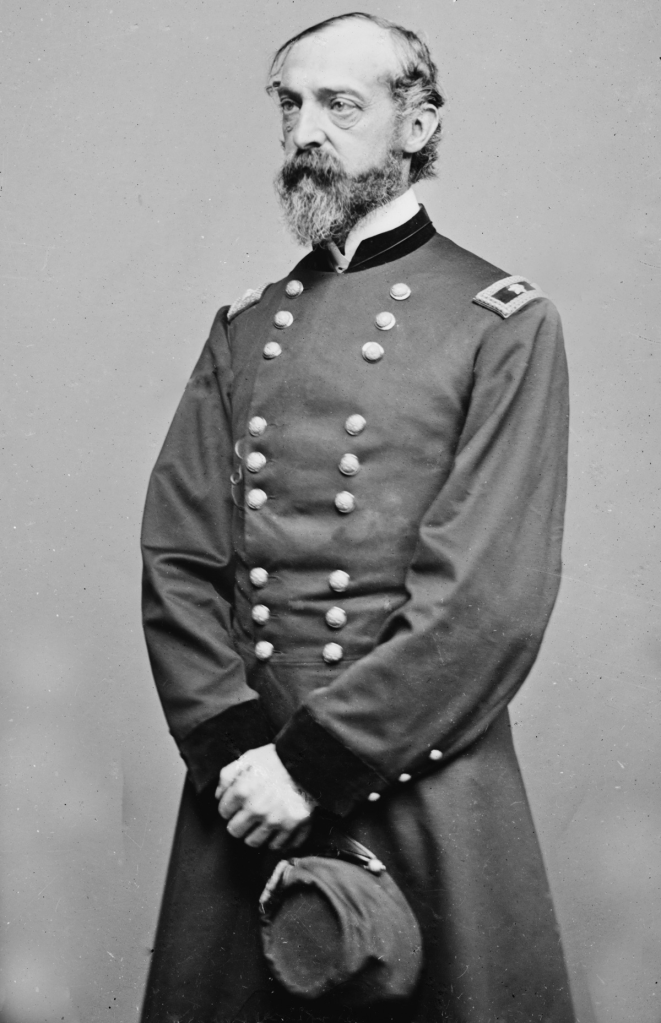
Where earlier commanders had been expected to adhere closely to rank and seniority, Meade was afforded latitude to designate command according to necessity. The expectation that authority must follow strict seniority was no longer absolute. He could elevate function over form – placing responsibility where it was most needed, even if doing so disrupted the established order.
It was not a formal rewriting of command structure – but it changed how that structure could be used. And at Gettysburg, on July 1, that difference mattered.
Because when the system no longer required strict adherence to hierarchy, Meade did not hesitate to act within this expanded authority.
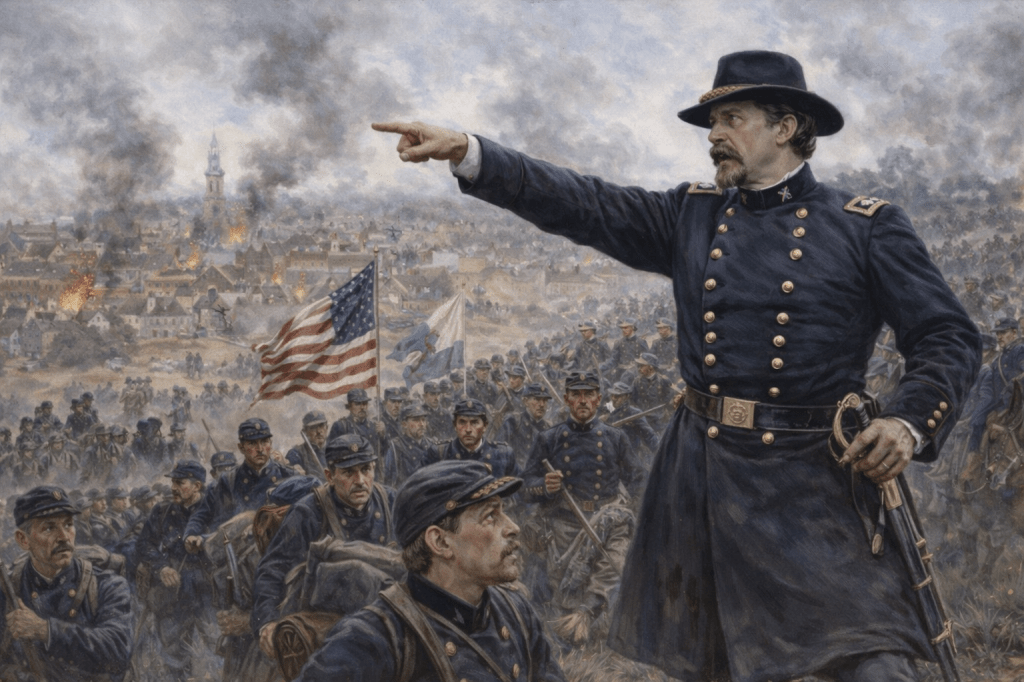
He sent Major General Winfield Scott Hancock.
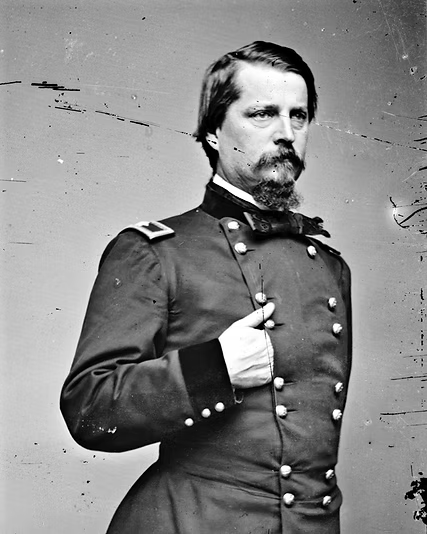
That decision did more than dispatch an officer – it altered how authority itself would function on the field at Gettysburg.
Authority Chosen, Not Inherited
By the afternoon of July 1, the question was no longer whether a battle was developing at Gettysburg, but whether the Union army would arrive there in time – and in order – to fight it.
On the field was Major General Oliver O. Howard, who by rank held command. In that moment, authority rested with him – until Meade chose otherwise.
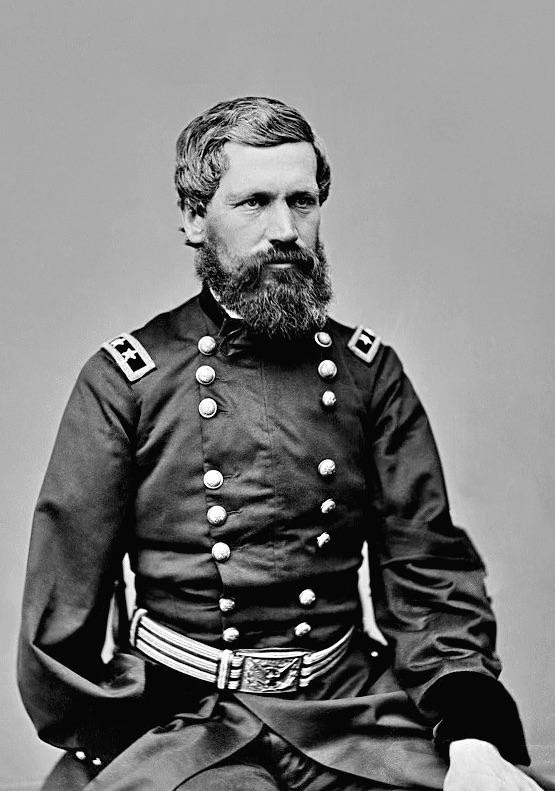
Howard had not failed in his duty. On the contrary, he had acted decisively. Arriving earlier in the day, he had assessed the ground, recognized the importance of Cemetery Hill, and designated it as the rallying point for Union forces should they be driven back through the town. It was a sound decision – one that preserved the army’s ability to hold a position at all.
But Meade’s concern was not whether the ground had been chosen – it was whether the army, as a whole, could cohere around it.
What Meade required was not simply command by rank – but command aligned with his intent.
Hancock had just come from Meade’s headquarters. He understood the broader operational picture – the defensive posture, the significance of terrain, and the contingency that the army might concentrate on a strong line, whether at Gettysburg or elsewhere (such as Pipe Creek). He carried not only orders, but the reasoning behind them.
When Hancock pointed out the obvious – that he was junior to Howard – Meade did not backstep in procedural caution. The situation did not allow it. Instead, he exercised the flexibility that had, until recently, been far less available to commanders of the Army of the Potomac.
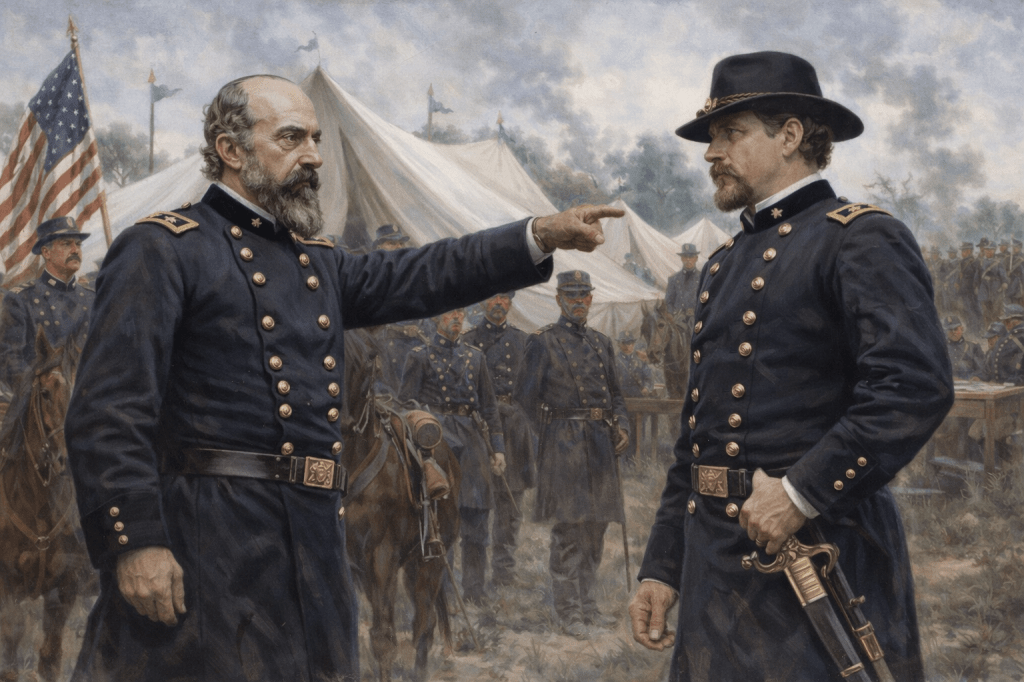
In this instance, authority would not follow rank – it would follow necessity.
And Hancock accepted.
But authority alone was not enough. It required ground upon which to act.
The Ground – A Position in the Making
By the time Hancock approached Gettysburg – likely between 3:00 and 3:30 in the afternoon – the field was in a state of transformation.
As described by Harry W. Pfanz, the retreat through Gettysburg was marked by confusion, fragmentation, and mounting pressure. Yet even within that disorder, units were not dissolving – they were converging toward the high ground.
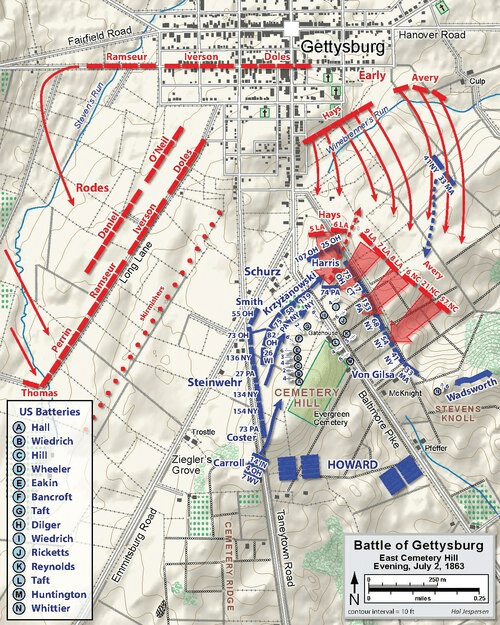
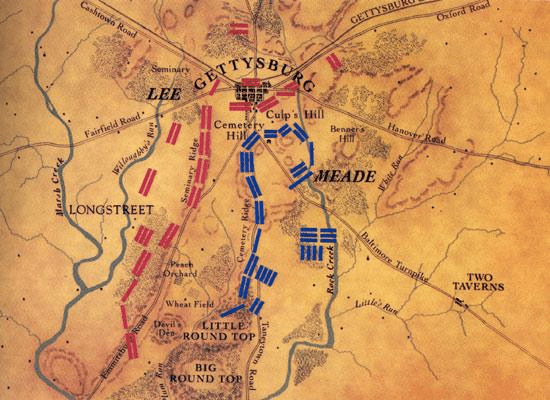
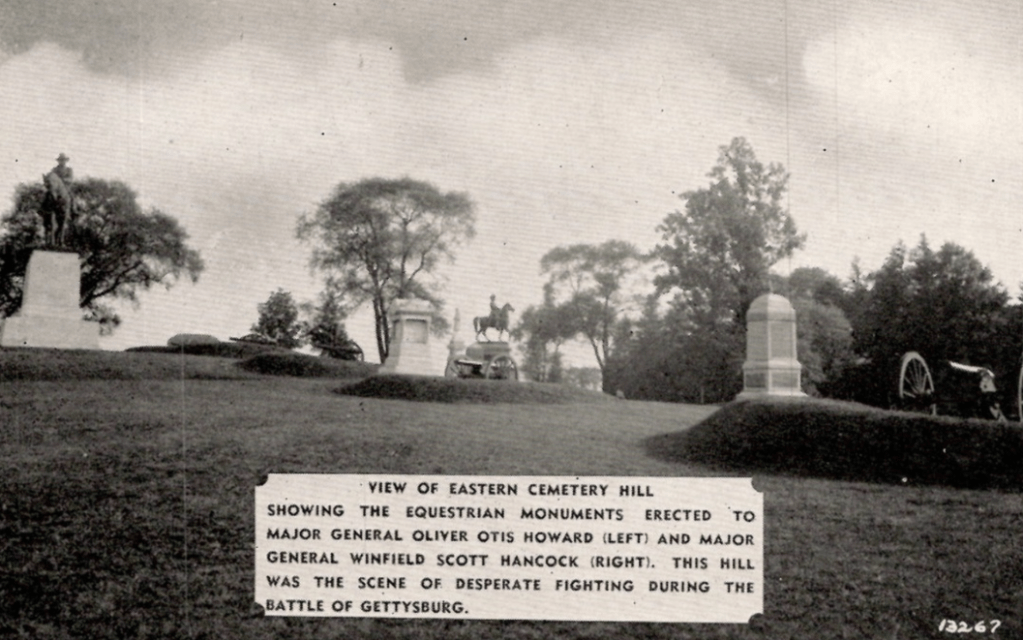
Cemetery Hill had become the focal point. Its elevation commanded the surrounding ground. Its position anchored the roads leading south toward the rest of the army.
When Hancock arrived, he found not just chaos, but something more fragile – and more important. He found a position in the process of becoming a line.
The ground existed. The men were arriving. What remained was the task to unify and cohere them.
A Meeting on the Hill
By the time Hancock reached Cemetery Hill, the position existed – but the line did not yet.
At the crest of the hill, near the Baltimore Pike, he encountered Howard. The moment was brief and direct.
Howard had already acted. He had chosen the ground, directed the rally, and begun forming a defensive line. The army’s survival to that point owed much to those decisions.
Hancock arrived with something different, however. He carried Meade’s authority and vision – and with it, a purpose that extended beyond the immediate field.
Riding up to where Howard stood, Hancock informed him that he had been sent forward by General Meade to take command of the forces present. He had written orders to that effect and, by his own account, offered to show them.
Howard declined to read the order.
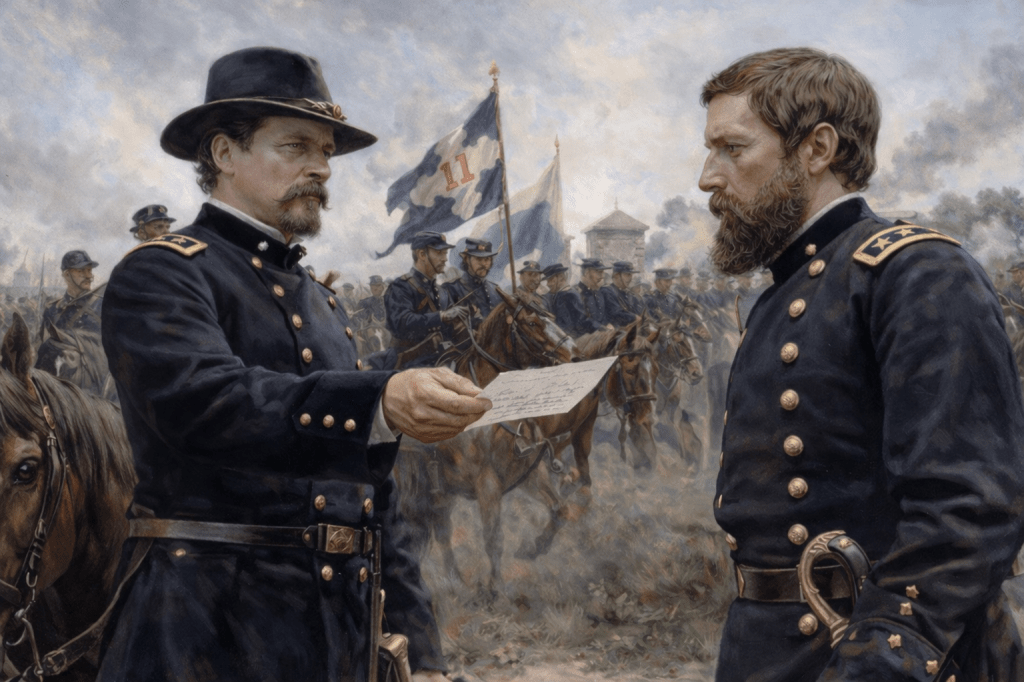
Howard did not contest the arrangement – but neither did the moment unfold as one of formal acknowledgment. The exchange was brief and shaped by urgency.
As Hancock later recalled, there was no time for extended conversation. The situation demanded action. The troops were still arriving, still reforming, and the line itself was not yet secure.
Hancock immediately began issuing broader dispositions – moving units, assigning positions, and shaping the emerging defensive line. Howard continued directing elements of his corps.
Whatever each man may have thought in that moment, neither allowed it to interrupt the crucial work at hand. And thus, the army continued to form.
What the Records Say
At investigation, the historical record does not describe this moment as a dispute – but neither does it support the idea of an immediately settled transfer of authority.
Hancock’s account (published in December 1876 in response to Howard’s claims) is explicit. He was sent forward “with an order superseding General Howard,” and upon arrival informed Howard that he had come “to take command of all the forces present.” Howard, according to Hancock, declined to read the order but ultimately “acquiesced” and understood the order’s meaning.
Set against this clarity is Howard’s account (published five months earlier in July 1876), which suggests a more limited or differently understood role in the moment. He would at times characterize Hancock as acting in a representative or coordinating capacity – such as a ‘temporary chief of staff for Meade‘ might do – rather than as fully superseding command.
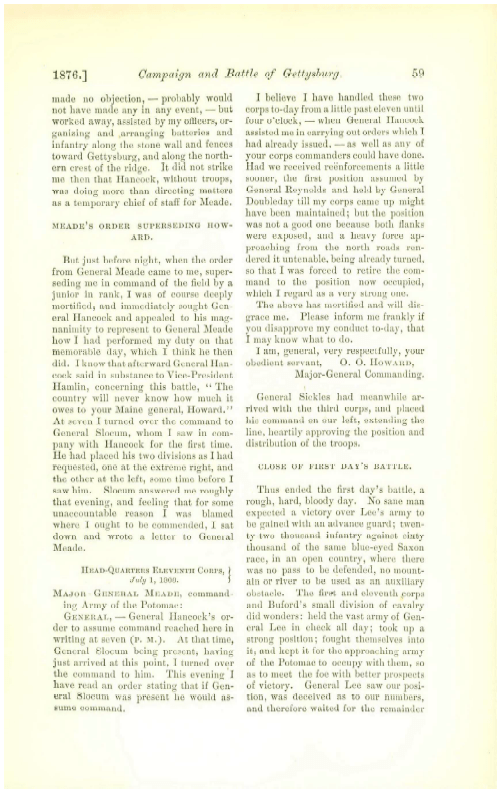
Even more telling is Howard’s private correspondence from the evening of July 1, in which he acknowledged the order and expressed to Meade that it had “mortified” him – evidence that the implications of Hancock’s authority were both understood and personally felt.
Ultimately, these accounts differ in perspective – but not in outcome.
What remains consistent across them is…
- Hancock arrived with written authority from Meade to assume command
- Hancock and Howard met on Cemetery Hill
- Hancock communicated that authority directly to Howard
- Howard did not resist the arrangement in action
- Both officers immediately turned their attention to organizing the field
In practice, Hancock exercised active, field-wide direction – issuing orders, placing troops, and shaping the defensive line. Howard continued to play a critical role, particularly in managing his own corps and supporting the formation of the position he had already chosen.
The result was not a rupture of command, but a compression and fusion of it.
Authority shifted – quickly, and under pressure – without disrupting the army’s ability to function.
The Structure Bends
This interpretation is reinforced by later historical analysis. As Edwin B. Coddington concludes in ‘The Gettysburg Campaign: A Study in Command‘, Hancock’s authority on the field was not merely nominal, but actively exercised in directing the placement and coordination of Union forces. At the same time, Howard’s continued cooperation ensured that this transition in command did not disrupt the army’s ability to function as a unified force.
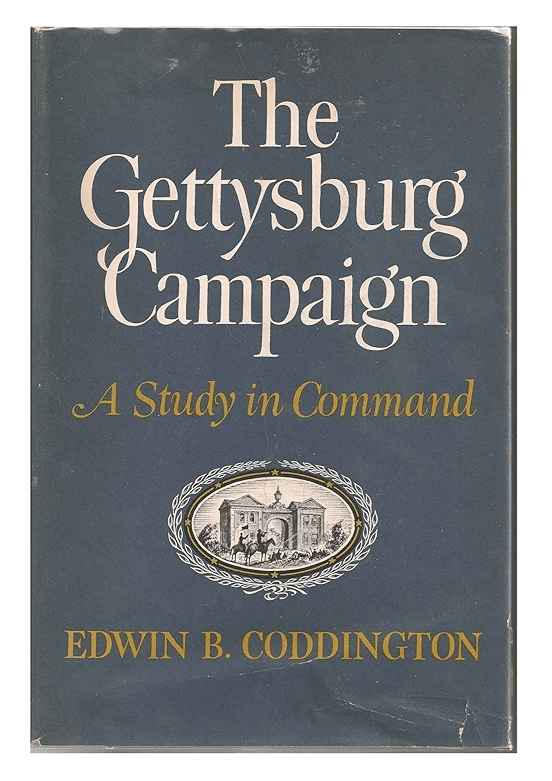
As Coddington illustrates in pages 216-219, “In those days it was the rule that even the general of an army could not make changes in command without… strict attention to seniority, and any major change had to receive the approval of army headquarters in Washington.”
But, under Meade, “Lincoln and Stanton authorized [him] to ignore this practice and make promotions as he saw fit.” Thus, the structure flexed. Meade now “had authority to appoint anyone to a command regardless of seniority, a power which was to prove of immense value to him.”
This authority was not theoretical. It was exercised – essentially immediately – on July 1.
Meade did not wait. He did not defer. He chose.
And in choosing, he redefined how authority would function on that field.
Howard did not resist in action. He worked alongside Hancock as the line took shape. It is only later that the meaning of that authority would be debated.
What mattered in that moment was not what was felt – but what was done. The line continued to form.
‘Hancock the Superb’ – Presence and Continuity
Structure alone does not steady an army in retreat. It must be made visible.
Hancock’s greatest contribution in those hours was not solely tactical. It was psychological.
He looked like command. He acted like command. And the men – officers and enlisted alike – responded.
In an army shaken by the death of Reynolds and driven back through town, his presence signaled that direction had not been lost.
At the same time, that signal depended on continuity.
Howard’s earlier decision, and his continued cooperation, ensured that Hancock’s authority could take effect without disruption.
Between them, the Union position at Gettysburg was not merely established. It was stabilized.
Where a Position Became a Line
By nightfall on July 1, the Army of the Potomac held the heights south of Gettysburg.
The position was incomplete. The line was imperfect. But it existed – and because it existed, the battle could continue.
That outcome did not begin with a charge. It began with decisions – made under pressure, shaped by circumstance, and enabled by a moment of unprecedented flexibility in command.
The command that Reynolds had carried forward in the morning did not end with his fall – it was transferred, reshaped, and held.
Authority did not follow rank that day. It followed necessity.
- Howard chose the ground.
- Meade placed authority where it was needed.
- Hancock unified and cohered the army upon it.
The structure did not break – it bent, because Meade had been given the power to bend it.
A position does not become a line by terrain alone – it becomes a line when trust, authority, and action converge.
On Cemetery Hill, that convergence was achieved – not by rigid adherence to form, but by the ability to adapt it.
Could this have been the change that made all the difference for the Army of the Potomac – an authority not bound strictly to seniority, but capable of adapting to necessity? And in that flexibility, might there have lain an advantage not always present in its adversary?
If so, then what held that line on July 1 was more than just ground or numbers – it was this new system that could better endure the most dangerous hour.
This is how the work – so nobly advanced – was carried forward.
Primary Source Quotes from “Gettysburg: Reply to General Howard“
The question of command on July 1, 1863 is not left to interpretation alone. It is addressed directly in the words of those who were present. What follows are selected passages from contemporary accounts – most notably Major General Winfield Scott Hancock’s 1876 reply – alongside corroborating statements from General George G. Meade.
Winfield Scott Hancock:
- “The Commanding General of the Army sent me forward to the scene of action with an order superseding General Howard.”
- “He replied that he had a communication from the Secretary of War authorizing him to make such changes as he saw fit in his commanders, and that any changes made by him would be sustained by the Secretary and the President.”
- “I rode directly to the crest of the hill… and said to him that I had been sent by General Meade to take command of all the forces present.”
- “From that moment until evening… I exercised positive and vigorous command over all the troops present.”
- “There was no division of command between General Howard and myself.”
- “To determine and inform General Meade whether or not… Gettysburg was the place to fight the battle.”
George G. Meade:
- “I immediately sent up General Hancock to assume command.”
- “I directed General Hancock to proceed to Gettysburg and take command of the troops there, and particularly to advise me of the condition of affairs there, and the practicability of fighting a battle there.”
- “By virtue of this order… you assume command of the corps there assembled, viz.: the Eleventh, First, and Third…”
Taken together, these accounts establish a consistent and compelling picture: Hancock was not merely sent to observe, nor to advise, but to assume command of the field.
That authority – explicitly granted by Meade and exercised in practice – superseded the normal expectations of rank and seniority. What might appear, in abstraction, as a disruption of structure was, in reality, a deliberate act of command.
Sources
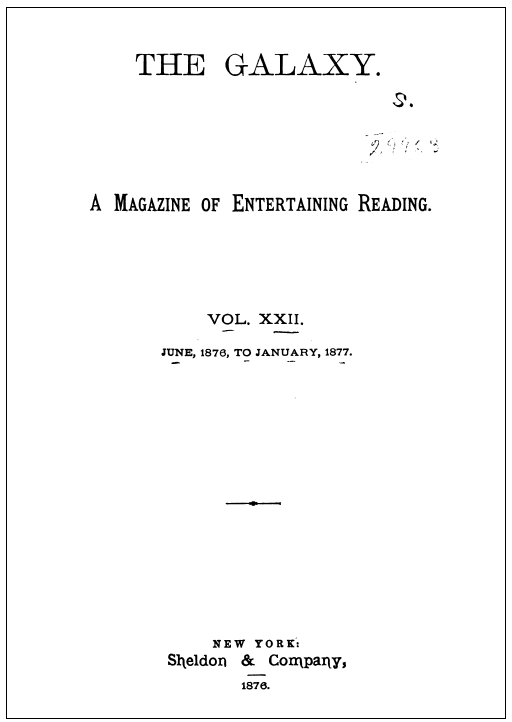
- Winfield Scott Hancock, “Gettysburg: Reply to General Howard,” The Galaxy, Vol. 22 (December 1876), pp. 821-831.
- Oliver Otis Howard, “The Campaign and Battle of Gettysburg,” The Atlantic Monthly, Vol. 38 (July 1876), pp. 47-62.
- Edwin B. Coddington, The Gettysburg Campaign: A Study in Command (New York: Scribner, 1968), pp. 216-219.
- Harry W. Pfanz, Gettysburg: The First Day (Chapel Hill: University of North Carolina Press, 2001).
“The historian of the future who essays to tell the tale of Gettysburg undertakes an onerous task, a high responsibility, a sacred trust. Above all things, justice and truth should dwell in his mind and heart. Then, dipping his pen as it were in the crimson tide, the sunshine of heaven lighting his page, giving “honor to whom honor is due,” doing even justice to the splendid valor alike of friend and foe, he may tell the world how the rain descended in streams of fire, and the floods came in billows of rebellion, and the winds blew in blasts of fraternal execration, and beat upon the fabric of the Federal Union, and that it fell not, for, resting on the rights and liberties of the people,
it was founded upon a rock.” – Winfield S. Hancock.


 So Nobly Advanced
Leave a comment