
Final Part : “The Kittanning Regiments – A Portrait of Service”
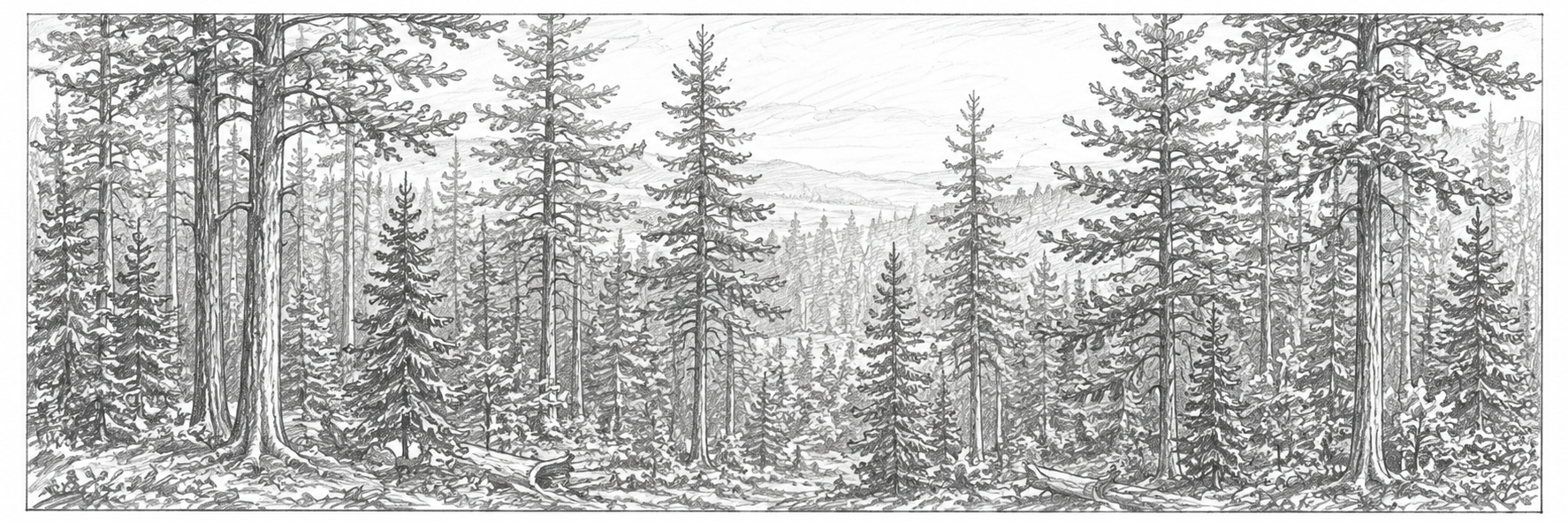
The men in camp all knew each other. Their work was hard, but it was shared. The seasons brought a rhythm to their business. In the winter they harvested the white pine and hemlock that grew abundantly in the forests of Jefferson county. The hot summer months were spent sawing and milling. In July of 1861, however, lumberman Edwin Little was preoccupied with other matters. He and the remaining Jefferson Guards had just missed out on the chance to join the 11th PA reserves. The county had filled her quota, and that was that.
“Muster About 40 or 50 men”
But Edwin Little was not easily dissuaded. He caught wind of another Company being formed up – again by Brookville native Robert Means – who now intended to join the 62nd. He wrote the following:
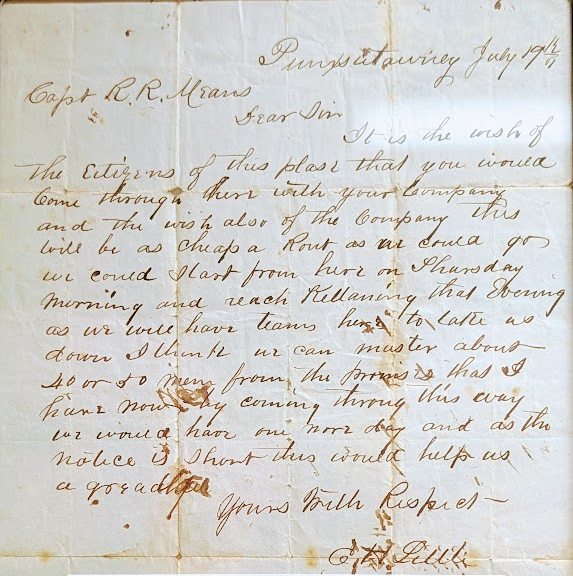
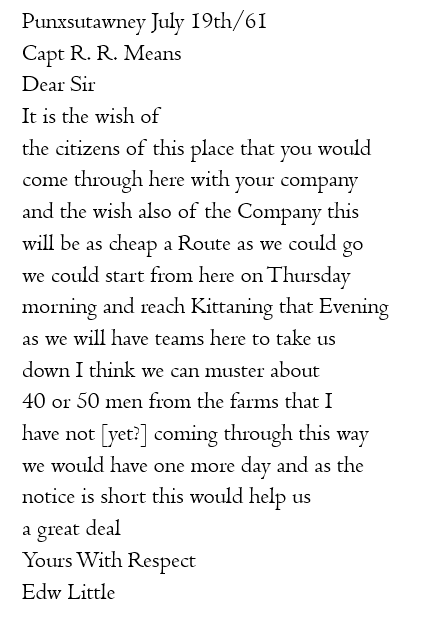
Colonel Samuel Black was a Mexican War vet who intended to go right at the Rebs. Lieutenant Col T.F. Lehmann brought his years of experience and German military discipline. These were early days, but the 62nd had an eager spirit and a fighting reputation. And they had some room for the Jefferson boys.
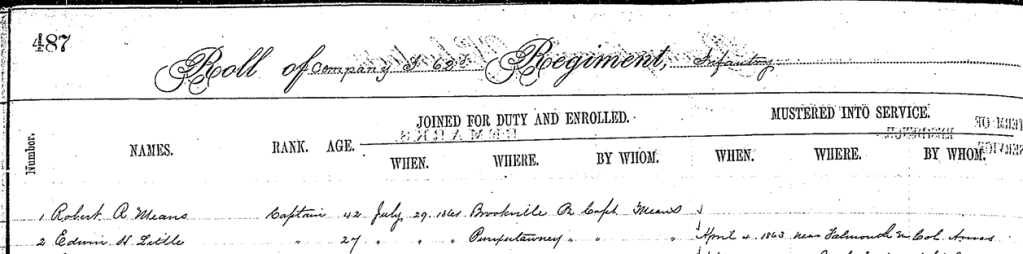
By 1861, Edwin Little was well established in the Punxsutawney community. He was the owner and operator of a local lumber business. Together, he and Margaret (Maggie) were raising two daughters. But beyond the obligations of home, Edwin and others were compelled by duty to their country. He assisted in the local recruiting effort, and when Company I officially mustered in at Camp Wright (present day Oakmont), Edwin was elected First Lieutenant behind Captain Robert Means.
“My Dearest, who will be the next”
The 62nd PA volunteers collected themselves in Pittsburgh, then set out for Camp Cameron near Harrisburg where they transformed from citizens to soldiers. The days consisted of drill, inspections, and military discipline. Through it all, Little wrote Maggie every chance that he could. Her letters, in return, were his continued source of strength.
Months passed, and the excitement in camp gave way to long stretches of waiting and harsh realities. Disease swept through, and the regiment suffered its first losses before ever seeing a battle. Private William Conrad of Company C became the first casualty to dysentery. Little attended the funeral with twenty other soldiers. Writing to Maggie afterward, he confessed, “When they lay him in the grave I could not help drop a tear not knowing, My dearest, who will be the next.”
From then on Death would be a constant companion. Still, Edwin remained steadfast in the path that he had chosen. Writing Maggie on his 28th birthday, he wished his next one to be spent “in the bosom of my Family and this War and the Constitution and the Union preserved.” He continued, “but if so unfortunate to die in battle, it will be striking to defend the Rights and privileges that our ancestors obtained through hardships that we as soldiers will never see.”
“Tired of playing soldier”
The months that followed carried the 62nd Pennsylvania far from the forests of Jefferson County. The regiment marched through Maryland and into Virginia as part of McClellan’s Peninsula Campaign. The men of “Little Mac’s” army endured long marches, contagious disease, and the growing fatigue of chasing a Southern surrender that seemed always on the horizon. Each delay hinted at a war that would stretch on longer than anyone was prepared for.
By May 1862, the men of the 62nd were weary. Writing to Maggie from camp along the Chickahominy River, Little confessed, “I am getting tired of Playing Soldier, and heartily wish the War was at an end.” Nearly a year had passed since his recruitment drive in the farm fields of northern PA. The excitement was gone. What remained was a longing for home and an unwavering sense of patriotic duty.
“I hope to Eat with you all one of these days”
As the Peninsula campaign ground on, the 62nd PA was earning its stripes as a veteran regiment. At Malvern Hill, Edwin Little and the men of Company I found themselves in a fierce struggle to protect Griffin’s artillery. Confederate attacks crashed against the Union line, and casualties mounted steadily. During the fighting, Lieutenant Edwin Little was struck in the thigh and carried from the field. Captain Robert Means suffered a wound of his own and was captured. He was held at Libby Prison in Richmond until his parole a month later.
Before the battle, Little had written home to Maggie: “I would have loved to be at Home and Eat Supper with the girls, but Keep in good Heart. I hope to Eat with you all one of these days.”
The silver lining to his wound at Malvern Hill was a furlough home during the remainder of July and August. Despite less than ideal circumstances, Edwin enjoyed time at home with Maggie and the girls.
“The sight is grand”
By September, however, Edwin was back with the boys of Company I as Lee worked his way north into Maryland. On September 17, during the Battle of Antietam, Little found time to write to Maggie while the regiment waited in reserve.
“The sight is grand,” he admitted, “but still, it makes one’s Heart ache to think of a Nation fighting among themselves as we are, and for nothing.” It would become the bloodiest single day of the war. It was a war of attrition, and Edwin Little had returned to see it through.
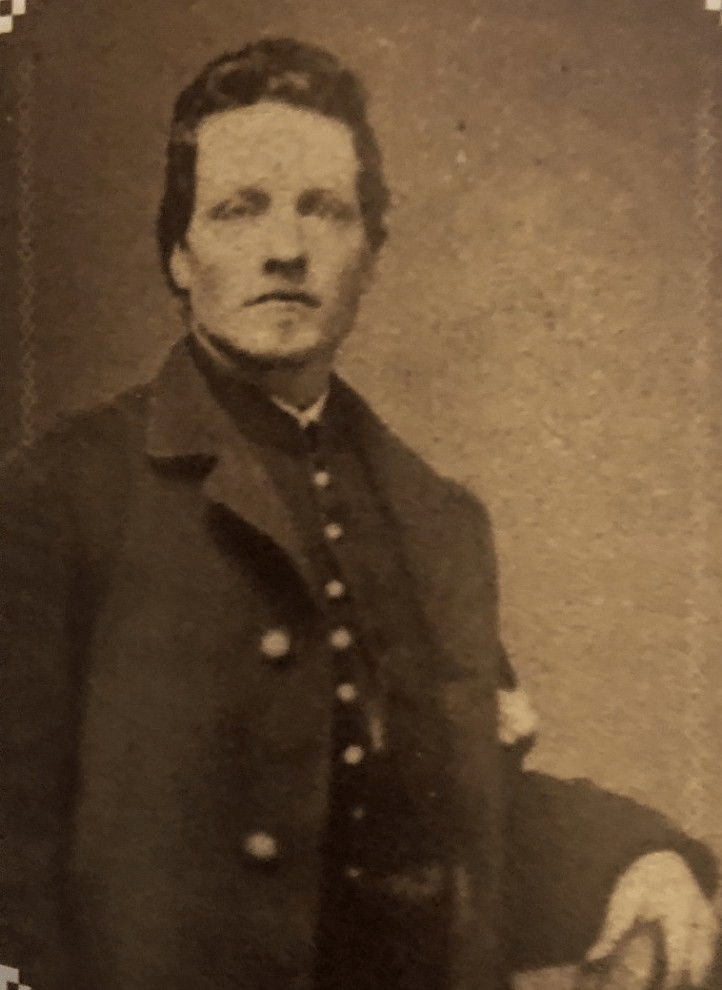
The winter of 1862 brought the 62nd Pennsylvania to Fredericksburg. Seeking shelter in a ravine just below Marye’s Heights, Little pressed himself to the ground. They had endured “Tremendous fire of Artillery for nearly 3/4 of a mile before they could get Under Cover.” Wave after wave went forward and staggered back.
When the 62nd was called upon to advance, Little remembered that “Every step Spoke of death.” The regiment struggled forward but was pinned down again. Unable to advance or withdraw, Edwin wrote, “We lay down among the dead and wounded where we lay all night side by side.” Darkness mercifully covered the battlefield, and “closed the Scene of Carnage and death.”
Amid the horrors of war, Little’s thoughts always returned home.

“My love for you tonight is Stronger than ever. I only wish I could clasp you to my heart tonight and tell you how dearly I love you. I cherish the name of Maggie … the Angel form of my Wife is ever with me, and I can see that calm Sweet face where ever I go.”Her memory was his continued well of strength. The letter was mailed home and he pressed on.
“My first and Last thought”
A change in command and a winter’s reprieve from fighting brought some better times to the 62nd. “We boys have plenty of Provisions, and get Soft Bread two days every week and Potatoes and Onions the same,” Edwin wrote. Better still, the men were granted furloughs home in late January. Edwin reconnected with Maggie and visited his ailing mother. Major William Lowry seized the chance to marry his twenty-five-year-old sweetheart, Mattie S. Stewart. The men cherished time with their families, then returned to their soldiering business.
The calamitous end of ‘62 was giving way to fresh hope. Once 1,200 men strong, the 62nd had been whittled to about four hundred. But those remaining had more to fight for than ever before. On March 24, Little learned that Maggie was pregnant. “My first and Last thought will be for my dear wife and children,” he wrote.
April came, and Edwin earned an overdue promotion to Captain. The newly formed Fifth Corps prepared for Hooker’s spring offensive. Edwin closed a letter to home, “If God spares my life, I think in a few months I will be happy.”
“Short and inglorious Campaign”
But Hooker’s secret plan to crush the rebellion unraveled rapidly. At Chancellorsville he was badly outmaneuvered. The 62nd was mostly held in reserve and limited to some skirmish duty. In just a week, the Chancellorsville campaign ended with a soggy retreat to the northern shore of the Rappahannock.
And here the armies sat and waited, watching each other from across the river. At a loss to explain Hooker’s strategy, Little summed it up simply as a “Short, and inglorious Campaign.”
On picket duty one day, a Confederate officer approached Edwin under a flag of truce seeking safe passage for an elderly woman whose son-in-law had died at Chancellorsville. Little could not grant such a request, but promised to forward it up the chain of command. As the two men parted, the Confederate remarked, “When we meet again it would be as friends.” Little replied simply, “I hope to God it would be so.”
Hooker’s men waited by the river and put themselves to the task of constructing a nice summer camp. Lee and Jefferson Davis met and landed on a more decisive strategy. They were taking the war to the Yankee homeland.
“Upon the Soil of Old Pennsylvania”
If it was a footrace, the Confederates were winning. On June 24th Ewell camped in Chambersburg, with an eye towards continuing east. Union forces were playing catch-up while Hooker bickered with Stanton. On June 28th, Hooker was out, and Little’s corps commander was elevated to lead the Army of the Potomac. It was not a happy change. The constant leadership turnover was taking a toll on the men.
But a Southern invasion of the North was an unprecedented emergency. The thought of it, Little wrote to Maggie, made his “blood boil.” Now in his third year of campaigning, Little was more resolved than ever. “If there is any place that I would risk my life more than I have done, it would be upon the Soil of Old Pennsylvania.”
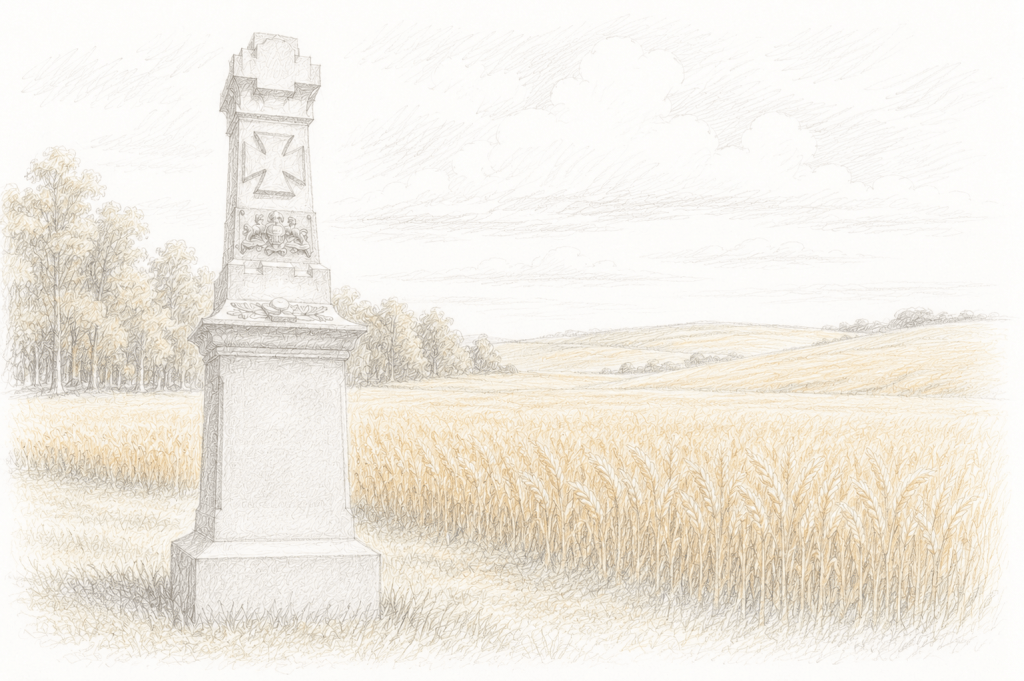
The Wheatfield today is a quiet corner of the battlefield. Monuments and silent guns stand watch over the fields. The Battle of Gettysburg is remembered as the turning point of the war. On July 2nd, 1863, it was a turning point that could have gone either way.
Nobody planned for what happened that day. Sickles bypassed Meade and advanced his corps towards a known enemy position. Longstreet led a head-on assault into what he thought was the Union flank. The Fifth Corps was scrambled from reserves and sent to plug the gaps in Sickles’ line. The 62nd was thrown into the Wheatfield.
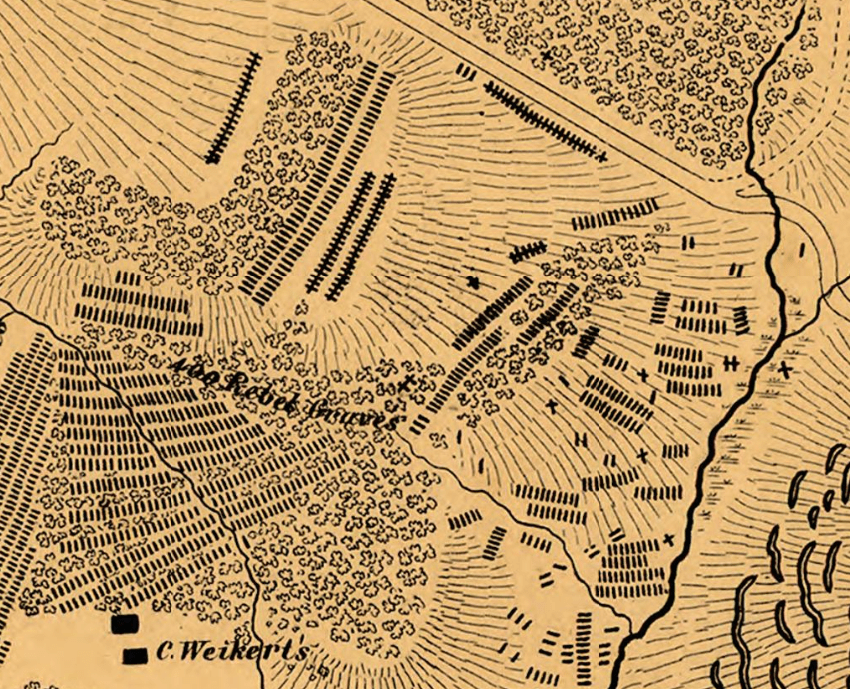
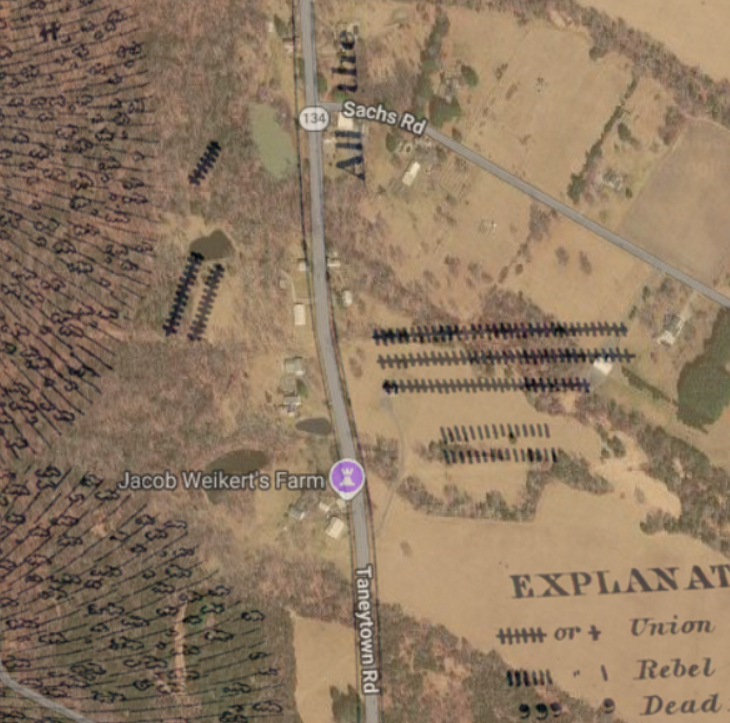
The Elliott burial map shows the aftermath.
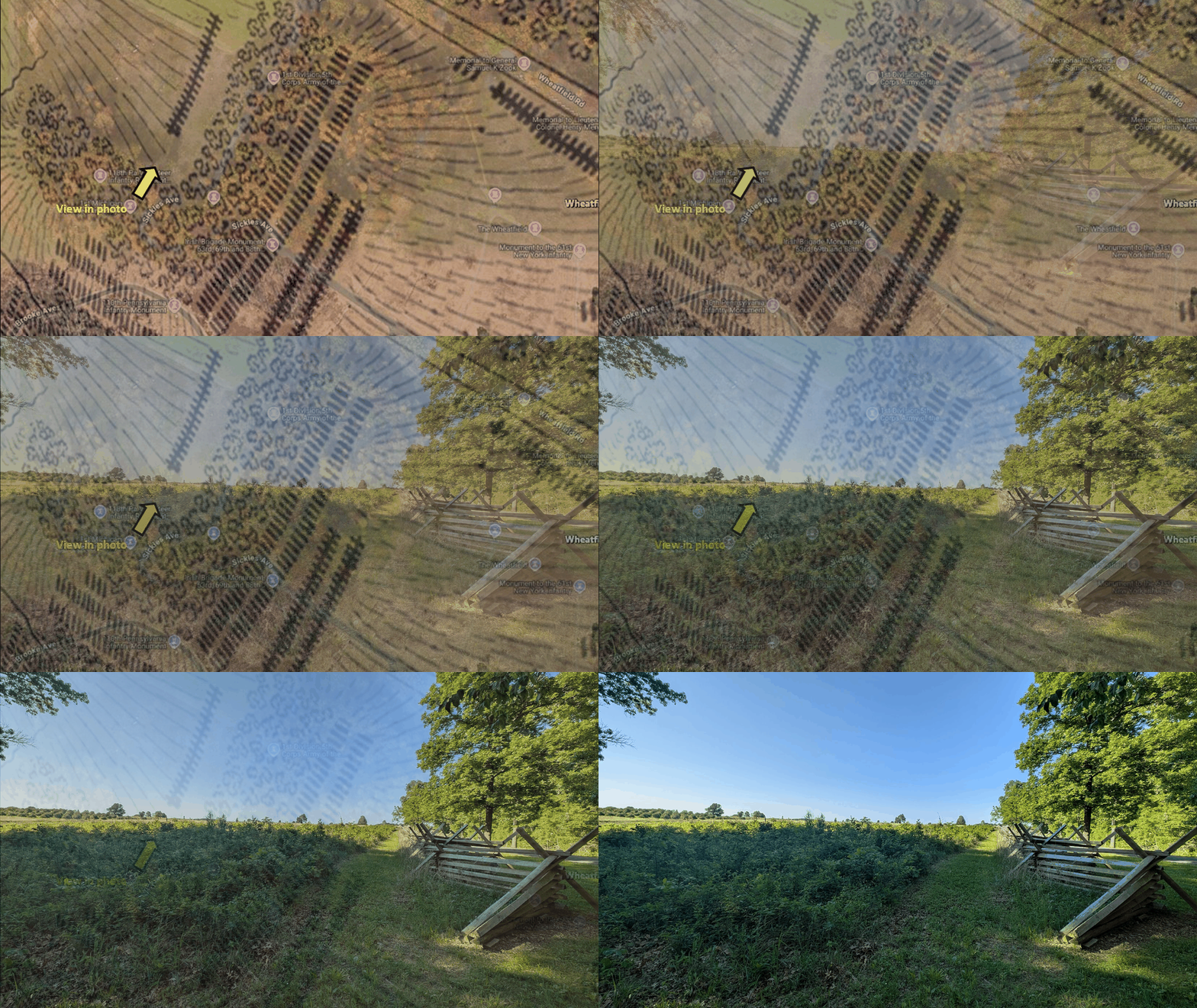
If you stand here along Sickles Ave and look to the north you are looking over a row of initial Union graves.
One of the shallow graves dug that day belonged to Edwin Little. Major William Lowry was buried beside him. Exactly where they were placed we cannot be certain. If they were carried from the Wheatfield that evening, then they were likely interred near the Jacob Weikert farm among hundreds of other temporary battlefield graves.
Their names are recorded consecutively on the Register of Deaths of Volunteers.

Edwin Little was not alone that day. He stood the proud captain of the old Jefferson guards. Maggie’s brother and fellow lumberman, George Campbell, witnessed the final moments when two Minie balls killed him instantly. The entire brigade took heavy losses. Despite the battlefield confusion, they retreated and regrouped, and endured for one more day.
At Gettysburg the Union held. The veterans who returned over the years recognized the significance of the ground defended there. Years later, the historian of the 141st PA wrote “This, however, may be said of the battle of Gettysburg, that the success of the Union arms was due very much more to the intelligent patriotism and invincible courage and determination of the rank and file, than upon the plans or efforts of Generals. The men felt they were on the sacred soil of the dear old Commonwealth, and there they would conquer or die.”
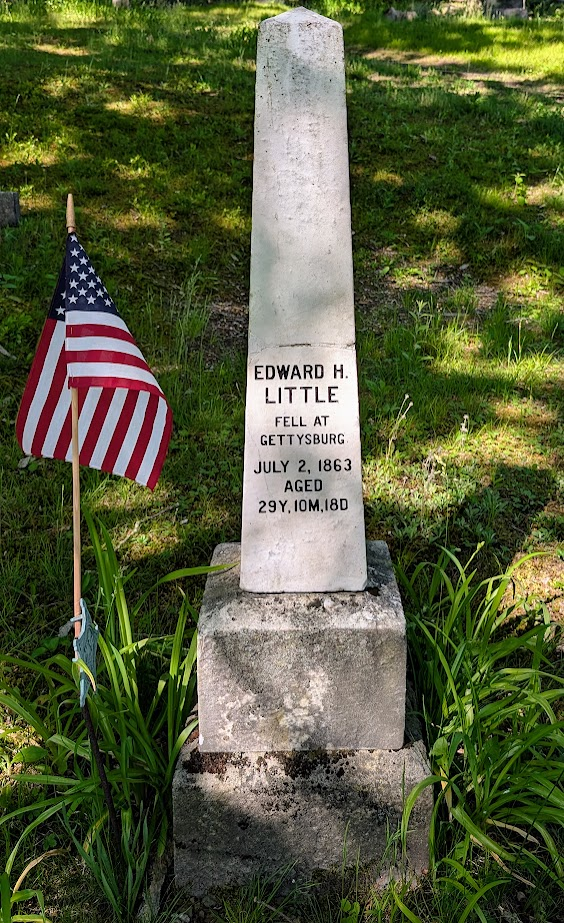
At some point Edwin made it home to Punxsutawney. He is buried at the North Findley St. Cemetery. He does not appear among the reinterments recorded for Gettysburg National Cemetery, so his exhumation from the shallow battlefield grave must have happened early on.
Ten days before Lincoln gave his Address at Gettysburg National Cemetery, another Edwin H Little came into the world. Maggie’s last child was born on November 9th, 1863. Edwin grew up and moved West. He became a lumberman.
Lincoln spoke of Edwin Little, though he never mentioned his name. He was one who struggled there, who consecrated that ground. It remains for us to be dedicated to the ever-unfinished task. Now in our 250th year as a nation, we are still in search of that new birth of freedom. And like the men who followed Little from their farms, we must so nobly advance.
Special thanks to the Armstrong County Historical Museum and Genealogical Society for preserving Edwin Little’s July 19, 1861 letter, which inspired and informed this article.
Sources
- Spisak, Ernest D. Pittsburgh’s Forgotten Civil War Regiment: A History of the 62nd Pennsylvania Volunteer Infantry.
- Little, Edwin H. Letter to Captain Robert R. Means, July 19, 1861. Armstrong County Historical Museum and Genealogical Society, Kittanning, Pennsylvania.
- Pennsylvania Register of Deaths of Volunteers, 1861–1865. Pennsylvania State Archives.
- Find A Grave Memorial: Edwin H. Little https://www.findagrave.com/memorial/30422960/edward_h-little
- Find A Grave Memorial: Margaret Elizabeth Little https://www.findagrave.com/memorial/58243953/margaret_elizabeth-little
- 62nd Pennsylvania Infantry Project (John R. Henderson) http://www.icyousee.org/pa62d/i.html
- Additional battlefield research conducted using the Elliott Gettysburg Map, Manifold Viewer mapping software, and on-site photography.
 So Nobly Advanced
Leave a comment